
 Rocky Reef
 Rocky Reef
Rocky Reef
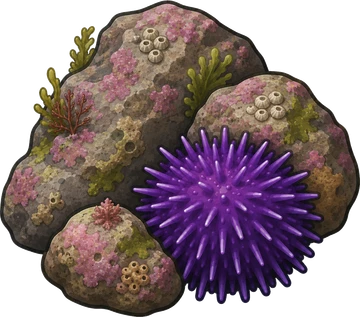
Bare rock and boulder structure without kelp cover on top.
About
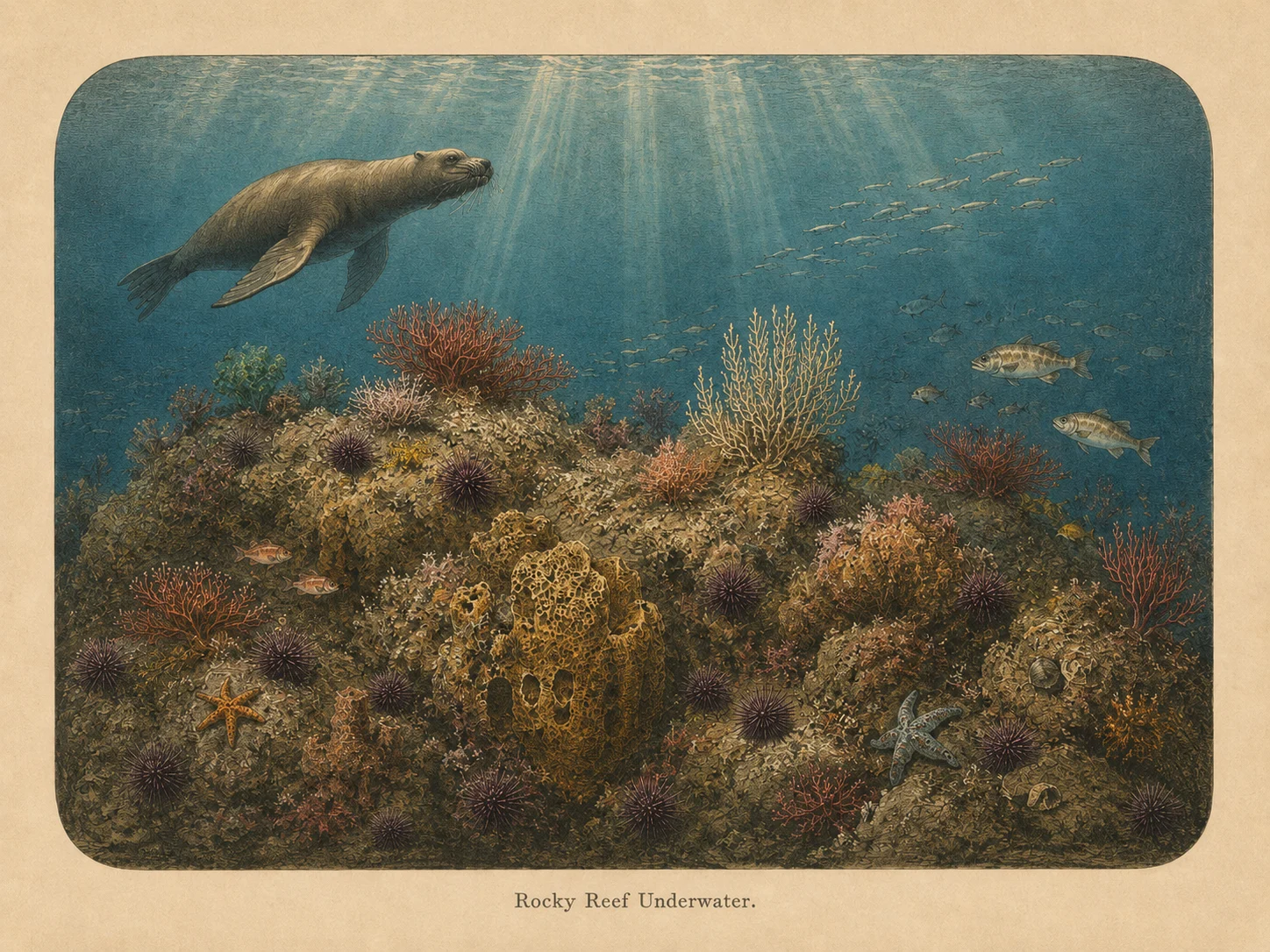
The Rocky Reef biome is the community of life that forms on hard, rocky seabed, the outcrops of bedrock, boulders, and cobble that rise from the ocean floor along the coast. Unlike a sandy or muddy bottom, rock gives marine life something solid to attach to and hide in, and that structure is what defines the biome. On the West Coast, rocky reefs run from the wave-battered shoreline out to deep offshore banks, and the Pacific Fishery Management Council has designated them a Habitat Area of Particular Concern, a designation that focuses conservation effort on a habitat rather than adding legal restrictions of its own, because so many fish depend on them.
What builds the reef
Flat rock supports far less life than a jumble of boulders cut with cracks, ledges, and overhangs, because each of those features is a place to shelter, attach, or hide. The more broken and vertical the seabed, the more animals it can hold.
Light divides the biome into zones. In the rocky intertidal, the stretch of shore between the high and low tide marks, the reef is exposed to air at low tide and pounded by waves, so only animals that can survive both water and air, such as barnacles, mussels, and anemones, live there. Below the low-tide line lie the nearshore reefs, which still receive enough sunlight for photosynthesis, so algae grow on them and, on the West Coast, often build the kelp forests that share this habitat. Deeper still, past the depth sunlight can reach, no algae grow, and the reef is dominated instead by sessile invertebrates, animals that live fixed in one place, along with deep-sea corals and groundfish.
How the reef works
There are two main food sources within the Rocky Reef biome, depending on the depth. On sunlit reefs, algae grow on the rock and form the base of the food web, much as plants do on land, supporting grazers and the fish that eat them. On deep reefs where no algae can grow, the community runs instead on filter feeders, animals such as sponges, sea fans, and anemones that sit in the current and strain out drifting food. Because these animals depend on moving water to bring their meals, the richest growth is usually on the ridges and edges where the current runs strongest.
The reef's structure also creates a sharp divide between shelter and open water. Fish such as rockfish and cabezon hold tight against the rock, relying on camouflage and quick retreats into cracks rather than open-water speed, while their prey and their predators move through the water around them.
What lives there
The West Coast rocky reef is best known for its groundfish, the bottom-dwelling fish that live in close association with the seabed. Rockfish (genus Sebastes), of which dozens of species live along the coast, are the signature residents, along with lingcod (Ophiodon elongatus) and cabezon (Scorpaenichthys marmoratus). Many rockfish are extraordinarily long-lived. The rougheye rockfish (Sebastes aleutianus) can reach roughly 200 years of age. Most species grow slowly, and many do not begin breeding until somewhere between 5 and 20 years old. Invertebrates cover the rock itself, from abalone, sea urchins, and anemones in the shallows to sponges and slow-growing deep-sea corals at depth. On deep reefs, some of these corals live for hundreds of years, according to NOAA.
Why the biome matters
On a rocky reef, the structure itself is the foundation of the ecosystem. The rock, with its cracks, ledges, and overhangs, creates the shelter that lets fish and invertebrates survive where a bare, flat bottom would hold almost nothing, and on deep reefs the slow-growing corals and sponges add a living layer of structure on top of the stone. Remove the structure and the community goes with it.
That structure supports fisheries that matter to the West Coast. Recreational and commercial fishers take groundfish such as lingcod, cabezon, and many rockfish from these reefs, and divers pursue spiny lobster on them, according to NOAA. The reef has scientific and medical value as well: the skeletons of deep-sea corals record centuries of past ocean conditions, and proteins from the giant keyhole limpet (Megathura crenulata), a large snail of West Coast reefs, are used in cancer research, according to NOAA.
Where the biome occurs
Rocky reefs form wherever hard bottom rises above the surrounding seabed and is not buried by sand or sediment, from the intertidal zone down past the reach of sunlight. Along the West Coast they run the length of the Eastern Pacific, from Alaska and Canada south through California to Baja, and they take many forms: intertidal ledges, nearshore reefs that host kelp forests, deep offshore banks, and seamounts, the undersea mountains whose steep sides force nutrient-rich deep water upward in a process called upwelling, creating islands of productivity in the open ocean, according to NOAA.
Threats and conservation
The main threat to rocky reefs is bottom trawling, a fishing method that drags heavy gear across the seabed. Trawls flatten the structure that makes the reef valuable and can destroy deep-sea corals that took centuries to grow, according to NOAA. Lost or abandoned fishing gear adds another hazard through ghost fishing, in which snagged gear keeps catching and killing animals for years. In the intertidal, heavy foot traffic near cities tramples and removes reef life. Over the longer term, warming water and ocean acidification, the drop in seawater pH as the ocean absorbs carbon dioxide, make it harder for corals, shellfish, and other invertebrates to build their calcium carbonate skeletons, threatening a major source of the reef's productivity, according to NOAA.
There is also a conservation success story here. Several West Coast rockfish were declared overfished around 2000. Through catch limits, gear restrictions, and areas closed to fishing, many of these long-lived stocks have since rebuilt, several of them years ahead of schedule, according to NOAA.
How divers can help the reef
Because rockfish grow and reproduce so slowly, they are easily depleted and slow to recover, so respecting size and bag limits matters more here than for fast-breeding species. Fish brought up from depth also suffer barotrauma, an injury caused when the gases inside the fish expand in the lower pressure near the surface, which can leave a released fish unable to swim back down. Using a descending device, a weighted tool that carries the fish back to depth and releases it, sharply improves the odds that a released rockfish survives, according to NOAA. Divers and anglers can also keep gear and anchors off the reef structure and support the marine protected areas and habitat closures that give slow-growing reefs time to recover.
Marine Life
Listed here are many of the aquatic species that you can find in this biome.
 Spearfishing
Locations with rocky reef habitat
Every tracked location whose detail page carries the rocky reef tag.