

Also calledpink surfperch


Taxonomy
Rarity
Abundance rates how many are in suitable habitat. Find difficulty rates how hard it is to locate one on a daylight snorkel or freedive through 50 ft. A higher find score means a harder search. The rarity category also reflects the kind of encounter; it is not an average of the 2 scores.
Depth and encounter availability
Full minimum about 10 m (33 ft), but routine habitat is much deeper. The 50–100 ft band begins to overlap the shallow edge of usual habitat. Rare is the retained category; the normal population is mostly below the surface–50 ft viewing range.
Seasonality
Location
Pink seaperch range from Mendocino County down to central Baja California, with a separate isolated population in the Gulf of California. There is a documented Southern California specimen, a 5.3 inch fish taken off Redondo Beach in November 2024, which is a useful reminder that the species is genuinely local rather than a northern curiosity.
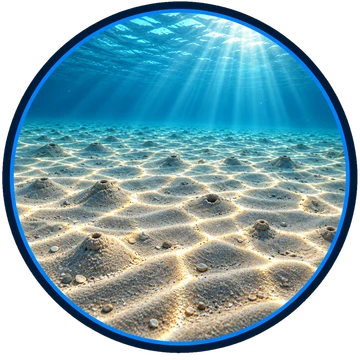
Where it lives is soft bottom on the upper and middle continental shelf, out past the reefs, and it also turns up over rocky ground and on open trawl grounds. The species belongs to the surf zone biome in this registry only as a stand-in, because there is no soft-bottom category and no better fit. In this case the stand-in is less of a stretch than usual, because juveniles are reported from the surf zone before they move offshore, which is the one stage of the life cycle within reach of a snorkeler.
The fish itself is unmistakable and looks nothing like the rest of the family. It is pinkish-red, fading to white on the underside of the head, with a pair of dark spots beneath the middle and rear of the dorsal fin and a dark bar at the base of the tail. The body is an elongated compressed oval rather than the deep disc most surfperch carry, the snout is conical and bluntly pointed, and the eyes are disproportionately large for the head. Males carry extended rays on the anal and caudal fins. Nothing else in the California family is pink, so there is no identification problem, only an availability one.
The diet fits the address. Pink seaperch eat small crustaceans, snails, marine worms and brittlestars, and that last item is a soft-bottom animal that essentially confirms where the fish is feeding. One account states that the dietary habits of this species have never been studied, which the state's own published food list contradicts.
Deep Dive
The name of this fish is a small joke that nobody intended. The genus was built from Greek words meaning choppy water and enduring or permanent, which reads as a fair description of a surfperch, a family named for animals that live in the surf. This particular species is the one member of that family that never goes near it as an adult. It is a surfperch of the continental shelf.
Getting there required changing 2 things. The first is the eye, which is disproportionately large, and that is what a fish moving into low light does. The second is less obvious and shows up in the timing of everything the animal does.
Surfperch do not lay eggs. Fertilization is internal, the female carries the young to full development, and what is born is a small complete fish that swims immediately. Across California's 18 marine species, that process is remarkably synchronized. Most mate in fall or winter and give birth in spring and summer, when the shallow water they live in is warming, productive and full of small food. The state's summary table shows it clearly: spring and summer, spring and summer, summer, spring to early fall, down nearly the whole column.
Pink seaperch does the reverse. Mating runs from March through June, gestation lasts 5 to 7 months, and the young are born in winter. It is the only California surfperch that gives birth in the cold half of the year, and there is a straightforward reason to suspect why. A fish living at 300 feet over soft bottom is not experiencing the seasonal swing that governs a beach. The surface warms and cools, plankton blooms and fades, and 300 feet down the changes are muted and delayed. A species that moved off the beach was free to detach its breeding calendar from the beach's calendar, and it did. One account calls the timing of this species' annual reproductive cycle a matter of scientific interest without saying why. The winter birth is the obvious candidate, and connecting the 2 is inference rather than something anyone has published.
The brood is the other extreme. A pink seaperch female carries 2 to 6 young. That is the smallest brood of any California surfperch by a wide margin, with the next lowest being the rainbow seaperch at 9 to 22 and the barred surfperch reaching 113. The young are born at about 1.4 inches against an adult maximum of 8, so each one arrives at roughly a sixth of full size.
Consider what that means. A fish produces perhaps 4 offspring a year, each already a sixth grown, each fully formed and swimming. There is no larval stage, no drifting cloud of eggs, no lottery. Against the ordinary marine strategy of releasing a million eggs and accepting near-total loss, this is the furthest thing from it that a fish can do while still being a fish. It is closer to how a mammal reproduces than to how a cod does.
That design works because the deep shelf is stable. Nothing about it prepares the species for change, and this is the part worth holding onto. The whole surfperch family is managed conservatively in California because low fecundity leaves no room for recovery, and the pink seaperch has the lowest fecundity in the family. What protects it is not a regulation. It is 300 feet of water and the fact that no fishery has any reason to go looking.
Where to Find Them
Researched habitat and range candidates
San Diego · 21 beaches
Orange County · 15 beaches
Catalina Island · 14 beaches
Los Angeles · 16 beaches
Channel Islands · 24 beaches
Ventura · 23 beaches
Santa Barbara · 13 beaches
San Luis Obispo · 26 beaches
Monterey · 18 beaches
These locations have suitable habitat within the species range. An assignment is a possible encounter, not a confirmed sighting at every beach. Season, depth, and local conditions still matter. Historical habitat without present-day evidence is excluded.