


Taxonomy
Rarity
Abundance rates how many are in suitable habitat. Find difficulty rates how hard it is to locate one on a daylight snorkel or freedive through 50 ft. A higher find score means a harder search. The rarity category also reflects the kind of encounter; it is not an average of the 2 scores.
Seasonality
Location
The 2021 checklist of the region's fishes by Milton Love and colleagues gives its range as San Francisco Bay south to Bahia Magdalena, including Isla Guadalupe. The San Francisco Bay record comes from the California Academy of Sciences fish collection, and FishBase places the northern limit farther south, at Piedras Blancas Point in San Luis Obispo County. It lives from the intertidal zone to 185 feet, usually shallower than about 66 feet.
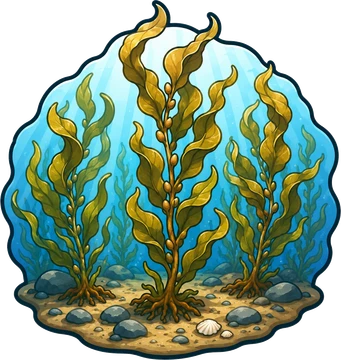
It lives in plants. FishBase describes it as usually found in seaweed, and Mexican Fish adds dense seaweed beds on rocky open coast and eelgrass and other plants in calm bays. Mexican Fish also reports that females live in shallower water than males. Ken Jones lists catches at piers from the Embarcadero Marina Pier in San Diego and Oceanside Harbor Pier north through the Cabrillo Mole on Santa Catalina Island, Redondo Sportfishing Pier and Malibu Pier to the Monterey Coast Guard Pier.
Deep Dive
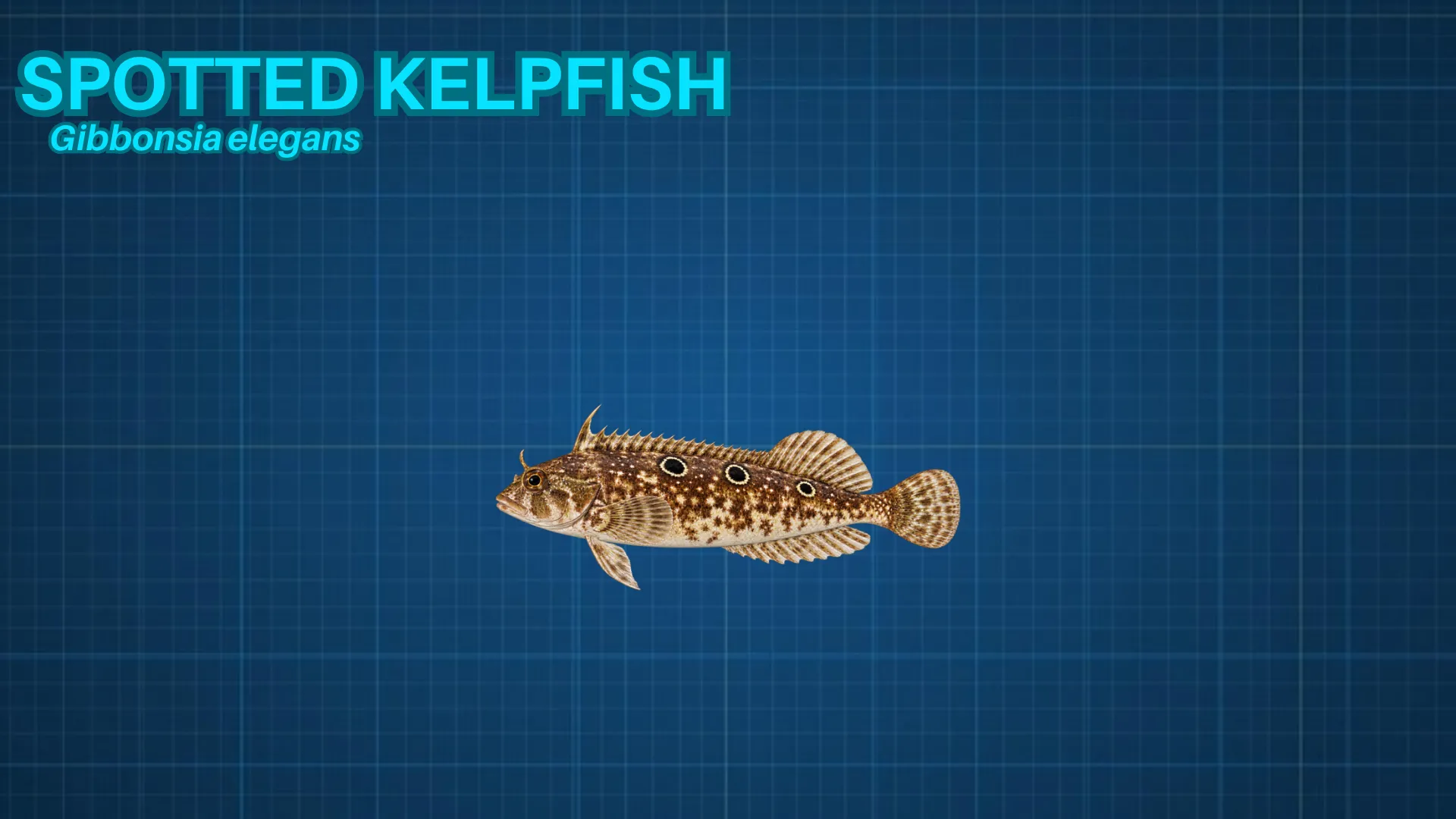
The spotted kelpfish is a clinid, one of a family of small blennies often called kelp blennies. It has the typical kelpfish shape: a pointed snout, a tiny mouth, a long dorsal fin down the back and a rounded tail. It grows to about 6.3 inches, and most caught from piers are 4 to 5 inches long.
Its color varies widely, from green to brown, tan or red, often blotched or streaked, which is why the color is a poor guide. The spots in its name are 1 to 3 eyespots, called ocelli, along the middle of the side between the midbody and the tail. Ken Jones and Mexican Fish both give 2 features that separate it from the other kelpfish: the soft rays at the rear of the dorsal fin are spaced wider apart than those in front, and its scales extend well onto the tail fin. Mexican Fish adds that the giant kelpfish, a much larger relative, can be told apart by its forked tail.
It eats crustaceans, small mollusks and worms from the bottom, and Ken Jones notes that it also eats a fair amount of algae. The female lays white eggs in a nest attached to short seaweed near the bottom, and the male guards the egg mass until the eggs hatch. Mexican Fish gives a lifespan of up to 7 years.
California counts it toward the general bag limit: no more than 10 per person per day, as part of a total of 20 finfish, with no size limit and no closed season. Take is prohibited inside state marine reserves.
Where to Find Them
Researched habitat and range candidates
San Diego · 15 beaches
Orange County · 10 beaches
Catalina Island · 13 beaches
Los Angeles · 10 beaches
Channel Islands · 24 beaches
Ventura · 17 beaches
Santa Barbara · 10 beaches
San Luis Obispo · 22 beaches
Monterey · 18 beaches
These locations have suitable habitat within the species range. An assignment is a possible encounter, not a confirmed sighting at every beach. Season, depth, and local conditions still matter. Historical habitat without present-day evidence is excluded.