
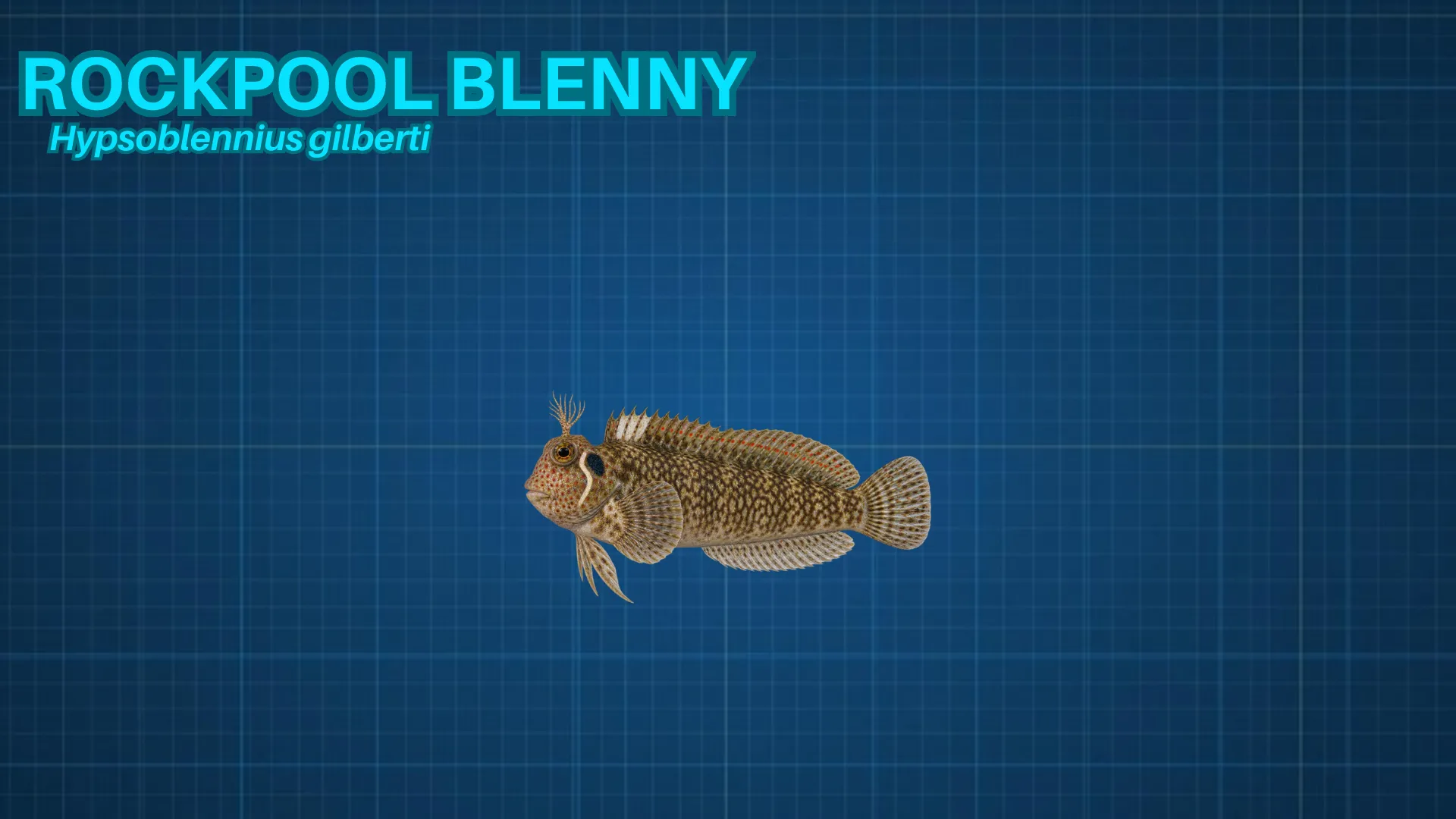
Also callednotchbrow blenny


Taxonomy
Rarity
Abundance rates how many are in suitable habitat. Find difficulty rates how hard it is to locate one on a daylight snorkel or freedive through 50 ft. A higher find score means a harder search. The rarity category also reflects the kind of encounter; it is not an average of the 2 scores.
Seasonality
Location
Bernardi gives the range as Morro Bay to Bahia Magdalena in Baja California Sur, and FishBase places the northern limit farther south, at Point Conception. Bernardi notes a single fish collected at Capitola, about 125 miles north of the published range, and he collected others at Gaviota, Santa Barbara, Palos Verdes, Newport Beach, Santa Catalina Island and Ensenada. FishBase records it to about 60 feet, usually shallower than about 16 feet.
Deep Dive
The rockpool blenny ranks among the largest blennies, according to Mexican Fish, reaching about 6.7 inches. Mexican Fish describes it as olive green mottled over tan, off-white below, with 2 slanting dark bars under the eyes and blue touches on the fin rays, and reports that it can change color to match its surroundings. The tufts of skin above its eyes, called cirri, split into 7 or more filaments, and Mexican Fish calls this the key to telling it from the bay blenny and mussel blenny, whose tufts are not divided that way.
It knows its way home. The 1970 study found that it wanders over a home range that can reach about 50 feet in radius, and returns to its home pool at low tide. Fish moved as far as about 150 feet still found their way back. Mexican Fish adds that it is active by day and eats bottom crustaceans and small crabs.
It can breathe air. FishBase lists it as an air-breather that stays in the water, and Mexican Fish reports that it can survive out of water for significant periods by taking oxygen from the air.
Breeding follows the pattern of its relatives. The 1970 study found that these blennies spawn from spring through late summer and that the male guards the eggs, which hatch in 4 to 18 days depending on the water temperature. Mexican Fish reports that the male guards the eggs for 2 to 3 weeks and that males are less territorial and aggressive than their relatives. Bernardi reports that the larvae drift in open water for about 66 days. FishBase gives a maximum age of 9 years.
Where to Find Them
Researched habitat and range candidates
San Diego · 13 beaches
Orange County · 10 beaches
Catalina Island · 6 beaches
Los Angeles · 10 beaches
Channel Islands · 21 beaches
Ventura · 15 beaches
Santa Barbara · 10 beaches
San Luis Obispo · 14 beaches
These locations have suitable habitat within the species range. An assignment is a possible encounter, not a confirmed sighting at every beach. Season, depth, and local conditions still matter. Historical habitat without present-day evidence is excluded.