



Taxonomy
Rarity
Abundance rates how many are in suitable habitat. Find difficulty rates how hard it is to locate one on a daylight snorkel or freedive through 50 ft. A higher find score means a harder search. The rarity category also reflects the kind of encounter; it is not an average of the 2 scores.
Seasonality
Location
Historically the sunflower star occupied intertidal and subtidal coastal waters of the northeast Pacific from the Aleutian Islands, Alaska south to at least northern Baja California, on reef, in kelp forest and over soft bottom, from the intertidal down to at least 1,427 feet. That is the range as agencies still describe it, and describing it any other way would erase what was lost.
What exists now is smaller. The animal is functionally gone from California and Oregon, greatly reduced from Puget Sound to Alaska, and the surviving concentration sits north of Puget Sound in the protected inland waters of British Columbia and southeastern Alaska.
The animal itself is worth picturing because most people never have. A sunflower star reaches an arm span of about 3.3 feet and weighs around 11 pounds, which makes it the heaviest sea star known. Adults carry 16 to 24 arms. Juveniles start life with 5, the ordinary number for a sea star, and add the rest as they grow, so arm count is a rough measure of age. The underside carries about 15,000 tube feet, the small hydraulic suckers sea stars walk on.
Deep Dive
Those 15,000 tube feet move the animal at roughly 3.3 feet per minute. For a sea star that is astonishing. The mental image most people carry of the group is something effectively motionless, a shape on a rock that may or may not have shifted since last week, and this species crosses a yard of reef in under a minute. That speed is the whole reason it mattered.
A sunflower star is a hunter. The prey list runs to sea urchins, clams, sea snails, mussels, abalone, crustaceans, fish, sea cucumbers, sand dollars and other sea stars, and for large prey the animal pushes its stomach out through its mouth and digests the food outside its own body. The relevant item on that list is the first one. Sunflower stars were among the main predators of sea urchins on this coast, and urchins eat kelp.
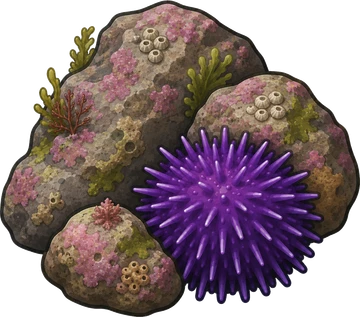
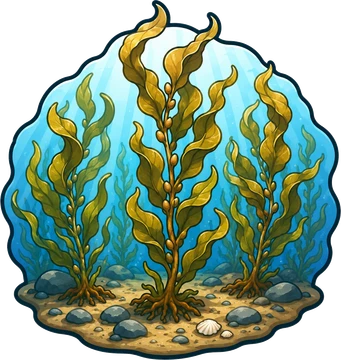
That is the connection that makes this animal's disappearance a problem for everyone else. Kelp forest holds together as long as something keeps urchin numbers down. Remove the predator and urchin populations climb, and grazing urchins strip kelp faster than it grows, leaving bare rock covered in urchins where a forest used to be. This site already carries entries for the purple sea urchin, the red sea urchin and the ochre sea star, and the sunflower star is the missing piece that ties them together. Its removal from the California coast happened at the same time as a marine heatwave and a purple urchin population explosion, and the kelp forests of northern California have not recovered.
The disease that did it is called sea star wasting, and the outbreak ran from 2013 to 2015 alongside unusually warm water. Infected animals develop lesions, lose arms and disintegrate over days. It struck many species, including the ochre sea star on this site, but the sunflower star took the worst of it, with biomass declines measured between 80 and 100 percent depending on the region and survey.
For more than a decade nobody could say what caused it, and in 2025 that changed. A multi-national team working through partners at the Hakai Institute published work in the journal Nature Ecology and Evolution identifying a marine bacterium, a strain designated FHCF-3, as a causative agent of the disease. The team cultured it from the body fluid of a diseased sunflower star collected near Friday Harbor, Washington, then exposed healthy animals to it and reproduced the disease and the deaths, while control animals stayed healthy. The wording in the paper is "a causative agent" rather than "the cause," and that hedge is deliberate and is kept here. Identifying a pathogen after 12 years of an unexplained mass mortality is the first real handle anyone has had on the problem.
One detail makes the failure to recover harder to explain and more worrying. Sunflower stars are not long-lived animals. Most live 3 to 5 years, they grow fast at first, about 3 inches a year, and they spawn by releasing eggs and sperm into the water in May and June, with larvae drifting for 2 to 10 weeks before settling. A short-lived, fast-growing, broadly dispersing animal is exactly the kind that should bounce back quickly once conditions improve. Twelve years on, it has not.
There is one more thing this species does that reads as a metaphor and is simply biology. A stressed sunflower star sheds arms, and the arms regrow within a few weeks. An animal that can regenerate that readily, from a population that reproduces that freely, is still gone from an entire coastline. Whatever is holding it down is not something individual toughness can fix.
Where to Find Them
Researched habitat and range candidates
South Sound · 12 beaches
Hood Canal · 12 beaches
Central Sound · 13 beaches
North Sound · 8 beaches
San Juan Islands · 8 beaches
Strait of Juan de Fuca · 5 beaches
Cape Flattery · 4 beaches
These locations have suitable habitat within the species range. An assignment is a possible encounter, not a confirmed sighting at every beach. Season, depth, and local conditions still matter. Historical habitat without present-day evidence is excluded.