
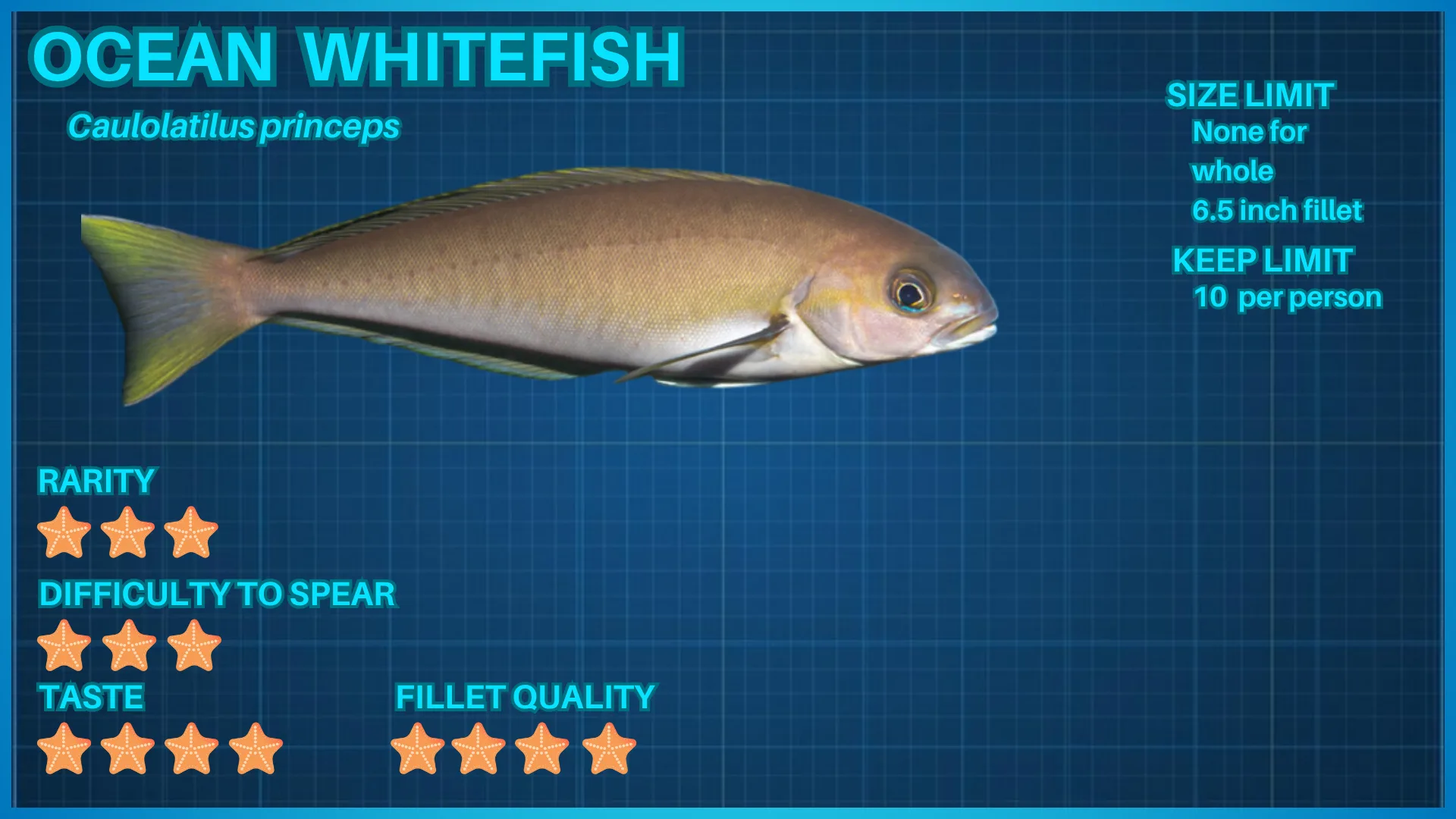
Also calledpoor man's yellowtail
 Spearfishing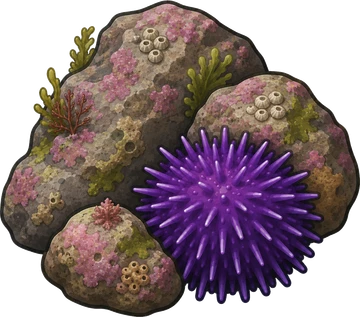

Spearfishing Stats
Southern California island reef–sand edges
Taxonomy
Rarity
Abundance rates how many are in suitable habitat. Find difficulty rates how hard it is to locate one on a daylight snorkel or freedive through 50 ft. A higher find score means a harder search. The rarity category also reflects the kind of encounter; it is not an average of the 2 scores.
Regulations
CDFW rules verified 2026-07-09
Seasonality
Edibility
Firm meat, but centerline pin bones run most of the length, and the skin has to come off or it carries an iodine note into the flesh.
Location
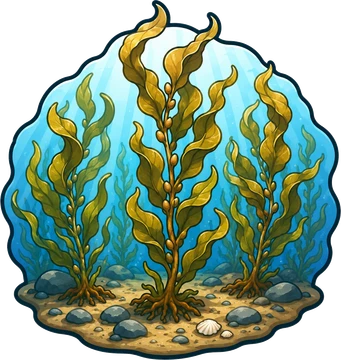
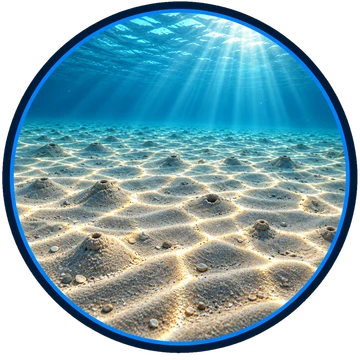
Ocean whitefish live along the eastern Pacific coast, from southern British Columbia south to Peru, and are also found around the Galapagos Islands. The center of the population sits between Point Conception and central Baja California. They live on and near the bottom over rocky reef and kelp, and also over the sand and mud right beside those structures. Their overall depth range runs from the shallow water just below the low tide line down to about 450 feet, and the largest concentrations of the species sit at 90 to 200 feet. Loose schools of adults are commonly encountered shallower than that, from 10 to 65 feet, especially around island reefs. The fish is documented digging into the substrate for food. It also shows a daily rhythm: adults spend the day in deeper, often sandy areas foraging, then retreat into rocky reef and kelp beds at night. In California the species is most closely associated with Catalina Island, San Clemente Island, the Channel Islands off Santa Barbara and Ventura counties, and the outer banks such as Tanner Bank and Cortez Bank.
Spearfishing Brief
Ocean whitefish rate a 3 overall, and the score comes from the search half of the hunt, not the shot. The fish is not camouflaged and it does not bury itself. It hangs a few feet above the reef and moves in loose schools. Where a diver is likely to have any luck at all is around offshore island reefs and outer banks. From a shore dive on the mainland the species is uncommon enough that a whole day of kelp work can pass without one appearing. From a boat at Catalina, San Clemente, or the Channel Islands the picture reverses, and the fish becomes something a diver expects to see. Depth is the other complication in finding one. Adults sit deepest at 90 to 200 feet, which is the far edge of what most freedivers can work, and the shallow-schooling fish at 10 to 65 feet are the fraction that are within easy reach. Which of those fish are within reach depends on the diver's own working depth rather than on where the species is thickest.
Once a fish is in sight, the shot itself is straightforward. How the fish reads a diver is not settled. The California Department of Fish and Wildlife calls ocean whitefish relatively easy and enjoyable to catch on baited hook and line, but a fish that takes a squid strip is not necessarily a fish that holds still for a speargun. The 2 sources that speak to divers disagree with each other. Diver.net groups whitefish with lingcod among the wary fish an experienced diver moves on to, and describes the species as naturally spooky. A single Spearboard account points the other way. A Spearboard account of a first ocean whitefish at Catalina described tracking the fish around a pinnacle for about 15 seconds before the shot. That behavior is consistent with a solitary reef feeder that stays with its food rather than fleeing when a diver is still far off. Shot difficulty rates a 2 on that basis. A diver who eases into the fish rather than charging it usually gets a workable window at close range.
The choice of weapon reflects the fish and the water more than the shot. Ocean whitefish top out around 40 inches, so a mid-length speargun, 75 to 110 centimeters with 1 or 2 rubber bands, has more than enough power for the fish itself. No specialty rig is required. The dive itself matters more than the gun. Because the fish holds on deeper reef and island structure, weighting, breath-hold discipline, and a good float line are what a diver should get right first. The hit fish will run into the reef given the chance, so aiming forward, at the head or the shoulder just behind the gill plate, shortens the fight and keeps the fish out of the rocks.
Handling matters after the shot. The gill plates are sharp enough to cut a bare hand to the bone. Gloves and a careful grip on the shaft rather than the fish itself are the standard practice.
Deep Dive
The ocean whitefish is a tilefish, not a whitefish, and the common name is a source of confusion. True whitefish live in cold freshwater lakes and belong to the salmon family. The ocean whitefish belongs to the deepwater tilefish family, whose relatives live along tropical and warm-temperate coastlines around the world. The scientific name was assigned in 1840 by the naturalist Leonard Jenyns from a specimen collected by the voyage of HMS Beagle in the Galapagos. The body is long and thin with a very long single dorsal fin that runs almost the full length of the back and an anal fin nearly as long underneath. The mouth is small. The back is brown or olive, the belly is pale, and the fins carry yellow and blue edging. Most fish taken are 12 to 24 inches long. The maximum recorded size is roughly 40 inches. The heaviest fish on record is a 17-pound 1-ounce fish taken on rod and reel at Hurricane Bank in 2011.
The species eats a wide variety of small prey. The documented diet includes crabs, shrimp, and other crustaceans, small octopus, squid, small fish such as anchovies and lanternfish, krill and other small shrimp-like crustaceans, worms, and small snails and sea stars. A feeding fish will drop from a few feet above the reef down to the bottom, use its small mouth to root into the sand or the crevices between rocks, and take whatever it finds. Documented predators include giant black sea bass, tope sharks, California sea lions, and other larger reef and pelagic predators. Females mature at 3 to 4 years old and males at 4 to 5. The recorded lifespan is at least 13 years. Sources disagree on when the species spawns in California. The state's own Marine Management News summary describes spawning as most likely from fall through early spring, while at least one other California profile describes a March through July spawn. The fish is a broadcast spawner. Fertilization happens in the open water, and the eggs and larvae drift with ocean currents.
The species has been part of the Southern California catch for as long as records have been kept. It is a popular sportfish taken on rod and reel at the offshore islands and outer banks, especially at Catalina, San Clemente, and Cortez Bank, where charter boats work rocky bottom at 60 to 100 feet with squid or mackerel for bait. Anglers rate it as an unusually strong fighter for its size, and hooked fish will run into the reef to abrade the line if given the chance. Divers take it as a secondary target while hunting island reefs for calico bass, sheephead, and yellowtail. The commercial catch is modest and has been since the mid-1990s. California Sea Grant classifies the fishery as sustainable, and the ocean whitefish is not one of the species the state manages under a rebuilding plan or a rockfish-style depth restriction.
The eating quality of the ocean whitefish is well regarded in Southern California, and the meat is what has kept the species on the menu at markets and dockside restaurants for decades. The flesh is white, low in fat, and breaks into thick flakes. The flavor is mild and the fillets are meatier than most similarly sized reef fish. Sea Forager, a Bay Area seafood distributor, describes the meat as closer in flavor and texture to white seabass than to rockfish or lingcod. The fish takes well to almost any preparation. Grilled, baked, pan-fried, and poached fillets all work, and the ocean whitefish is also a common choice for ceviche and fish tacos in Southern California and Baja California cuisine. There is one caveat that shows up across the community sources and in California Sea Grant's own profile. A small minority of individuals, especially fish feeding in kelp beds, carry a bitter taste in the flesh that cannot be predicted from the outside of the fish. Community estimates put the rate at roughly 1 in 100. That inconsistency is one of the reasons the commercial catch has stayed small. For the diver who lands one that is not bitter, the ocean whitefish is one of the better meals to come off an island reef.
Where to Find Them
Researched habitat and range candidates
San Diego · 21 beaches
Orange County · 15 beaches
Catalina Island · 14 beaches
Los Angeles · 16 beaches
Channel Islands · 24 beaches
Ventura · 23 beaches
Santa Barbara · 13 beaches
San Luis Obispo · 26 beaches
Monterey · 18 beaches
Oregon South Coast · 15 beaches
Oregon Central Coast · 8 beaches
Oregon North Coast · 8 beaches
South Sound · 12 beaches
Hood Canal · 12 beaches
Central Sound · 13 beaches
North Sound · 8 beaches
San Juan Islands · 8 beaches
Strait of Juan de Fuca · 5 beaches
Cape Flattery · 4 beaches
These locations have suitable habitat within the species range. An assignment is a possible encounter, not a confirmed sighting at every beach. Season, depth, and local conditions still matter. Historical habitat without present-day evidence is excluded.