

Also calledPacific purple sea urchin

Taxonomy
Rarity
Abundance rates how many are in suitable habitat. Find difficulty rates how hard it is to locate one on a daylight snorkel or freedive through 50 ft. A higher find score means a harder search. The rarity category also reflects the kind of encounter; it is not an average of the 2 scores.
Regulations
CDFW rules verified 2026-08-28
Seasonality
Edibility
The same operation as a red sea urchin and easier per animal, because purple urchins are smaller with shorter, blunter spines. The work is in the number of them rather than in any one. Cracking the test and rinsing the gut away leaves the 5 lobes of roe on the inside of the shell.
Not a fillet. An urchin yields gonads, and how full they run is the entire question with this species.
Location
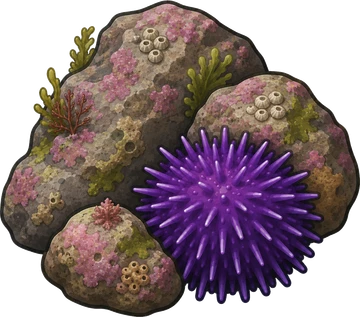
Purple sea urchins live along the eastern Pacific from Baja California north to Alaska, on rocky reef and in the rocky intertidal, with a particular hold on exposed coast. The test, which is the shell, is commonly about 2 inches across and occasionally reaches 4, standing roughly an inch and a half tall, and it is a deep purple that fades toward pale in older animals. The spines are short, blunt and dense, which is the quickest way to tell one from a red sea urchin at a glance: red urchins are larger, redder, and carry long spines with real reach.
The animals sit in cup-shaped depressions worn into the rock. Those are not natural pockets. An urchin grinds its own seat over years using its teeth and spines, and in soft rock the depressions become deep enough that the animal is wedged in and protected from surge. On a heavily grazed reef the rock ends up pitted with them.
Age is the surprise. Purple urchins are commonly cited as living around 20 years, and researchers believe they may reach 70, with growth-rate work putting the figure over 50 either way. An animal 2 inches across sitting in a rock pocket may have been there longer than the diver looking at it.
Harvest Brief
Core covered California habitat.
The take is by hand, with a short hand rake or pry bar to lever an urchin out of its seat and a mesh bag to carry them. Gloves are worth wearing, though the purple urchin's short blunt spines are far less punishing than the long spines on a red. Cleaning is the same operation as a red urchin and easier per animal: crack the test, rinse the gut away, and lift the 5 lobes of roe off the inside of the shell. The work is in the number of them, not in any single one.
The one thing that decides whether the dive is worth doing is where the urchins came from. In a barren the animals are effectively empty. A starved urchin drops its metabolism and puts its energy into staying alive rather than into gonad, to the point that reported fecundity in barrens runs about 99.9 percent below urchins in healthy kelp. Divers who have opened them call them zombie urchins, and the description is fair: alive, abundant, and containing nothing. There is now a small industry built on collecting barren urchins and feeding them until the gonads fill, which exists precisely because the wild ones do not. So the useful rule reverses the usual instinct. The thickest urchin ground is the worst place to take food from, and a thinner patch on the edge of living kelp is the better one.
The California rules are unusually generous and it is worth understanding why. The standard daily limit is 35 sea urchins of each species. But purple urchins taken while skin or SCUBA diving in Humboldt, Mendocino and Sonoma counties carry a limit of 40 gallons rather than 35 animals, which is a volumetric limit and an enormous one. Inside a marked area of Caspar Cove in Mendocino County, purple urchins may be taken in any number for the purpose of restoring the kelp ecosystem, and that authorization runs until April 1, 2029. Those 3 counties are the ones the barrens took. The state is not managing a fishery there so much as asking for help.
Two more rules apply. Take of all invertebrates is prohibited inside state marine reserves, with further restrictions in state marine parks and conservation areas. And north of Yankee Point in Monterey County, sea urchins are 1 of only 3 things a SCUBA diver may legally take, alongside rock scallops and crabs of the genus Cancer. Snorkels do not count as SCUBA, so freediving is unaffected. Oregon and Washington rules were not researched and nothing here covers them.
Deep Dive
An urchin barren is the clearest example on this coast of a system with 2 stable states, and understanding it explains why removing urchins is worth doing at all.
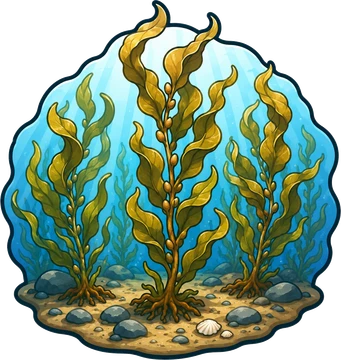
A kelp forest is stable for a reason that is not obvious. Growing kelp sheds enough drift, whole blades and fronds torn loose by surge, that urchins can sit in their rock pockets and eat what floats to them without ever having to graze the living plants. In that arrangement the urchins are sedentary, the kelp is unharmed, and the whole thing holds. Sunflower stars and sea otters keep the urchin numbers from rising past what the drift can feed.
Take away the drift, by killing the kelp with warm nutrient-poor water, and the urchins have to go and find food. Take away the predators at the same time, and their numbers climb instead of falling. Grazing urchins do not eat only blades; they eat the holdfast, which is the anchor that keeps kelp attached to rock. Once holdfasts go, the forest cannot regrow from what is left, and any new kelp settling on bare rock is grazed as a sprout. The system then holds in the other state, and it holds hard, because the urchins no longer need much food to persist.
That is why the numbers on this page look strange next to every other species here. A 99.9 percent drop in fecundity would be a catastrophe for almost anything. For an urchin in a barren it is a survival strategy that works: the population is not reproducing much, but it does not need to, because almost nothing is eating it and the individuals live for decades.
Which leaves removal as one of the few levers available, and the reason a recreational diver's limit in 3 California counties is measured in gallons. It is worth being honest about the scale. Barrens run to hundreds of miles, and no amount of hand-collecting clears that. What removal can do is hold small patches clear long enough for kelp to re-establish and start shedding drift again, which is what the Caspar Cove authorization is testing. The animal in the bag is not the point. The bare rock it came off is.
Where to Find Them
Researched habitat and range candidates
San Diego · 13 beaches
Orange County · 10 beaches
Catalina Island · 14 beaches
Los Angeles · 10 beaches
Channel Islands · 24 beaches
Ventura · 15 beaches
Santa Barbara · 10 beaches
San Luis Obispo · 25 beaches
Monterey · 17 beaches
Oregon South Coast · 15 beaches
Oregon Central Coast · 8 beaches
Oregon North Coast · 8 beaches
South Sound · 12 beaches
Hood Canal · 10 beaches
Central Sound · 13 beaches
North Sound · 8 beaches
San Juan Islands · 8 beaches
Strait of Juan de Fuca · 5 beaches
Cape Flattery · 4 beaches
These locations have suitable habitat within the species range. An assignment is a possible encounter, not a confirmed sighting at every beach. Season, depth, and local conditions still matter. Historical habitat without present-day evidence is excluded.