

Also calledseatrout, greenling seatrout, rock trout, kelp trout, kelp cod
 Spearfishing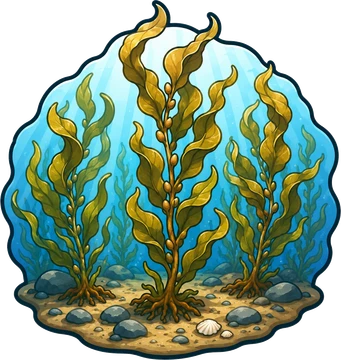

Spearfishing Stats
Northern California, Oregon and Washington rocky shallows
Taxonomy
Rarity
Abundance rates how many are in suitable habitat. Find difficulty rates how hard it is to locate one on a daylight snorkel or freedive through 50 ft. A higher find score means a harder search. The rarity category also reflects the kind of encounter; it is not an average of the 2 scores.
Regulations
CDFW rules verified 2026-08-07
Seasonality
Edibility
Few pin bones and almost no bloodline make this an easy fish to clean, but the flesh turns mushy unless it is bled and iced immediately.
Very few pin bones and almost no bloodline, so the fillets come off clean.
Location
Kelp greenlings live in the northeast Pacific, from Amchitka Island in the Alaskan Aleutians south to La Jolla in San Diego County. The center of abundance is between southeast Alaska and northern California. They hold on shallow rocky inshore bottom, in kelp beds, and on adjacent sand, from the intertidal zone down to about 150 feet, holding where the kelp and algae are thickest. Adults are largely site-attached to a stretch of reef. The 2 sexes are colored so differently that early naturalists described them as separate species. Males are gray to brownish-olive with irregular iridescent blue spots surrounded by small rust-colored rings. Females are gray to brown with rust-colored or golden spots scattered evenly across the body and yellow-orange fins. Both sexes have a yellowish mouth.
Reproduction is what most clearly ties this fish to its structure. From July through January, with most eggs laid in the fall, males claim nesting sites on rocky outcrops where current is running strongly enough to carry oxygen over the eggs. A single nesting site may cover 75 square feet and hold up to 11 separate egg masses from multiple females. The male drives off other males, fans the pale-blue eggs, and stays until they hatch.
Spearfishing Brief
The kelp greenling is the honest, everyday target of the Pacific Northwest shallow reef, and the difficulty is a 2.5 to find and a 1 to shoot. Finding one is easy in the north, and the rating carries the southern half of the range, where the fish thins out. A diver in kelp or on shallow rocky bottom, from Oregon north through southeast Alaska, will see kelp greenling on almost every dive. They hold to structure and drift around it slowly, and the sexual color pattern makes them unmistakable once the eye learns the 2 forms. A male with iridescent blue spots against dark reef is impossible to miss in good light.
The shot rates a 1. Kelp greenlings hold structure and tolerate a controlled approach, though they are not as bold as a lingcod. The fish will move if a diver charges through the kelp, and it will resettle nearby if the diver stops and waits. Community accounts converge on a short to mid-length speargun of 75 to 100 centimeters with a single band and a standard flopper tip, or a 6 to 7 foot polespear. Larger open-water guns are unnecessary. Shots come inside 4 to 8 feet from the fish and go behind the gill plate through the spine. The fish is also a common rod-and-reel target on bait, especially clams, worms, sand shrimp, and mussels drifted along kelp and rocky shore.
One field consideration matters more for greenling than for most other reef fish: the meat is delicate and deteriorates fast. Any fish taken should be bled at the boat or the shore by a cut through the gills, iced immediately, and cooked fresh rather than frozen, because ice crystals damage the flesh and the flavor turns fishy. Smaller and medium fish are noticeably better on the plate than the largest of the catch.
Deep Dive
The kelp greenling is one of about 12 species in the greenling family, a Pacific-only group that also contains the lingcod, the rock greenling, the whitespotted greenling, and the small painted greenling. Growth is slow by shallow-reef standards but far faster than most of the deep-water rockfish that share the same reef. Maximum length is about 24 inches, maximum weight around 4.6 pounds, and maximum age about 18 years. Most adults a diver encounters run 10 to 21 inches.
Diet is broad and reef-centered. Kelp greenlings eat small crustaceans, segmented marine worms, brittle stars, mollusks, and small fishes. The mouth is set for picking prey off rock rather than for chasing open water. Documented predators of juvenile kelp greenling include salmon and steelhead, which take them from open water during their first months. Adults on the reef are eaten by lingcod, larger rockfish, seals, sea lions, and diving seabirds.
The mating system is more studied than most of the fish's biology. A single territorial male attracts multiple females to his nest site over the spawning season, and researchers have documented up to 11 egg masses accumulated in one male's territory in a single season. Females are batch spawners, contributing at least 3 clutches over the season and often distributing them across more than one male's nest. The eggs themselves are pale blue and are held together in clusters the size of a golf ball to a tennis ball, averaging about 4,000 eggs per cluster. The male fans the nest to keep oxygen flowing across the eggs, defends it against other males and against egg predators, and does not leave until the eggs hatch. That parental care is the reason the species produces steady numbers of young year after year on healthy shallow reef, and it is why the shallow rocky habitat and kelp cover matter as much as any harvest rule.
On the plate the kelp greenling is a good but delicate fish. The meat is white, mild, buttery, and slightly sweet in a way that some cooks compare to crab or lobster. The texture is softer than most white-fleshed reef fish and can be described as delicate at best and mushy at worst. Pan-frying in butter with light seasoning is the standard preparation across the Pacific Northwest. Small and medium fish taste noticeably cleaner than the largest of the catch, which is one reason many divers release big greenlings back onto the reef and keep a couple of the smaller ones for the pan.
Where to Find Them
Researched habitat and range candidates
San Diego · 9 beaches
Orange County · 10 beaches
Catalina Island · 14 beaches
Los Angeles · 10 beaches
Channel Islands · 24 beaches
Ventura · 15 beaches
Santa Barbara · 10 beaches
San Luis Obispo · 25 beaches
Monterey · 17 beaches
Oregon South Coast · 15 beaches
Oregon Central Coast · 8 beaches
Oregon North Coast · 8 beaches
South Sound · 12 beaches
Hood Canal · 10 beaches
Central Sound · 13 beaches
North Sound · 8 beaches
San Juan Islands · 8 beaches
Strait of Juan de Fuca · 5 beaches
Cape Flattery · 4 beaches
These locations have suitable habitat within the species range. An assignment is a possible encounter, not a confirmed sighting at every beach. Season, depth, and local conditions still matter. Historical habitat without present-day evidence is excluded.