


Taxonomy
Rarity
Abundance rates how many are in suitable habitat. Find difficulty rates how hard it is to locate one on a daylight snorkel or freedive through 50 ft. A higher find score means a harder search. The rarity category also reflects the kind of encounter; it is not an average of the 2 scores.
Seasonality
Location
A 2014 genetic study of the same 3 blennies by Giacomo Bernardi gives the range as Morro Bay to Puerto Marquez in Mexico, with a separate population in the northern Gulf of California. Bernardi collected mussel blennies at Los Alamitos, Scripps Pier in La Jolla, Santa Catalina Island and Ensenada. FishBase records it from about 3 to 70 feet, usually shallower than about 33 feet, and Mexican Fish adds bays and estuaries to its habitat.
Deep Dive
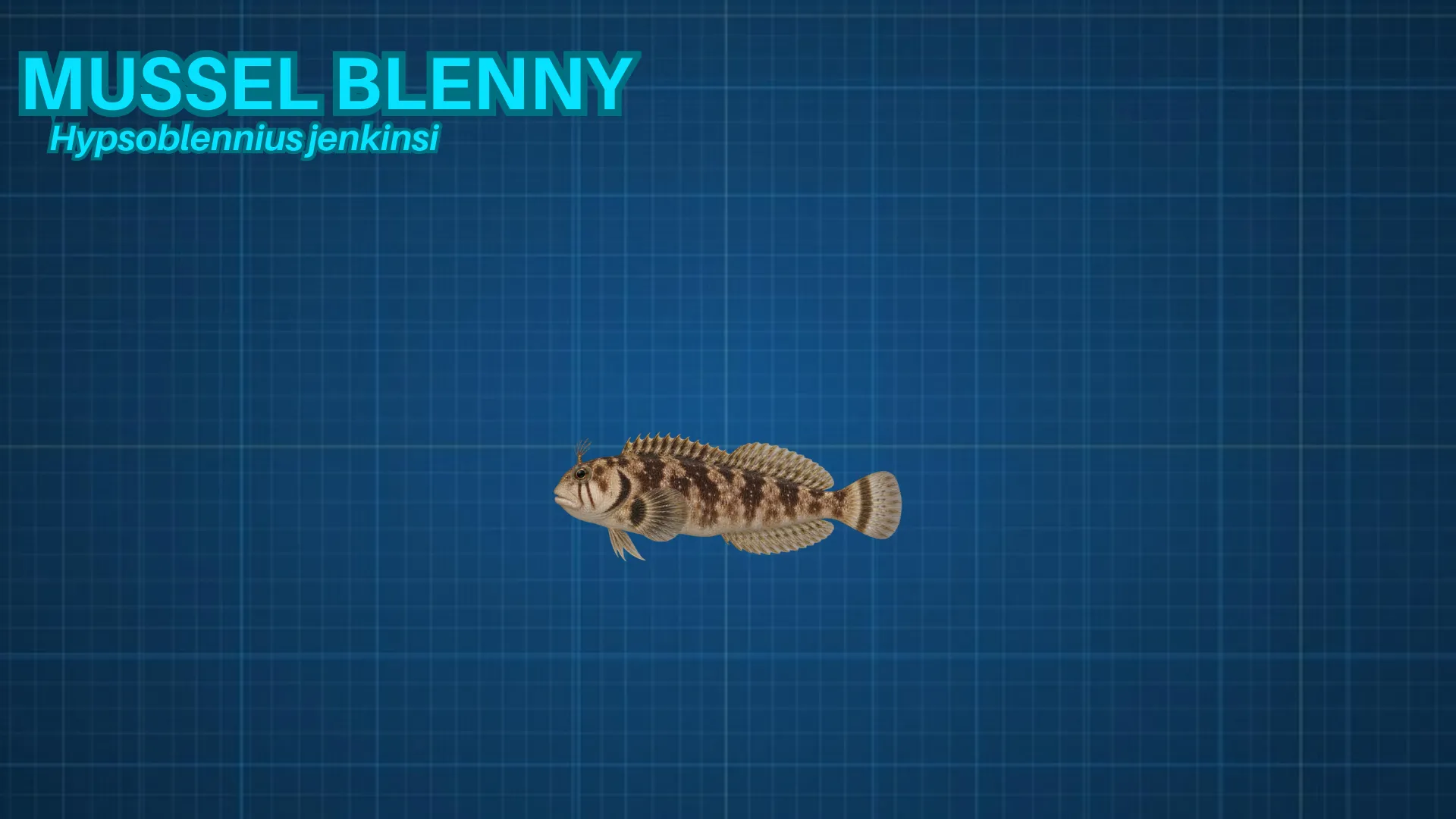
The mussel blenny is a combtooth blenny with a short, blunt head and a very steep forehead. Mexican Fish describes a tan body crossed by many brown bars, with 9 wider bars under the dorsal fin, 2 thin dark bars under each eye and small round spots on the head. A pair of heavily branched tufts of skin, called cirri, sits above the eyes. It reaches about 5 inches.
Its home shapes its size. The 1970 study found that the size of the tubes the fish live in controls how big they grow, probably because predators remove the fish that outgrow their shelter, so populations in different tube sizes differ in average size. Mexican Fish also notes that its growth is limited by the size of its tube.
It holds its ground. Stephens and his colleagues found it highly territorial, and fish moved about 16 feet from home did not find their way back. It eats algae and small invertebrates, according to Mexican Fish.
Breeding follows the pattern of its relatives. The 1970 study found that these blennies spawn from spring through late summer and that the male guards the eggs, which hatch in 4 to 18 days depending on the water temperature. Mexican Fish reports that the female attaches sticky eggs to the walls of the shelter and that the male guards them for 1 to 2 weeks. The larvae then drift in open water. Bernardi reports about 44 days for this species, shorter than its 2 relatives. FishBase gives a maximum age of 6 years.
Where to Find Them
Researched habitat and range candidates
San Diego · 14 beaches
Orange County · 10 beaches
Catalina Island · 6 beaches
Los Angeles · 11 beaches
Channel Islands · 21 beaches
Ventura · 16 beaches
Santa Barbara · 12 beaches
San Luis Obispo · 16 beaches
These locations have suitable habitat within the species range. An assignment is a possible encounter, not a confirmed sighting at every beach. Season, depth, and local conditions still matter. Historical habitat without present-day evidence is excluded.