
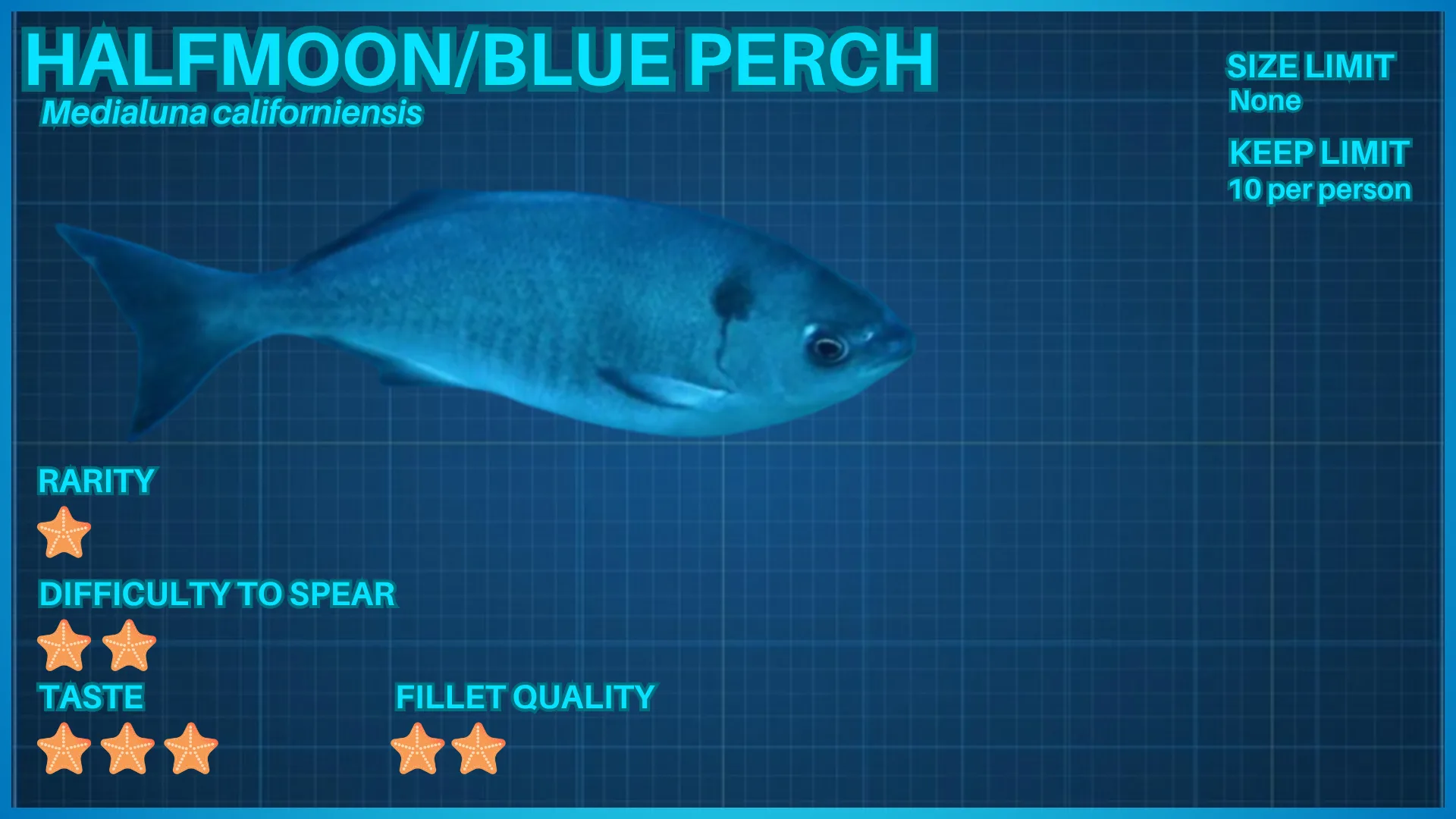
Also calledCatalina blue perch, blue perch, island mackerel, blue bass
 Spearfishing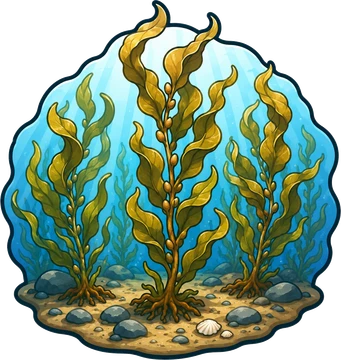

Spearfishing Stats
Southern California shallow reefs and kelp
Taxonomy
Rarity
Abundance rates how many are in suitable habitat. Find difficulty rates how hard it is to locate one on a daylight snorkel or freedive through 50 ft. A higher find score means a harder search. The rarity category also reflects the kind of encounter; it is not an average of the 2 scores.
Regulations
CDFW rules verified 2026-07-09
Seasonality
Edibility
Small fillets carrying a lot of bones for the size of the fish.
Location
Halfmoon range along the eastern Pacific from Vancouver Island, British Columbia south to the Gulf of California, Mexico. They become rare north of Point Conception, Santa Barbara, and the center of the population sits in Southern California and northern Baja California. They live over rocky bottoms and in kelp beds from the shallows down to about 130 feet, and they hold high in the water column more often than they hold to the bottom. Offshore, they gather beneath floating kelp paddies and around oil rigs, both of which give them structure and shade in open water. Juveniles school with young opaleye beneath drifting rafts of kelp. Adults form loose midwater schools, though the larger fish tend to travel alone. Spawning runs from June through October, and larvae are most abundant off northern Baja California.
Spearfishing Brief
The halfmoon is one of the easier fish in a Southern California kelp forest to find and shoot. Finding one is straightforward. Halfmoon hover in the open water above the reef and along the outer edge of the kelp canopy, a dark blue-gray oval against green fronds and blue water. A slow pass through the kelp usually turns up a school within the first few minutes. Community sources describe the fish as not particularly skittish, and a still diver will often see them drift closer to investigate.
The approach is a slow drift into the midwater near a school, followed by a short wait. The fish tend to hold their position or drift closer, which puts them inside comfortable spearing range without a hard chase. Larger adults become more solitary and a little warier, so a bigger halfmoon means a more careful approach and often a longer shot. Halfmoon are also a popular hook-and-line target for pier and skiff anglers. California Sea Grant notes that the recreational catch outweighs the commercial catch, and pier fishermen commonly hook them on fresh mussels, small crabs, or squid strips.
Because the shots are close and the fish is not large, a pole spear or a short to medium speargun suits the job. Cast and Spear's California guide puts beginner targets under 15 pounds in the 60 to 90 centimeter speargun range without naming halfmoon specifically, and the same site's halfmoon page calls a large gun overkill and frames a pole spear as a way to make an easy fish harder rather than as the standard tool. Most adult halfmoon run 8 to 14 inches, and the record is about 19 inches. A heavy long-range gun is no help on a close shot in the kelp, and the extra size only makes the gun harder to swing in the water column.
Deep Dive
The halfmoon takes its common name from its tail, a smooth crescent that curves back like a rising half moon. Its scientific name means the same thing, half moon, and the species was first described from San Diego, California, in 1876. Along the California coast the fish is also called blue perch or Catalina blue perch, though it is not a perch at all. It belongs to the halfmoon family, a small group of mostly Pacific reef and kelp fish that share an oval body. Most members of the family feed mainly on small shrimp-like crustaceans, though the halfmoon itself eats mostly algae.
Adult halfmoon are dark bluish-gray on the back, paler on the belly, with a black spot on the gill cover and dark edges along the tail. Fish that live away from shore, around oil rigs and offshore kelp paddies, tend toward a brighter blue than the ones caught closer in. Juveniles are blue above and silvery below, and they will school in mixed groups with young opaleye beneath rafts of drifting kelp. Halfmoon can also change color quickly as a fright response. A startled fish will darken into gray longitudinal bands within seconds.
A halfmoon lives up to 8 years and grows to a maximum of about 19 inches and 5 pounds, though the average fish in a school is closer to 8 to 14 inches. Sexual maturity comes at around 2 years old, at about 8 inches of length. Spawning runs from June through October in open water, where the fish release eggs and sperm into the current. The fertilized eggs and larvae are planktonic, and larvae are most concentrated off northern Baja California.
Halfmoon are omnivores, but algae make up most of the diet. They graze giant kelp, red algae, and green algae, and they also feed on small invertebrates: crustaceans, sponges, sea anemones, and small worms. The small mouth and light head are built for grazing rather than for chasing. Halfmoon grazing is considered important for controlling kelp growth, though the same feeding habit can make them a problem for commercial kelp farmers. Documented predators include California sea lions, northern fur seals, larger predatory fish, and diving seabirds such as loons and cormorants. On Catalina Island, Los Angeles County, bald eagles have been recorded taking halfmoon from the shallows.
On the plate, halfmoon are better than their reputation among divers suggests, though only to a point. The meat is white, mild, low in fat, and small-flaked, with a firm texture that holds together when baked, grilled, breaded and fried, or sauteed. California Sea Grant compares the flavor to surfperch. Community opinion among divers is mixed. Cast & Spear rates halfmoon good table fare with a mild, pleasant flavor and a firm texture. Set against the fish a diver can choose from on the same reef, that puts halfmoon in the fair range rather than among prized targets like white seabass and yellowtail.
Where to Find Them
Researched habitat and range candidates
San Diego · 13 beaches
Orange County · 10 beaches
Catalina Island · 14 beaches
Los Angeles · 10 beaches
Channel Islands · 24 beaches
Ventura · 15 beaches
Santa Barbara · 10 beaches
San Luis Obispo · 25 beaches
Monterey · 17 beaches
Oregon South Coast · 15 beaches
Oregon Central Coast · 8 beaches
Oregon North Coast · 8 beaches
South Sound · 12 beaches
Hood Canal · 10 beaches
Central Sound · 13 beaches
North Sound · 8 beaches
San Juan Islands · 8 beaches
Strait of Juan de Fuca · 5 beaches
Cape Flattery · 4 beaches
These locations have suitable habitat within the species range. An assignment is a possible encounter, not a confirmed sighting at every beach. Season, depth, and local conditions still matter. Historical habitat without present-day evidence is excluded.