


Taxonomy
Rarity
Abundance rates how many are in suitable habitat. Find difficulty rates how hard it is to locate one on a daylight snorkel or freedive through 50 ft. A higher find score means a harder search. The rarity category also reflects the kind of encounter; it is not an average of the 2 scores.
Seasonality
Location
Wolf-eels live across the North Pacific. On the Asian side they range from the Sea of Japan and the Sea of Okhotsk to the Aleutian Islands. On the North American side they range from Kodiak Island, Alaska, south to Southern California, with records as far south as Imperial Beach and northern Baja California. They live from shallow water down to about 740 feet.
An adult picks a cave or crevice in rocky reef, or a gap among pilings, and winds its long body inside so that only its head shows. According to FishBase, a wolf-eel keeps the same shelter until a larger wolf-eel or a large octopus drives it out. The Monterey Bay Aquarium describes adults as slow and reclusive, and aggressive mainly toward other wolf-eels.
Deep Dive
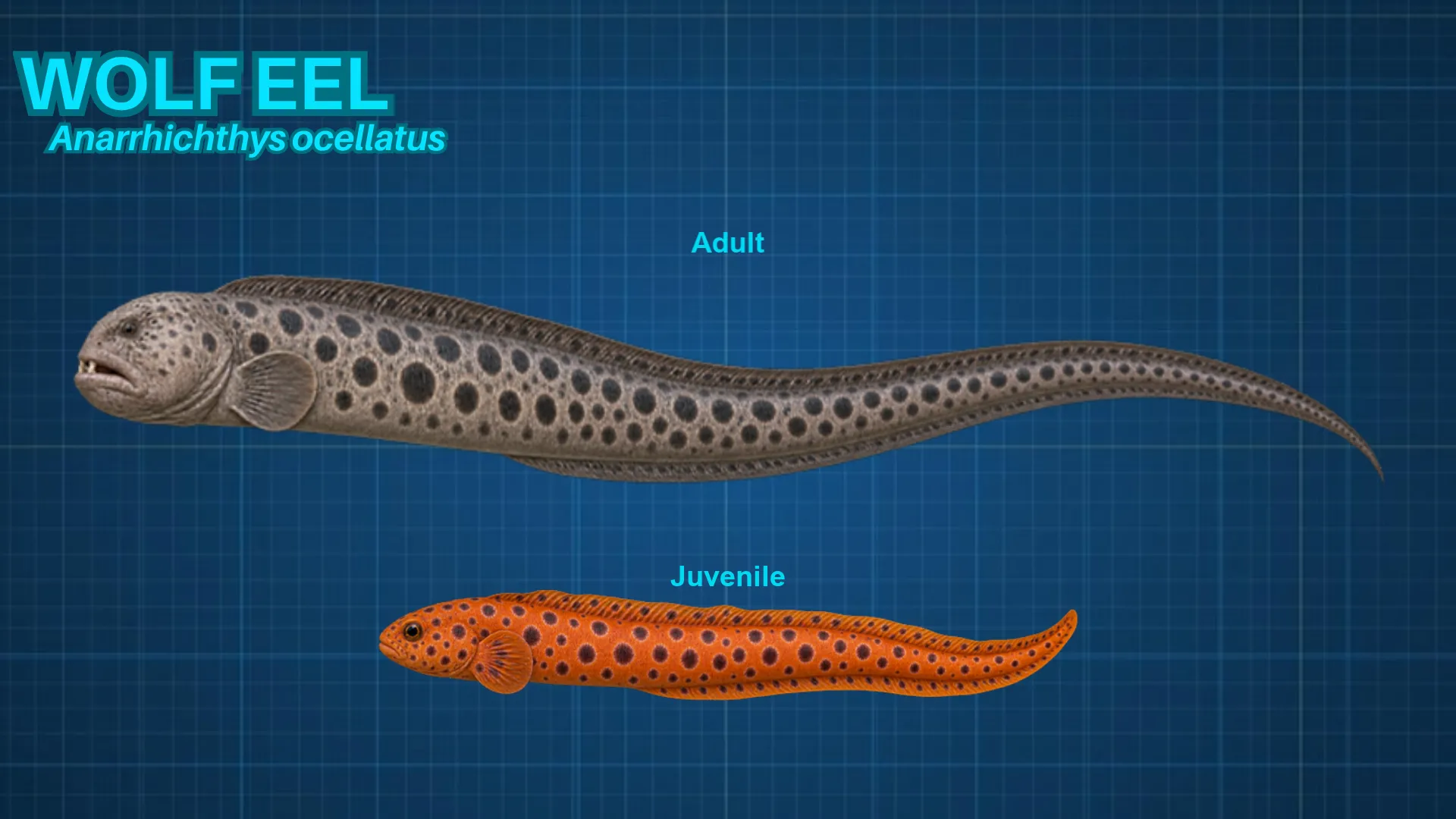
The wolf-eel is not an eel. It is 1 of 5 species in the wolffish family, which belongs to the large order of perch-like fishes, and it is the only one in the family with a long, skinny, eel-like body. It swims by bending its body into deep S-shapes. FishBase gives a maximum length of about 7.9 feet and a maximum recorded weight of about 41 pounds, and the Monterey Bay Aquarium lists adults at up to 8.2 feet.
Adults are gray with dark spots along the back. Males have thick jaws and a bulging forehead. Young wolf-eels are bright orange, and the color fades as they grow. The species name refers to its eye-like spots.
The mouth is built for crushing. Long, crooked front teeth grab the prey, and broad molars at the back of the jaw crush shells. Adults eat hard-shelled animals: crabs, sea urchins, sand dollars, snails, abalone, mussels and clams, along with some fish. A captive young adult at the Monterey Bay Aquarium ate as many as 24 Dungeness crabs in a single day. Young wolf-eels do not yet have the back molars, so they catch fish with their front teeth. Wolf-eels also eat young giant Pacific octopuses. Large wolf-eels can give a painful bite, and FishBase lists the species as able to wound people.
Pairs stay together. FishBase and the Monterey Bay Aquarium both report that wolf-eels may pair for life. During courtship the male butts his head against the female's belly and wraps his body around hers, fertilizing the eggs as she lays them. Starting at about age 7, a female lays up to 10,000 eggs at a time and shapes them into a ball about the size of a grapefruit. Both parents coil around the eggs in the den, and only 1 leaves at a time to feed. The female turns and massages the eggs to keep oxygen-rich water moving over them. They hatch after about 4 months.
The hatchlings are about 1.6 inches long. They drift in open water, feeding on small floating animals, and spend up to 2 years living in the water column before they move to shallow water and settle on the bottom.
Harbor seals eat adult wolf-eels. The Monterey Bay Aquarium records a harbor seal seen eating a wolf-eel at Point Lobos, about 10 miles south of Monterey. Rockfish and kelp greenling eat eggs that are left unguarded.
Where to Find Them
Researched habitat and range candidates
San Diego · 13 beaches
Orange County · 10 beaches
Catalina Island · 14 beaches
Los Angeles · 10 beaches
Channel Islands · 24 beaches
Ventura · 15 beaches
Santa Barbara · 10 beaches
San Luis Obispo · 25 beaches
Monterey · 17 beaches
Oregon South Coast · 15 beaches
Oregon Central Coast · 8 beaches
Oregon North Coast · 8 beaches
South Sound · 12 beaches
Hood Canal · 10 beaches
Central Sound · 13 beaches
North Sound · 8 beaches
San Juan Islands · 8 beaches
Strait of Juan de Fuca · 5 beaches
Cape Flattery · 4 beaches
These locations have suitable habitat within the species range. An assignment is a possible encounter, not a confirmed sighting at every beach. Season, depth, and local conditions still matter. Historical habitat without present-day evidence is excluded.