


Taxonomy
Rarity
Abundance rates how many are in suitable habitat. Find difficulty rates how hard it is to locate one on a daylight snorkel or freedive through 50 ft. A higher find score means a harder search. The rarity category also reflects the kind of encounter; it is not an average of the 2 scores.
Seasonality
Location
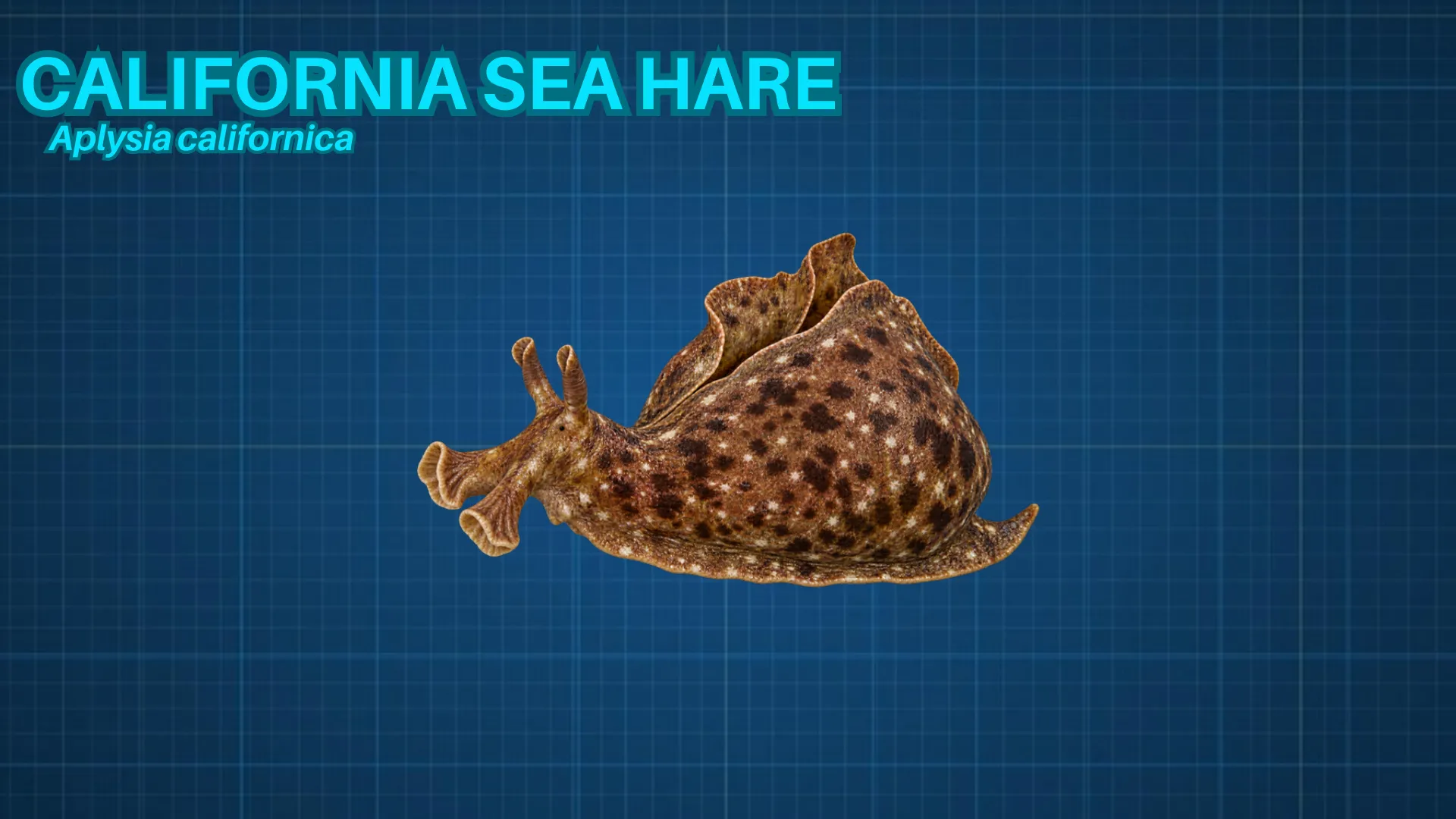
Sea hares live along most of the California coast and in parts of the Gulf of California. They prefer sheltered water where seaweed grows thick. Adults live in the middle and lower intertidal zones, the part of the shore that floods and drains with each tide, and young sea hares live deeper, down to about 60 feet.
The animal can reach 16 inches long and 5 pounds, though most are about half that size. Its color depends on what it eats. Sea hares range from reddish brown to greenish brown or greenish gray, often mottled, and the reddish ones have been eating mostly red seaweed.
Deep Dive
Sea hares eat eelgrass and tough brown and green seaweed. They graze with a pair of jaws and a radula, a ribbon of tiny teeth that works like a rasp.
When disturbed, a sea hare releases a cloud of slimy, reddish-purple ink from a gland inside its body. The ink irritates predators and distracts them. Its color comes from compounds in the red seaweed the animal eats.
Every sea hare is both male and female. Groups of them mate in chains, and each animal lays its eggs in long, tangled strings that look like yellow spaghetti. A single sea hare can lay up to 80 million eggs. The eggs hatch in 10 to 12 days, and the young drift in open water among the plankton, the tiny drifting life of the sea, for about 30 days before settling. For the adults, laying eggs is usually the end. Most die afterward, although sea hares can live longer in water between 57 and 77 degrees Fahrenheit.
The sea hare's nerve cells are unusually large, and the Aquarium of the Pacific in Long Beach calls them the largest in the animal kingdom. The aquarium notes that the species has been used extensively in research on memory, behavior and learning. The best-known work used sea hares of the same genus and earned Eric Kandel a share of the 2000 Nobel Prize in Physiology or Medicine. He studied a simple reflex that pulls a sea hare's gill in to protect it, in an animal whose nervous system has only about 20,000 nerve cells. The work showed that learning changes the strength of the connections between nerve cells. Short-term memory comes from temporary changes in those connections, and long-term memory from lasting changes in their structure.
Where to Find Them
Researched habitat and range candidates
San Diego · 15 beaches
Orange County · 10 beaches
Catalina Island · 6 beaches
Los Angeles · 10 beaches
Channel Islands · 21 beaches
Ventura · 17 beaches
Santa Barbara · 10 beaches
San Luis Obispo · 20 beaches
Monterey · 18 beaches
These locations have suitable habitat within the species range. An assignment is a possible encounter, not a confirmed sighting at every beach. Season, depth, and local conditions still matter. Historical habitat without present-day evidence is excluded.