

Also calledkelp blenny, iodine fish

Taxonomy
Rarity
Abundance rates how many are in suitable habitat. Find difficulty rates how hard it is to locate one on a daylight snorkel or freedive through 50 ft. A higher find score means a harder search. The rarity category also reflects the kind of encounter; it is not an average of the 2 scores.
Seasonality
Location
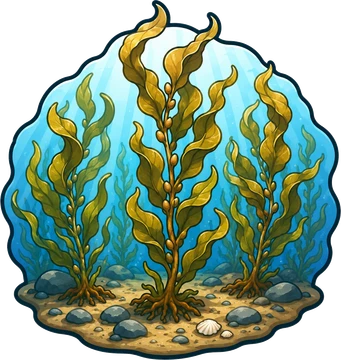
Giant kelpfish live in the eastern Pacific from California south to southern Baja California, including Guadalupe Island. They hold in kelp beds and in rocky areas with heavy seaweed cover, from the intertidal down to about 130 feet. The habitat requirement is standing plant cover rather than reef structure, which is why the fish is found in giant kelp, in shallow beds of other large algae, and in surfgrass, and why it disappears from stretches of reef that have been grazed bare.
The body is built for one job. A giant kelpfish is long, flattened side to side, and drawn out into a pointed snout, so that seen from the side it is a blade and seen from the front it is almost nothing. It reaches about 24 inches, which makes it far larger than most people expect from a fish they have only ever seen described as a small reef species. Juveniles school; adults are solitary. FishBase gives a maximum reported age of 4 years, which is short for a fish of that length and means the largest individuals a diver sees are near the end of their lives.
Deep Dive
The interesting part of this species is that it does not have one color. Giant kelpfish come in 3 color forms, red, brown and green, and the difference is the number of melanophores, the pigment cells in the skin. The forms are not scattered at random. Carol Stepien, whose work on this species in the 1980s is still the foundation for what is known about it, collected the color forms and found that fish were usually taken from plant cover that matched their own color: green fish in green algae, red fish in red algae, brown fish in brown.
She then tested whether that was a choice. Given a background to sit against, red, green and brown fish all preferred backgrounds matching their own color over backgrounds that did not, and the preference was strongest against live plants rather than artificial ones. She also reared juveniles and found that the color a young kelpfish develops is set by the plant background it grows up against, so a fish is not born red or green so much as it becomes one.
The most striking result came from experiments run in the water rather than in a tank, where the color shifts were largest. Some adult females changed all the way between red, brown and green. Males and juveniles could not turn red at all, and adult males also appeared to lose the ability to reach a true green. Stepien concluded that the ability to change color, and specifically the ability to go red, is likely governed by sex hormones. That leaves a species in which the females are the better camouflage artists, with a range of disguises their males cannot reach.
Color is not the only thing that differs by sex and age. Stepien's later work found that males, females and juveniles differ in color pattern as well as color, and that the 3 groups hold different habitat. So a kelp bed does not contain one kind of kelpfish wearing 3 coats. It contains 3 groups of fish, living in somewhat different parts of the same plant cover, wearing different patterns for different reasons.
The rest of the natural history is quieter. The diet is small crustaceans, mollusks and small fishes, taken from the plant cover the fish lives in. Reproduction splits the work in a way that is common among blennies and their relatives and uncommon among fish generally: the female attaches her eggs to seaweed and leaves, and the male stays with them and guards them. The genus contains no other species, so a giant kelpfish has no close relatives to compare it against on this coast, and the smaller kelpfishes a diver sees in the same habitat belong to different genera in the same family.
Where to Find Them
Researched habitat and range candidates
San Diego · 15 beaches
Orange County · 10 beaches
Catalina Island · 14 beaches
Los Angeles · 10 beaches
Channel Islands · 24 beaches
Ventura · 17 beaches
Santa Barbara · 10 beaches
San Luis Obispo · 25 beaches
Monterey · 18 beaches
These locations have suitable habitat within the species range. An assignment is a possible encounter, not a confirmed sighting at every beach. Season, depth, and local conditions still matter. Historical habitat without present-day evidence is excluded.