

Taxonomy
Rarity
Abundance rates how many are in suitable habitat. Find difficulty rates how hard it is to locate one on a daylight snorkel or freedive through 50 ft. A higher find score means a harder search. The rarity category also reflects the kind of encounter; it is not an average of the 2 scores.
Regulations
CDFW rules verified 2026-09-26
Seasonality
Edibility
Location
Wavy turban snails live on rock from Point Conception, Santa Barbara, south to Isla Asunción in Baja California Sur, Mexico. California Sea Grant places the northern edge a little farther north, in San Luis Obispo County. The snails range from the low intertidal, the lowest band of shore that the tide uncovers, to more than 250 feet deep, and where they live changes with size. Small snails are dense in shallow water, while large snails live deeper and farther apart. Very shallow water, under about 10 feet, and the deepest part of the range both hold few snails.
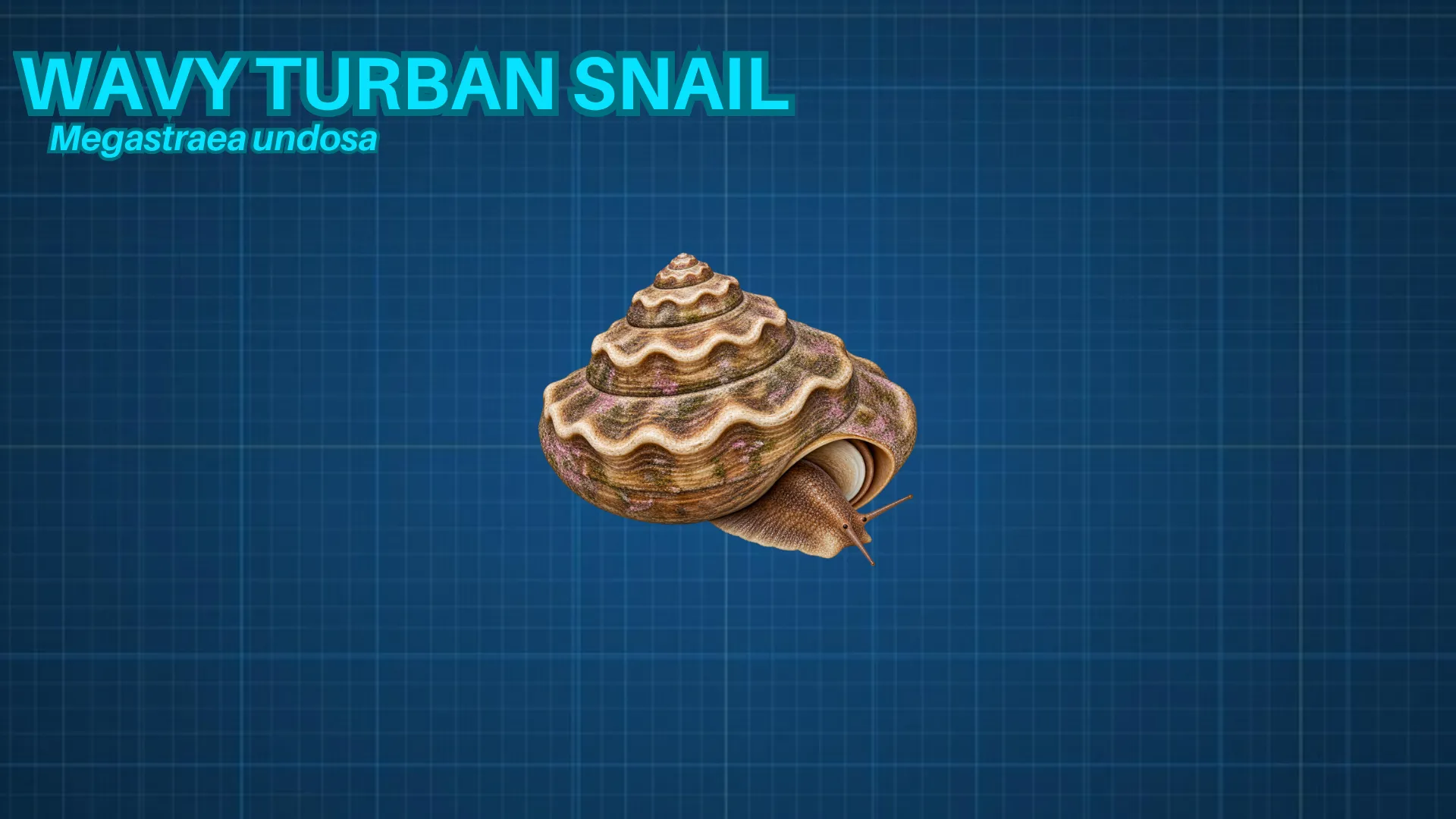
The shell reaches 6 inches across. It is heavy, with thick, wavy ridges that give the species its name, and it sits on a flat base. A tan, fibrous outer skin covers the shell, and coralline algae, a pink seaweed hardened with lime, often grow over that. The opening is sealed by a hard, thick, oval trapdoor called the operculum, which carries rough ridges of its own.
Harvest Brief
Southern California from Point Conception south into Baja California.
California allows saltwater mollusks to be taken only by hook and line or by hand. The daily bag limit is 35 turban snails per person, and there is no size limit or closed season. Most turban snails live below the tide line, but the ones in the rocky intertidal may also be taken. State marine reserves are closed to all invertebrate take, and some state marine conservation areas close their tidepools too.
Snails under about 2.2 inches across are too young to breed, while females are fully mature above 3.5 inches and males above 3.1 inches.
The meat is the muscular foot, the part the snail crawls on. Commercial buyers sell it to restaurants as wavalone, a substitute for abalone, and California Sea Grant describes its taste and texture as abalone-like. It can be grilled, sautéed, battered and fried, added to pasta, chowders, and soups, or cooked in a stir-fry.
Deep Dive
Wavy turban snails eat seaweed. They graze on kelp and on coralline algae. Many animals eat the snail in turn. Sea stars and Kellet's whelks, large sea snails that eat other animals, are likely predators, because lab experiments show the turban snail trying to escape them. Octopuses, lobsters, and fishes also take them.
The snail has a nightly defense against those predators. After dark, it crawls up giant kelp into the canopy, the mat of kelp at the surface. The state's 2001 report describes this climb as a way to escape being eaten.
Growth is slow. A study at Santa Catalina Island found that small snails grow fastest and that growth slows as they get larger. Growth also slows in spring and summer and speeds up in fall and winter, and females grow more slowly than males. The 2001 report summarizes Baja California studies that found the snails breed year-round, with peaks in spring and fall. It also describes a yearly cycle in which the reproductive organs ripen through spring and early summer, spawning follows in late summer, and the body grows through fall and winter. Young snails settle onto the reef from January to April.
People ate this snail long before it was sold. Archaeological evidence shows that native peoples harvested wavy turban snails before European and Asian settlement of California. The modern commercial fishery began in the early 1990s and is centered off San Diego, where most of the catch comes from Point Loma. Divers collect the snails with handheld tools and net bags, the same gear used in the red sea urchin fishery. Records of the catch begin in 1992. The catch peaked in 1993 and crashed the next year when market demand collapsed, then rose to a higher peak in 1998. The foot was sold as meat, the heavy shells were made into buttons, and in Mexico the meat is canned.
The 2001 report named one rule that kept the commercial fishery near San Diego. Commercial divers could not take snails within 1,000 feet of the low tide line. At the Channel Islands, most of the snail habitat lies inside that zone.
Where to Find Them
Researched habitat and range candidates
San Diego · 13 beaches
Orange County · 10 beaches
Catalina Island · 13 beaches
Los Angeles · 10 beaches
Channel Islands · 24 beaches
Ventura · 15 beaches
Santa Barbara · 5 beaches
These locations have suitable habitat within the species range. An assignment is a possible encounter, not a confirmed sighting at every beach. Season, depth, and local conditions still matter. Historical habitat without present-day evidence is excluded.