
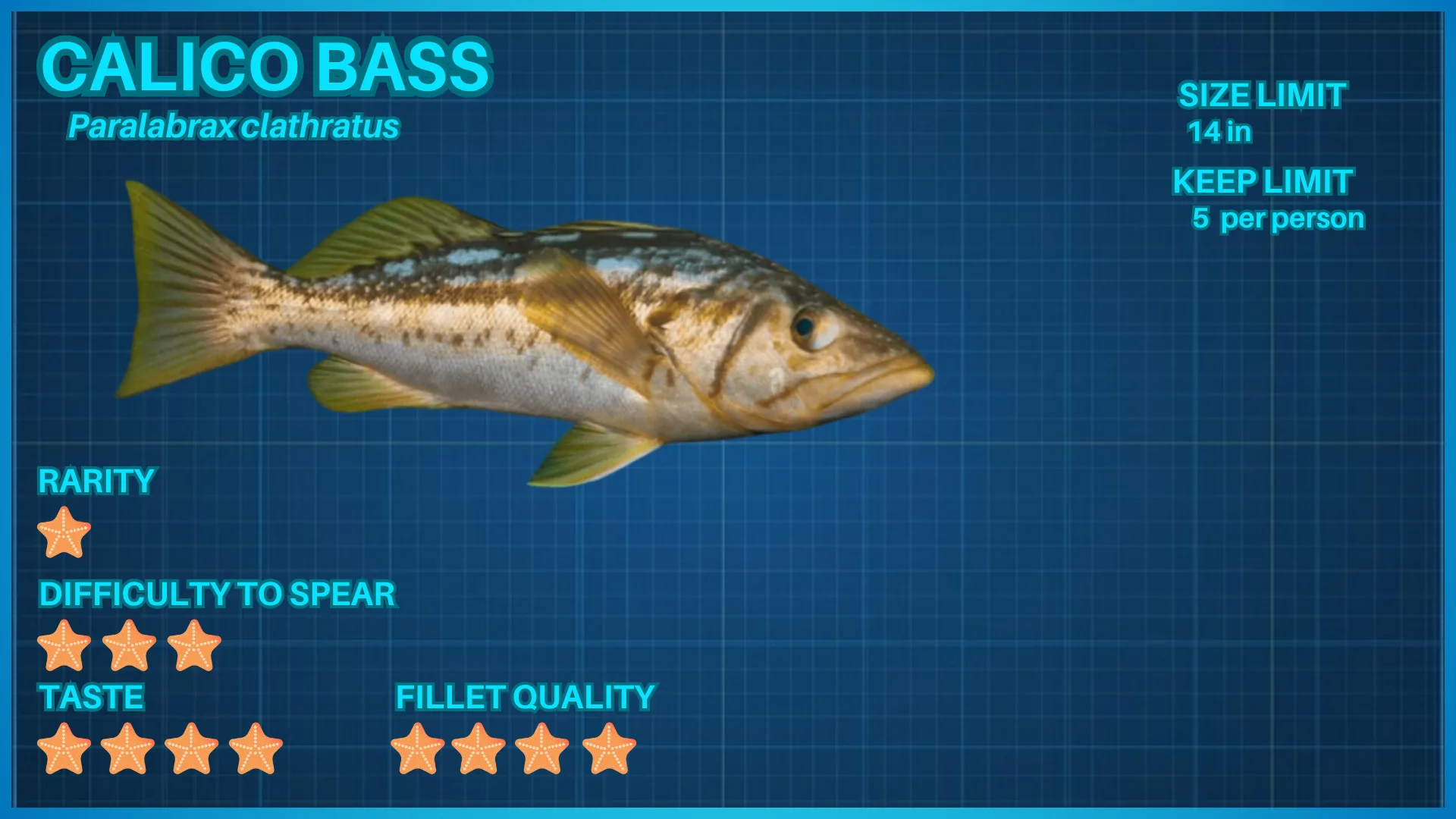
Also calledkelp bass, rock bass, bull bass, checkerboard bass, kelp salmon
 Spearfishing

Photo: Allison Wylot, Marine Room shallow reef, La Jolla
Spearfishing Stats
Southern California kelp and rocky reefs
Taxonomy
Rarity
Abundance rates how many are in suitable habitat. Find difficulty rates how hard it is to locate one on a daylight snorkel or freedive through 50 ft. A higher find score means a harder search. The rarity category also reflects the kind of encounter; it is not an average of the 2 scores.
Regulations
CDFW rules verified 2026-07-07
Seasonality
Edibility
Firm, clean white meat with a minimal bloodline that holds together perfectly.
Location
Calico bass live in kelp forests and on rocky reefs along the coast from central California through the Southern California Bight and down into Baja California. The center of the population sits south of Point Conception. They range from the surface down to about 200 feet, but most fish hold in the 8 to 70 foot band where the kelp is thickest and the reef is most complex. Juveniles hide inside kelp blades and among shallow rocks and seaweed. Adults spread out onto deeper reef, kelp stringers, wrecks, pipes, boulders, and any hard structure. The species is largely a homebody. A single adult may keep a home range of only about 32,000 square feet, roughly three-quarters of an acre, and hold that same patch for up to 3 years. Broad sand channels between reefs act as barriers that most fish will not cross. Activity climbs in spring, peaks through summer and into early fall when the water reaches the mid to upper 60s Fahrenheit, and drops off in winter. From May through September the fish gather at the kelp canopy in groups of dozens to about 200 to spawn, mostly in the 2 hours around sunset, and most heavily on the days around the full moon.
Spearfishing Brief
Calico bass are the bread-and-butter fish of Southern California spearfishing. They are common, they hold to structure, and they will sometimes drift closer to a diver who stays still, though experienced divers report that the heavily hunted fish on Southern California reefs stay much warier than the unpressured fish in remote Baja. That is why they are the fish most divers shoot first, and why the shot itself is a moderate problem rather than a hard one. Finding them is easy. A diver who searches the kelp canopy and the reef edges between 15 and 40 feet, in the summer months when the water is warmest, will see calicos. Their home ranges are small and their site fidelity is strong, so a good patch of kelp with structure underneath tends to hold the same fish week after week. That earns finding them a 1 on the 1-to-5 scale. The shot is harder and rates a 3. Calicos are skittish enough that a diver who charges through the kelp will spook every fish in the area. Those fish hold to structure and drift back to it. A calico will approach a diver who stays still.
The method that works is waiting. A diver drops through the canopy, tucks into the kelp stringers or against a boulder, and waits. Community guides report that a diver who settles and goes quiet will often draw a broadside look that a moving diver never gets. One community guide reports that a spooked calico does not travel far and settles back onto the same structure within a few minutes if the diver stops moving. When a fish turns broadside inside the range of the gun, the shot goes behind the gill plate through the spine.
The size of the fish and the distance they tend to keep from divers decide which weapon a diver brings for calicos. A calico is a thick-bodied reef fish, but it is much smaller than a white seabass. Inside the kelp, most shots come at 3 to 6 feet. Community guides converge on a small gun rather than a large one, a short to mid-length speargun of 75 to 100 centimeters carrying 1 or 2 bands and a standard flopper tip. A 6 to 7 foot polespear with a paralyzer tip works equally well for divers who prefer it, and both weapons are cheap and quick to load in the kelp. Larger guns are heavier to swing and tangle more easily in the canopy, and their extra range is no help when every shot comes this close.
Deep Dive
Despite the name, the calico bass belongs to the sea bass family, alongside the groupers. It shares the Southern California reef with 2 close relatives, the barred sand bass and the spotted sand bass. California's fishing regulations group all 3 species under a single 5-fish combined daily bag limit. Calico bass carry a mottled pattern of dark blotches and pale rectangular spots along the back that gives the fish its name. Adults run brown to olive-green, with yellow fin tips. During the spawn, females darken above and turn bright white below, and about three-quarters of the males develop a bright orange snout and lower jaw.
The species grows slowly and lives a long time. A 16.5-inch calico bass is about 9 years old, and a fish at the 14-inch legal size has taken 5 or 6 years to get there. The record maximum age is 34 years, and the record maximum length is 28.5 inches, and the record maximum weight is about 15 pounds. A typical catch is much smaller. Males and females mature at around 9 inches, well below the legal size, which means that every legal fish taken from the reef has already spawned at least once, and usually several times. This is the biological reason the 14-inch limit exists, and it is why calico bass populations respond so slowly to overfishing and so slowly to protection. A single strong recreational season can take fish that took a decade to grow.
Calico bass eat small shrimp-like crustaceans at every size, and larger fish add anchovies, small surfperch, other small reef fishes, and squid. They are largely diurnal ambush predators. On the reef, a calico holds inside kelp stringers, tucks against boulders, or sits under ledges and darts out to grab prey that drifts within reach. In open water, calicos will gather to hunt schools of baitfish cooperatively, sometimes driving anchovies right up against the surface. Adults have few predators once they reach size. Their predators include the giant black sea bass, which shares the same kelp forests and is now recovering under protection, along with the California moray eel, which takes more calico bass than any other prey.
Reproduction is the part of the biology that shaped the fishery. Calico bass spawn from May through September, peaking in July. They gather at the kelp canopy in groups that build to as many as 200 fish, usually at 25 to 60 feet, and release eggs and sperm into open water in the 2 hours around sunset. The bulk of the spawning happens in the days around the full moon. Eggs hatch in about 36 hours, and the larvae drift for 25 to 36 days before settling onto the kelp and starting life on the reef. The spawning groups are big, predictable, and shallow enough to reach, which is why the fishery collapsed. That is what closed the commercial fishery in 1953 and shaped the recreational rules that still hold today: a size limit set well above the size at first spawn, a combined daily bag limit, and a permanent ban on commercial sale. Today the calico bass is one of Southern California's most popular saltwater gamefish, pursued far more with rod and reel than with a speargun.
On the plate the calico is a respected but not premier table fish. The meat is white, firm, mild, and low in oil, and it takes well to a pan, a grill, a tortilla, or a marinade. Fillets are modest in size compared to a white seabass or a yellowtail, so a meal usually takes 2 or 3 fish. Many Southern California anglers now release most of the calicos they catch, partly on principle and partly because the meat, while good, is not the reason people fish for the species. Divers tend to fall in the same camp. A calico bass or 2 in the cooler for tacos or ceviche is a common end to a kelp forest dive, and any more than that gets released back to the reef.
Where to Find Them
Researched habitat and range candidates
San Diego · 13 beaches
Orange County · 10 beaches
Catalina Island · 14 beaches
Los Angeles · 10 beaches
Channel Islands · 24 beaches
Ventura · 15 beaches
Santa Barbara · 10 beaches
San Luis Obispo · 25 beaches
Monterey · 17 beaches
Oregon South Coast · 15 beaches
Oregon Central Coast · 8 beaches
Oregon North Coast · 8 beaches
These locations have suitable habitat within the species range. An assignment is a possible encounter, not a confirmed sighting at every beach. Season, depth, and local conditions still matter. Historical habitat without present-day evidence is excluded.