


Taxonomy
Rarity
Abundance rates how many are in suitable habitat. Find difficulty rates how hard it is to locate one on a daylight snorkel or freedive through 50 ft. A higher find score means a harder search. The rarity category also reflects the kind of encounter; it is not an average of the 2 scores.
Regulations
CDFW rules verified 2026-10-12
Seasonality
Edibility
Location
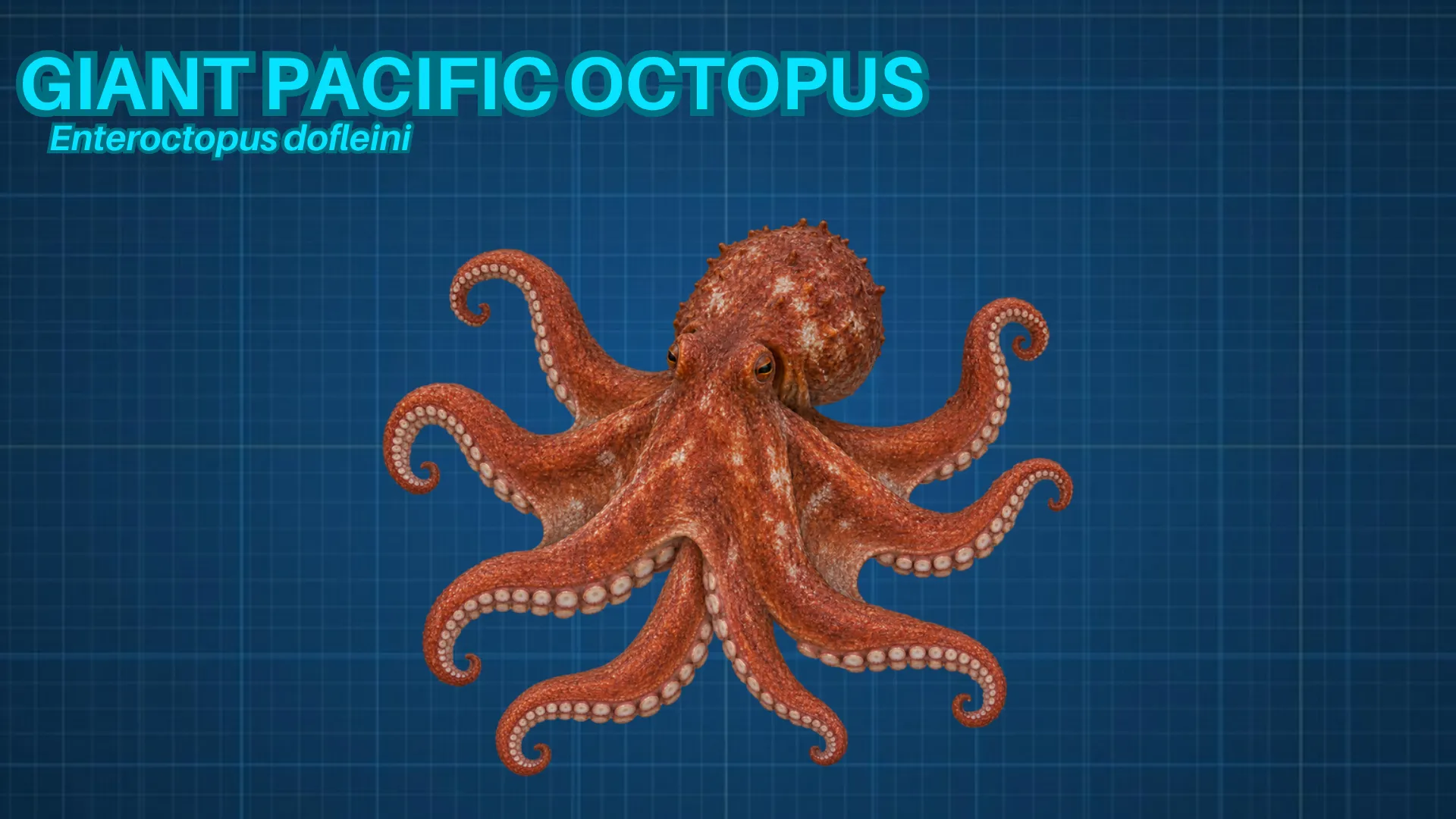
The giant Pacific octopus lives across the North Pacific, from Japan and Korea to Alaska and south along the North American coast to Baja California. Temperature sets its depth. The Monterey Bay Aquarium reports that it lives in water of 60°F or colder. In the north, where the water near shore is cold, it ranges from the intertidal zone down to at least 330 feet. In the southern part of its range it is recorded from the shallow subtidal down to about 3,280 to 4,920 feet.
Adults live on rocky bottom and spend the day in a den under a boulder or in a crevice. The octopus carries prey home to eat, and the discarded shells and crab backs build up outside the entrance in a pile called a midden. That pile is the easiest way to find an occupied den. Sunflower sea stars and small scavenging snails have been recorded at these middens.
The animal is solitary. Each octopus lives alone until it looks for a mate near the end of its life. The species lives 3 to 5 years.
Harvest Brief
North Pacific from Japan to Alaska and south to Baja California; a shallow-water animal mainly in the cold north.
Take is legal in all 3 Pacific states, and Washington's rules are the strictest. California regulation 29.10 allows octopus to be taken only with the hands or on hook and line, and California sets the limit at 35 octopus per person per day with no size limit and no closed season. Take of all invertebrates is prohibited inside state marine reserves. North of Yankee Point in Monterey County, scuba may be used only for sea urchins, rock scallops and Cancer crabs, so a scuba diver there may not take an octopus. A diver on a snorkel is not using scuba. Oregon allows 1 octopus per day, by angling, dip net, pot, hand or hand-powered tool. Washington allows 1 giant Pacific octopus per day, taken by hand or with a tool that does not pierce the animal, with no chemical irritants. Washington closes Hood Canal, its marine preserves and conservation areas, and a set of Octopus Protection Areas to all octopus. They include Seacrest Park Coves 1 to 3 and the Alki Beach Junk Yard, both in Seattle.
The find rates a 3 on the 1 to 5 scale. Divers find occupied dens by the midden of shells outside the entrance. A 50-pound octopus can still squeeze through a 2-inch hole, because its beak is the only hard part of its body, so the den entrance is often much smaller than the animal inside.
The species has a venomous bite. The Monterey Bay Aquarium describes the bite as harmful but not fatal when treated promptly, and notes that the animal usually avoids divers. The author of Walla Walla University's guide to the invertebrates of the Salish Sea reports never having seen anyone bitten, even while pulling one off a rock, and finds it much less ready to bite than the smaller red octopus.
Deep Dive
The weight of a giant Pacific octopus is usually given in tens of pounds. The Alaska Department of Fish and Game puts adults at 22 to 110 pounds, averaging 45 to 65 pounds. Its largest documented animal is a 156-pound octopus recorded by Canadian researchers, and the Monterey Bay Aquarium cites 200 pounds as the heaviest on record. Larger figures circulate in older references, but these 2 agencies give the documented numbers. The body reaches about 2 feet long, and an adult carries roughly 2,140 to 2,240 suckers along its 8 arms.
Growth is fast. A hatchling is about the size of a grain of rice. After it settles to the bottom it weighs about 2 pounds within a year, and by age 2 it may weigh about 20 pounds and be ready to mate. Adult weight is reached in about 5 years. The animal has 3 hearts and blue blood, colored by a copper-based protein called hemocyanin that carries oxygen.
It eats almost anything it can catch: crabs, shrimp, clams, cockles, scallops, abalone, fish and fish eggs, and other octopuses. Staff at the Seattle Aquarium watched an octopus catch a spiny dogfish, a small shark, and in 2005 a picked-clean dogfish skeleton turned up on a midden outside a den. The octopus opens hard-shelled prey in 3 ways: pulling it apart, biting it with its beak, or drilling. To drill, it softens the shell with saliva, scrapes a hole with its radula, a ribbon of tiny teeth, and injects a toxin that paralyzes the prey. In middens studied at Bowman Bay, Washington, about half the crab shells had drill holes, while almost none of the scallop shells did. The animal is also known for stealing crabs out of crab traps.
Young octopuses are eaten by lingcod, halibut, wolf-eels, seals and sea otters. Octopuses over about 10 pounds face fewer threats. Documented predators of the species as a whole include seals, sea lions, sea otters, lingcod, dogfish, halibut, wolf-eels, birds and people. An octopus defends itself by fighting, releasing a cloud of ink, or retreating into its den or the kelp. It can change color and skin texture through millions of pigment cells in its skin, yet laboratory experiments show it is color-blind. In aquariums it learns to open jars and solve puzzles.
Breeding ends its life. A female chooses a mate, usually a larger male, and the pair moves deeper than about 165 feet. The male passes a packet of sperm into the female's body and dies a few weeks later. About 40 days after mating, the female lays her eggs in strings of about 250 on the roof of her den. A single brood holds 18,000 to 74,000 eggs, and sometimes as many as 100,000. She stays with them for about 5 to 7 months, cleaning them and pushing oxygen-rich water over them, and she does not eat during that time. She dies at about the time they hatch. The hatchlings drift near the surface as plankton for weeks to several months, depending on water temperature, before they settle to the bottom.
Where to Find Them
Researched habitat and range candidates
San Diego · 14 beaches
Orange County · 10 beaches
Catalina Island · 13 beaches
Los Angeles · 10 beaches
Channel Islands · 24 beaches
Ventura · 15 beaches
Santa Barbara · 10 beaches
San Luis Obispo · 22 beaches
Monterey · 17 beaches
Oregon South Coast · 15 beaches
Oregon Central Coast · 8 beaches
Oregon North Coast · 8 beaches
South Sound · 12 beaches
Hood Canal · 9 beaches
Central Sound · 13 beaches
North Sound · 8 beaches
San Juan Islands · 8 beaches
Strait of Juan de Fuca · 5 beaches
Cape Flattery · 4 beaches
These locations have suitable habitat within the species range. An assignment is a possible encounter, not a confirmed sighting at every beach. Season, depth, and local conditions still matter. Historical habitat without present-day evidence is excluded.