


Taxonomy
Rarity
Abundance rates how many are in suitable habitat. Find difficulty rates how hard it is to locate one on a daylight snorkel or freedive through 50 ft. A higher find score means a harder search. The rarity category also reflects the kind of encounter; it is not an average of the 2 scores.
Regulations
CDFW rules verified 2026-10-12
Seasonality
Edibility
Location
Red octopuses live from central Alaska south to Baja California and into the Gulf of California. They use almost every kind of bottom along that coast: kelp beds, rocky reef, sandy mud, and the undersides of stones at the lowest tides. The recorded depth range runs from the low intertidal to about 690 feet. Young animals settle into kelp holdfasts, the root-like tangles that anchor kelp to the rock, and they are often found when storms wash those holdfasts onto the beach. As they grow, the larger animals move offshore onto sandy mud.
A red octopus will den in nearly anything with a hollow. Researchers in Puget Sound, Washington studied the diet of red octopuses by collecting the beer bottles they were living in, and a female laid her eggs inside a bottle crusted with barnacles and tube worms. The animal hunts mostly at night and carries prey back to the den to eat. The empty shells pile up outside the entrance, and that pile is often the only sign that an octopus is home.
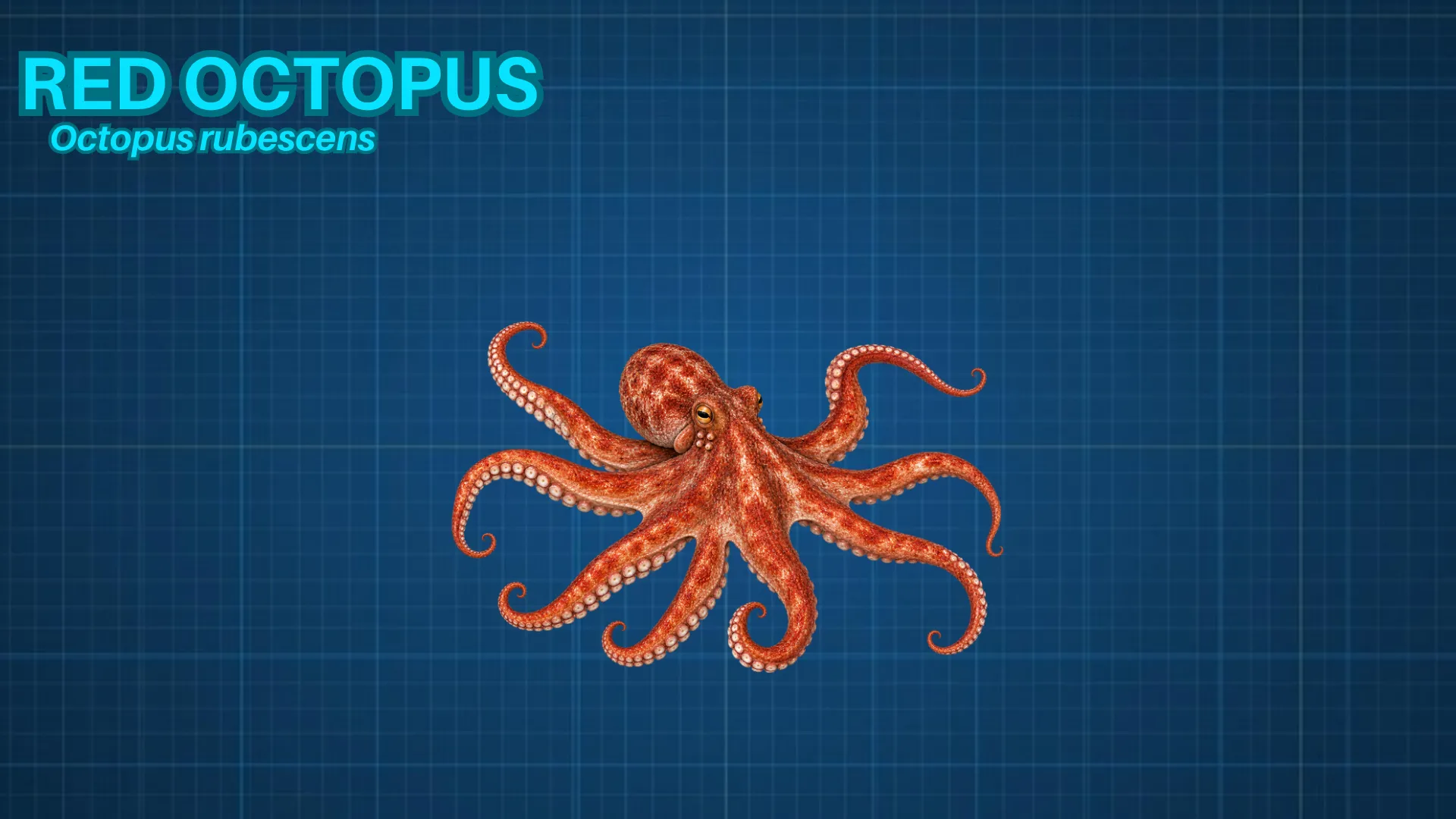
The giant Pacific octopus shares much of this range and is also red, so a small giant Pacific octopus and a red octopus can look alike. Size settles most cases, because an adult red octopus has a body under 4 inches long and weighs well under a pound. Up close, the red octopus has small pointed bumps on its skin, while the giant Pacific octopus has loose folds of skin and large flat-topped bumps. Researchers have also reported 3 small skin flaps below each eye as a sign of the red octopus.
Harvest Brief
The whole Pacific coast, from central Alaska to Baja California and the Gulf of California.
Take is legal in California and Oregon, and the rules differ more than most divers expect. California regulation 29.10 allows octopus to be taken only with the hands or on hook and line, so spears, gaffs and hooked tools are not legal gear. California sets the limit at 35 octopus per person per day, with no size limit and no closed season. Take of all invertebrates is prohibited inside state marine reserves. North of Yankee Point in Monterey County, scuba may be used only for sea urchins, rock scallops and Cancer crabs, which means a scuba diver there may not take an octopus at all. A diver on a snorkel is not using scuba, and that restriction does not apply. Oregon allows 1 octopus per day, taken by angling, dip net, pot, hand or hand-powered tool. Washington requires the hands or a tool that does not pierce the animal and closes Hood Canal and its Octopus Protection Areas to all octopus. Its pamphlet sets a daily limit only for the giant Pacific octopus.
The find rates a 4 on the 1 to 5 scale. The animal is not scarce, but by day it is wedged into a den with its color and skin texture matched to the surface. Its color can shift within a fraction of a second between red, brown, yellow, white and mottled patterns. The reliable sign is the pile of empty crab and snail shells outside an occupied den. Bottles, cans and empty shells on a sandy bottom are worth checking, because the species moves into them so readily.
The red octopus bites. Walla Walla University's guide to the invertebrates of the Salish Sea warns that "this species often bites," and the same author found the much larger giant Pacific octopus far less likely to bite. The bite carries venom from the salivary glands, the same venom the animal uses to subdue crabs, and the Monterey Bay Aquarium notes that a bite can take 3 weeks to heal. Gloves are the usual precaution for anyone handling one.
Deep Dive
The red octopus is a small animal. Its body, called the mantle, is usually under 4 inches long, and its arms are 3 to 5 times that length. SeaLifeBase gives a maximum length of 18 inches from body to arm tip and a maximum weight of about 0.9 pounds, while the Monterey Bay Aquarium gives a length of up to 20 inches. Like other octopuses it has 3 hearts: 1 pumps blood through the body and 2 pump it through the gills. Its normal color is red or reddish brown, which is where the name comes from.
It eats small crabs above all, along with hermit crabs, other crustaceans, snails and small fish. The octopus finds much of its food by touch and taste, using sensors in its suckers. It kills prey with venom from its salivary glands and cracks shells open with its beak, a hard parrot-like mouth at the center of the arms. A snail is handled differently. The octopus scrapes a hole through the shell with its radula, a ribbon of tiny teeth, and injects a chemical that loosens the snail from its shell.
Red octopuses differ from one another in temperament, and that difference has been measured. In a 1993 study in the Journal of Comparative Psychology, the researchers Jennifer Mather and Roland Anderson tested 44 red octopuses in 3 situations: being alerted, being threatened and being fed. The animals' behavior sorted into 3 consistent traits, which the authors labeled activity, reactivity and avoidance. Together those traits explained 45% of the differences between individuals.
Breeding ends the life of both parents. Mating takes place in deeper water. Afterward the adults move inshore, and the female lays her eggs in the intertidal zone or on shallow rocky reef. She guards and grooms them for 6 to 8 weeks until they hatch, then dies. Males die after mating. Sources disagree on the season. The Monterey Bay Aquarium places mating in late winter and early spring, while the Walla Walla University guide reports a breeding peak in August and September. The hatchlings, under a tenth of an inch long, spend a short time drifting in the plankton before they settle into kelp beds.
Where to Find Them
Researched habitat and range candidates
San Diego · 14 beaches
Orange County · 10 beaches
Catalina Island · 13 beaches
Los Angeles · 10 beaches
Channel Islands · 24 beaches
Ventura · 15 beaches
Santa Barbara · 10 beaches
San Luis Obispo · 22 beaches
Monterey · 17 beaches
Oregon South Coast · 15 beaches
Oregon Central Coast · 8 beaches
Oregon North Coast · 8 beaches
South Sound · 12 beaches
Hood Canal · 9 beaches
Central Sound · 13 beaches
North Sound · 8 beaches
San Juan Islands · 8 beaches
Strait of Juan de Fuca · 5 beaches
Cape Flattery · 4 beaches
These locations have suitable habitat within the species range. An assignment is a possible encounter, not a confirmed sighting at every beach. Season, depth, and local conditions still matter. Historical habitat without present-day evidence is excluded.