

Also calledgreen surf anemone, giant green sea anemone, giant tidepool anemone, rough anemone
Taxonomy
Rarity
Abundance rates how many are in suitable habitat. Find difficulty rates how hard it is to locate one on a daylight snorkel or freedive through 50 ft. A higher find score means a harder search. The rarity category also reflects the kind of encounter; it is not an average of the 2 scores.
Seasonality
Location
The giant green anemone lives on rock from above the low tide line down to about 50 feet. It wants exposed coastline with cold water and heavy wave action, and the classic position is a tidepool or a surge channel where water is moving hard and often. It also colonizes bays and harbors, on seawalls, rocks and pilings, which puts it in reach of anyone walking a jetty.
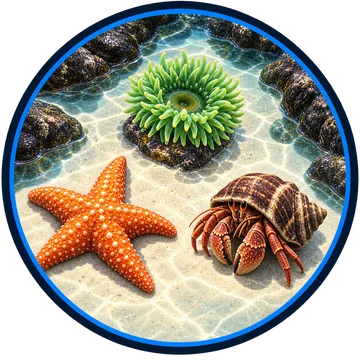
The animal is large for an anemone and it is built like a column. The body is a greenish-brown cylinder up to about 12 inches tall and 7 inches across, topped by a crown of tentacles that can spread nearly 10 inches. The tentacles are green, bluish or white, and the oral disk in the middle, which is the mouth surrounded by those tentacles, runs green, bluish-green or gray.
The green is the interesting part, because it is not fixed. Anemones living in direct sunlight are bright green. Anemones in caves and shaded areas are pale. The same species, sometimes on the same stretch of rock, is a different color depending on how much light falls on it.
Deep Dive
The reason for the color is that the anemone is not living alone. Photosynthetic algae live inside its tissue, in the outer layer of the body and in the lining of the gut, and they make sugars from sunlight and pass some of that food to their host. There are 2 kinds involved: a green alga and a dinoflagellate, which is a different single-celled organism that plays the same role in reef-building corals. The green alga in this partnership was formally described as its own species in 2009, in work covering this anemone and its smaller relative on the same coast.
That arrangement explains the color, and the explanation runs the opposite way from the obvious guess. The green pigment is not the algae showing through. The pigment belongs to the anemone, and the accepted reading, hedged as the agency source hedges it, is that it works as a sunscreen for the algae inside, blocking light strong enough to damage them. In dim conditions the anemone makes little or none of it, so more light gets through to the tenants that need it. An anemone in a shaded cave is pale because it has stopped shading its lodgers.
It is not a plant, though, and the diet says so plainly. The list is mussels, sea urchins, small fish and crabs, taken by a sessile animal that cannot chase anything, in the surge zone where waves knock things loose. The agency source lists 4 feeding modes for the species at once: omnivore, photosynthetic, scavenger and suspension feeder. Very few animals on this site earn all 4. The algae are a subsidy, not a living.
The number worth carrying away is the age. A giant green anemone can live more than 80 years. The species grows slowly, recruits new individuals unevenly and in low numbers, and holds highly stable adult populations, which together describe an animal that establishes itself once and then stays. The anemone in a particular tidepool is quite possibly older than the person looking at it, and it has been in that same spot the entire time, because it cannot go anywhere else.
Reproduction happens in open water. In late spring and summer the anemones release sperm and brownish eggs into the surge, and the larvae that result drift as plankton and feed while they drift rather than living off a yolk supply. Most of them die. A few land on bare rock in the right kind of place and begin an 80-year occupancy.
This entry, along with the 2 sea fans and the strawberry anemone written the same day, exists because the Ichthyopedia had reached 139 species without a single cnidarian in it. Cnidarians are the group holding corals, anemones, jellyfish and hydroids, all built on one body plan of a soft sac ringed with stinging tentacles, and on this coast they cover the rock. Starting the group with this species is the obvious choice, because it is the one a reader has almost certainly already met.
Where to Find Them
Researched habitat and range candidates
Santa Barbara · 1 beach
San Luis Obispo · 22 beaches
Monterey · 17 beaches
Oregon South Coast · 15 beaches
Oregon Central Coast · 8 beaches
Oregon North Coast · 8 beaches
South Sound · 12 beaches
Hood Canal · 9 beaches
Central Sound · 13 beaches
North Sound · 8 beaches
San Juan Islands · 8 beaches
Strait of Juan de Fuca · 5 beaches
Cape Flattery · 4 beaches
These locations have suitable habitat within the species range. An assignment is a possible encounter, not a confirmed sighting at every beach. Season, depth, and local conditions still matter. Historical habitat without present-day evidence is excluded.