
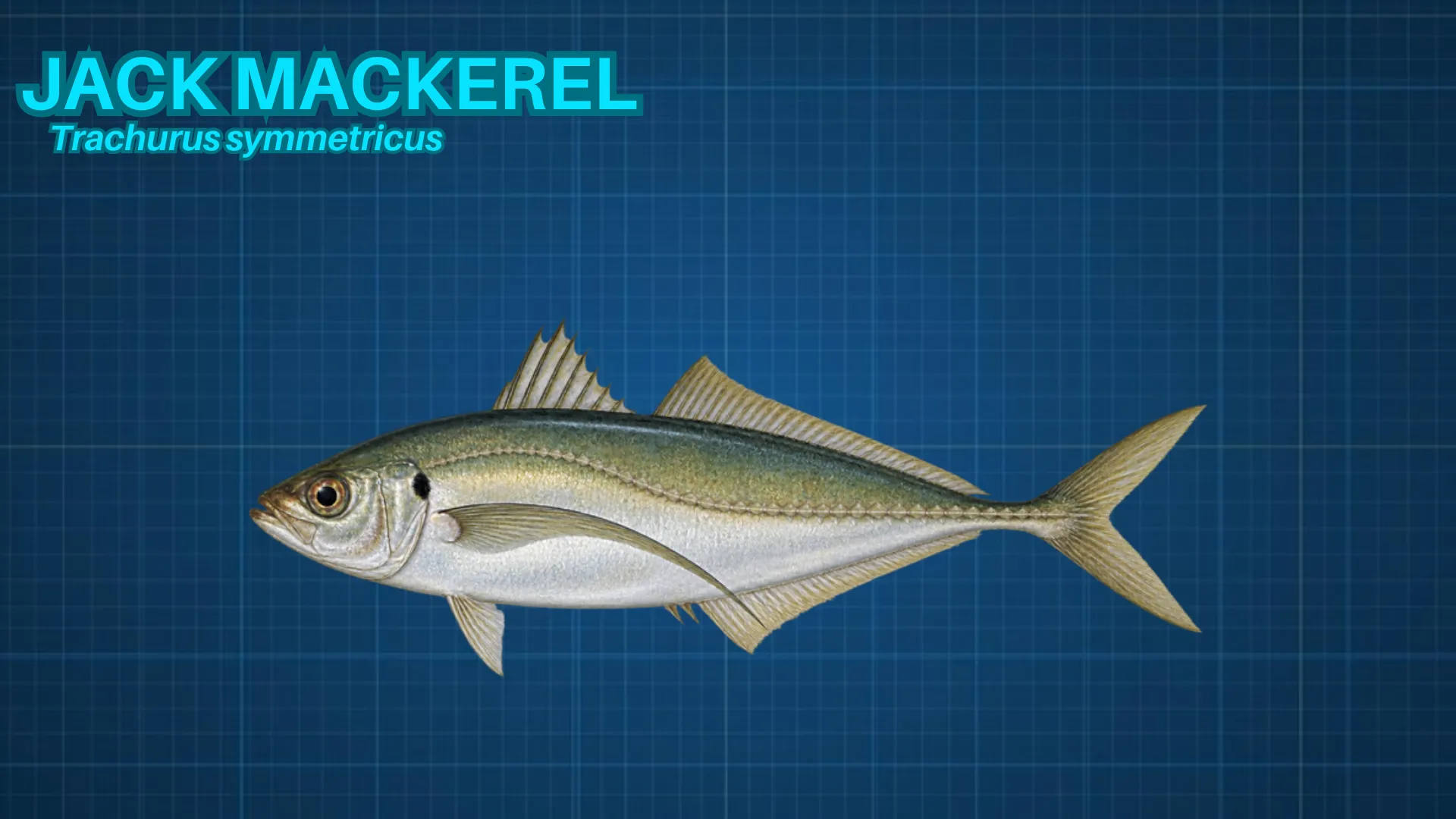
Also calledhorse mackerel, California horse mackerel, Spaniard, saurel, Pacific jack mackerel
 Spearfishing

Spearfishing Stats
Alaska to Baja California; young fish school over shallow reef in Southern California.
Taxonomy
Rarity
Abundance rates how many are in suitable habitat. Find difficulty rates how hard it is to locate one on a daylight snorkel or freedive through 50 ft. A higher find score means a harder search. The rarity category also reflects the kind of encounter; it is not an average of the 2 scores.
Regulations
CDFW rules verified 2026-10-13
Seasonality
Edibility
Small, oily fillets with a strong flavor.
Location
Jack mackerel live from southeastern Alaska to southern Baja California and into the Gulf of California. The 2001 report describes 2 different lives. Young fish, up to about 6 years old and 12 inches long, school over shallow rocky reefs, generally less than 200 feet deep, and along the rocky shorelines of the coast and islands from Southern California south. Large fish, 16 years and older and about 20 inches long, live offshore and farther north, as far as the Gulf of Alaska, and do not form the dense, shallow schools of the young. FishBase adds that the adults can be found as far as 500 miles from the coast, that young fish often school near kelp and under piers, and that large fish often move inshore and north in summer. Little is known about where fish between 6 and 15 years old live.
Ken Jones lists Ocean Beach, Oceanside, San Clemente, Balboa, Newport, Redondo Beach and Hermosa Beach among the best piers for them. Some years bring large schools to central coast piers from Avila to Santa Cruz, and he has had reports of big fish, 22 to 28 inches long, at Crescent City in late August and September.
Spearfishing Brief
The jack mackerel rates a 3 overall, and the shot sets it.
Finding them rates a 2. The young fish school over shallow rocky reef and along rocky shores in Southern California, the same water divers work, and Ken Jones notes that they often travel with Pacific mackerel and sardines. A school is hard to miss once it shows up.
The shot rates a 3. A jack mackerel is small and fast, and it moves in a school that turns together. A pole spear or a short speargun suits a fish this size. No spearfishing account for this species turned up in the research for this page, so the weapon note is reasoned from the fish's size and habits rather than taken from a published one.
California sets no bag limit, no size limit and no closed season. Because jack mackerel counts as a pelagic finfish, some marine protected areas that ban most other take still allow it. Take is prohibited in state marine reserves, and north of Ventura County spears may not be used within 100 yards of a stream mouth. Oregon counts all jacks toward a limit of 25 offshore pelagic fish in aggregate and allows spears.
On the table, Ken Jones rates it only fair: a strong flavor, small flakes, a firm texture and an oily, off-white flesh best broiled or baked. Small ones also make bait: Ken Jones notes that small jack mackerel are a favorite bait for white seabass and yellowtail.
Deep Dive
The jack mackerel is not a true mackerel. The 2001 report explains that it belongs to the jack family, Carangidae. It was once called the horse mackerel, and in 1947 the U.S. Food and Drug Administration approved the name change to jack mackerel to make the canned fish sound more appealing to shoppers.
It is slim, with the second dorsal fin and the anal fin both running almost to the tail. The best mark is the lateral line, the row of sensory pores along the side. On a jack mackerel it is covered by a ridge of hard, bony scales, called scutes, that runs almost the whole length of the fish. Ken Jones describes the color as iridescent green above, sometimes bluish and often mottled, with a silvery belly, and Mexican Fish adds a black spot on the upper edge of the gill cover. Mexican Fish warns that it is easily confused with the mackerel scads, which have weaker scutes and a less sharply arched lateral line.
It grows to about 32 inches, and FishBase gives a maximum age of 30 years. Ken Jones reports that the California record weighed 5 pounds 8 ounces, caught at the Huntington Beach Pier in 1988. Most caught from piers are under 14 inches.
Jack mackerel spawn many times a year. The 2001 report describes females spawning about every 5 days, around 25 times a year, beginning at about their first birthday. The eggs float free for 3 to 5 days before hatching. Young fish eat copepods, pteropods and krill, and at times feed almost only on young squid and anchovies.
Large fish such as tunas and billfishes prey on them, and a study of the diet of California sea lions in the northern Channel Islands from 1981 to 1995 found jack mackerel to be the fourth most frequent food.
Where to Find Them
Researched habitat and range candidates
San Diego · 13 beaches
Orange County · 10 beaches
Catalina Island · 14 beaches
Los Angeles · 10 beaches
Channel Islands · 24 beaches
Ventura · 15 beaches
Santa Barbara · 10 beaches
San Luis Obispo · 25 beaches
Monterey · 17 beaches
Oregon South Coast · 15 beaches
Oregon Central Coast · 8 beaches
Oregon North Coast · 8 beaches
South Sound · 12 beaches
Hood Canal · 9 beaches
Central Sound · 13 beaches
North Sound · 8 beaches
San Juan Islands · 8 beaches
Strait of Juan de Fuca · 5 beaches
Cape Flattery · 4 beaches
These locations have suitable habitat within the species range. An assignment is a possible encounter, not a confirmed sighting at every beach. Season, depth, and local conditions still matter. Historical habitat without present-day evidence is excluded.