
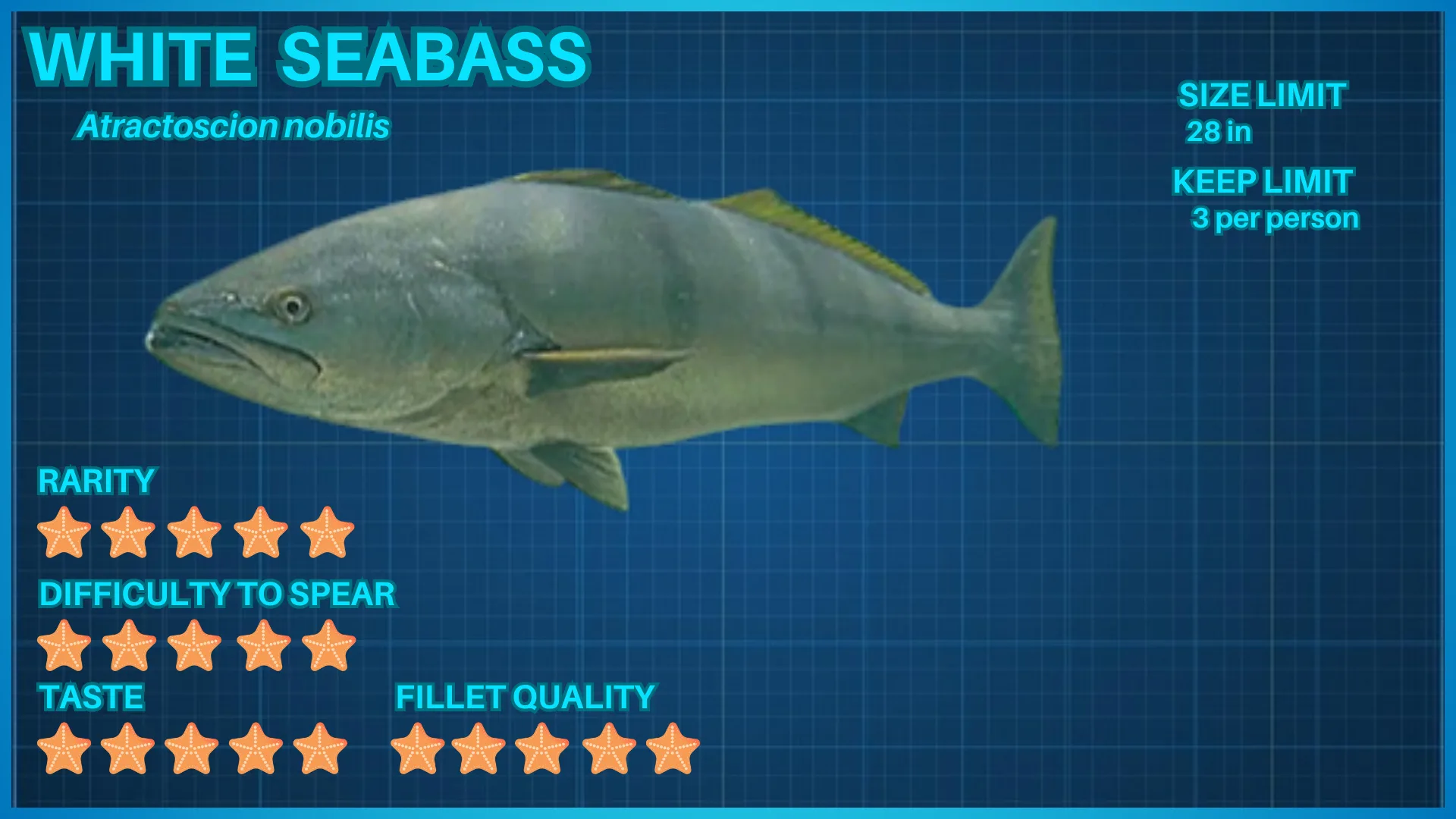
Also calledghost, grey ghost, Catalina salmon, king croaker, weakfish
 Spearfishing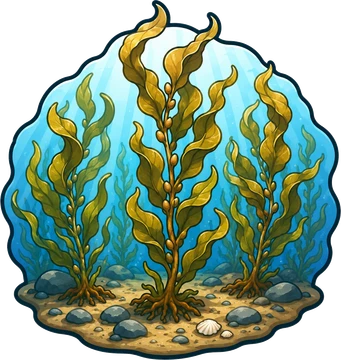




Spearfishing photos - viewer discretion advised
Spearfishing Stats
Southern California kelp edges and coastal banks
Taxonomy
Rarity
Abundance rates how many are in suitable habitat. Find difficulty rates how hard it is to locate one on a daylight snorkel or freedive through 50 ft. A higher find score means a harder search. The rarity category also reflects the kind of encounter; it is not an average of the 2 scores.
Regulations
CDFW rules verified 2026-07-06
Seasonality
Seasonal availability
Spring and summer.
Active season: abundance 2 / 5, find difficulty 5 / 5, legendary.
Adults use shallower water in spring and summer and tend to move deeper in autumn and winter. Active-season abundance remains 2/5 and find difficulty 5/5; winter shallow abundance is provisionally 1/5. Some fish remain, and no fixed arrival or departure month is established.
Edibility
Very firm, in thick flakes, with a minimal bloodline.
Location
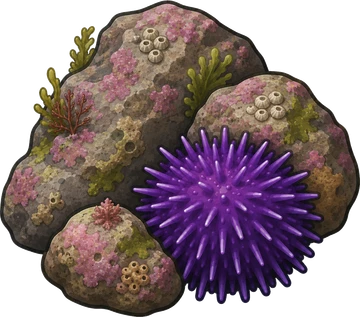
White seabass live along the eastern Pacific coast, from Baja California in Mexico north to central California. A few stray as far as Alaska in warm-water years. The center of the population is off central Baja California. They are schooling fish that live near the bottom, over rocky ground and in kelp forest biomes, from the surface down to about 400 feet. They also range into the open water of the pelagic biome beyond the kelp line. They move north along the coast as the water warms through summer. Adults roam widely, and hatchery fish have turned up more than 80 miles from where they were released. Young fish live apart from the adults, growing up inshore in bays, estuaries, and the shallows along sandy beaches before they join the adults at the kelp line. Through spring and summer, the fish gather into temporary spawning groups across Southern California and northern Baja California. In the kelp forests, those groups can build to as many as 9 males circling a single female.
Spearfishing Brief
The white seabass is the classic wary, open-water target, and both halves of the hunt are hard for the same reason: the fish senses a diver before the diver senses the fish. Finding one is the first problem. They are thinly spread. They prefer water in the upper 50s and low 60s Fahrenheit, and they follow the market squid they feed on. A whole dive can pass over a good kelp bed without a single fish appearing. When one does show, it appears at the edge of visibility and is gone within seconds. That is the second problem. White seabass belong to the croaker family, which has unusually sharp hearing, and they also have a sensitive lateral line, the row of sensory pores along the side that senses water movement. A clumsy breath, a bumped weight belt, or a rattled piece of kelp warns the fish, and it flees before the diver can raise the gun. Finding one rates a 5. The fish is not buried or camouflaged the way a halibut is, but it is thinly spread and it senses the diver first, so a diver in the right location on the right structure can still go dive after dive without a look. The shot is no easier, and it rates a 5. A white seabass holds at the far edge of range, and the diver gets a single short window to place the shot before it turns. A chance that good comes rarely, and a hit fish that reaches the kelp and ties up can still be lost. That is about as hard as taking a fish gets, and it sets the overall difficulty at a 5.
Most Southern California divers cover ground rather than sit and wait. The common method is a working search of the kelp. A diver drops 10 to 20 feet, takes hold of the kelp, scans in every direction, then swims on another 10 to 20 feet and looks again. The search stays along the outside edges of a dense bed rather than pushing into the middle, where a bumped frond inside shooting range gives the diver away. Depth follows the season and the thermocline, the boundary where the warm surface water meets the colder water below. Early in the year the fish sit high, from the surface down to about 20 feet, and several experienced hunters report most of their shots inside that top 20 feet. Later in the season the fish hold deeper, closer to 25 to 40 feet. Waiting on a kelp edge with a clear lane into open water is one tool among several rather than the whole method. Sinking below a cruising fish and looking up for its outline works better than dropping on it from above, because white seabass share the kelp with sea lions and read an attack from overhead. Slack tide and the up-current side of the bed are the usual starting points. During the spring spawn, the fish give themselves away by sound. Spawning males make a deep, regular grunting that grows louder toward the bottom, and a croak strong enough to feel in the chest. Divers listen for it, and some also imitate the low croak to try to draw a fish into range. The sound means a diver is closing in on the fish. Far more often, it still leads to nothing.
The right weapon depends on the distance and the size of the fish. A short speargun is the wrong tool here, because the shot comes at long range across open water, and the fish is covered in thick, tough scales that a light spear will not punch through. The community consensus is a long-range speargun, a 90 to 110 centimeter model or larger, with 2 or 3 rubber bands and a heavy 7 millimeter shaft. Many divers add a slip-tip, a detachable point that toggles sideways inside the fish so it cannot tear free. A float and a long float line matter as much as the gun. A hit fish runs hard and drives for the kelp, and a white seabass can top 60 pounds, so most hunters aim for the head or the shoulder just behind the gill plate to shorten the fight. Experienced divers let a running fish go rather than trying to haul it in, since a big one usually tires within 20 to 40 seconds.
Deep Dive
The white seabass is not a true bass at all. It is the largest croaker on the west coast, a member of the drum family, and its relatives are better known for the sounds they make than for the size they reach. It lives in the kelp forest and the open water beside it. This chrome-sided predator hunts anchovies, sardines, herring, and market squid, the same small prey that feeds much of the nearshore California food web. The smallest ones start life on an almost pure diet of tiny mysid shrimp before moving up to fish and squid. Pacific mackerel are part of the adult diet as well. The species grows slowly and lives long, reaching about 20 years of age at the outside and a maximum of roughly 5 feet and 90 pounds. The average adult is nearer 3 feet and 20 pounds.
The most studied part of its biology is its voice. Like all drums and croakers, the white seabass makes sound with special fast muscles that it contracts against its swim bladder, the gas-filled organ a fish uses to control its depth. A study of spawning fish in net pens in Catalina Harbor recorded 5 distinct sounds. They ranged from single and repeated pulse trains during courtship, to drumrolls and thuds during spawning, to deep booms during fast bursts of swimming. Most of it was pitched low, around 70 to 80 hertz. This is not idle noise. These sounds, alongside visual and tactile cues, signal a fish's readiness to spawn, and researchers think they help draw the group together and hold it there. That is how their spawning works. From spring into late summer, when the water reaches about 64 degrees Fahrenheit, the fish gather and chorus. A ready female develops dark bars along her sides and slows down while several males compete for position around her. They spawn by releasing their eggs and sperm into open water at night, which lets fewer of the eggs get eaten. A white seabass also lays the largest eggs of any west-coast croaker, about 1.3 millimeters across. A single female may spawn 5 or 6 times in a season.
That way of reproducing, tied to predictable spawning groups in easy-to-reach kelp forests, is also what made the fish easy to overfish. The California fishery declined through the middle and late 20th century. Overfishing, pollution, and lost habitat all played a part, alongside natural ocean conditions. The response was one of the more ambitious recovery efforts on the coast. The Ocean Resources Enhancement and Hatchery Program, run through the Hubbs-SeaWorld Research Institute, was established by state legislation in the early 1980s and released its first hatchery-raised white seabass into Mission Bay, San Diego, in 1986. Biomass did climb from the 1970s low to a peak in the mid 2000s. It has fallen since. The first modern stock assessment, in 2016, estimated an ongoing 9-year decline in spawning biomass, down to 27 percent of the level expected with no fishing at all. The minimum size limit was set to 28 inches on a maturity study from 1930 that examined 8 females, a rationale the 2016 assessment called outdated. Newer and larger sampling puts female maturity closer to 34 inches, which means a share of the fish taken legally have never spawned. Those rules also brought a reduced bag limit in the region south of Point Conception, Santa Barbara.
Documented predators of the white seabass include great white sharks and California sea lions. People take far more than any predator does, by rod and reel and by spear. On the plate, it is worth the effort. The meat is low in fat, firm, mild, and pale, and it breaks into thick, large flakes that hold up to grilling, searing, baking, and broiling. That is the reason the gray ghost sits near the top of nearly every California spearfisher's list.
Where to Find Them
Researched habitat and range candidates
San Diego · 21 beaches
Orange County · 15 beaches
Catalina Island · 14 beaches
Los Angeles · 17 beaches
Channel Islands · 24 beaches
Ventura · 24 beaches
Santa Barbara · 20 beaches
San Luis Obispo · 30 beaches
Monterey · 18 beaches
Oregon South Coast · 15 beaches
Oregon Central Coast · 8 beaches
Oregon North Coast · 8 beaches
South Sound · 12 beaches
Hood Canal · 12 beaches
Central Sound · 13 beaches
North Sound · 8 beaches
San Juan Islands · 8 beaches
Strait of Juan de Fuca · 5 beaches
Cape Flattery · 4 beaches
These locations have suitable habitat within the species range. An assignment is a possible encounter, not a confirmed sighting at every beach. Season, depth, and local conditions still matter. Historical habitat without present-day evidence is excluded.