



Taxonomy
Rarity
Abundance rates how many are in suitable habitat. Find difficulty rates how hard it is to locate one on a daylight snorkel or freedive through 50 ft. A higher find score means a harder search. The rarity category also reflects the kind of encounter; it is not an average of the 2 scores.
Seasonality
Location
Bat stars live along the eastern Pacific from Sitka, Alaska, south to Baja California. They range from the low intertidal to about 950 feet, on rock, on sand bottom, and among surfgrass. The ones in tidepools are usually small, 1 to 3 inches across, and they are often found on the undersides of rocks or on sand.
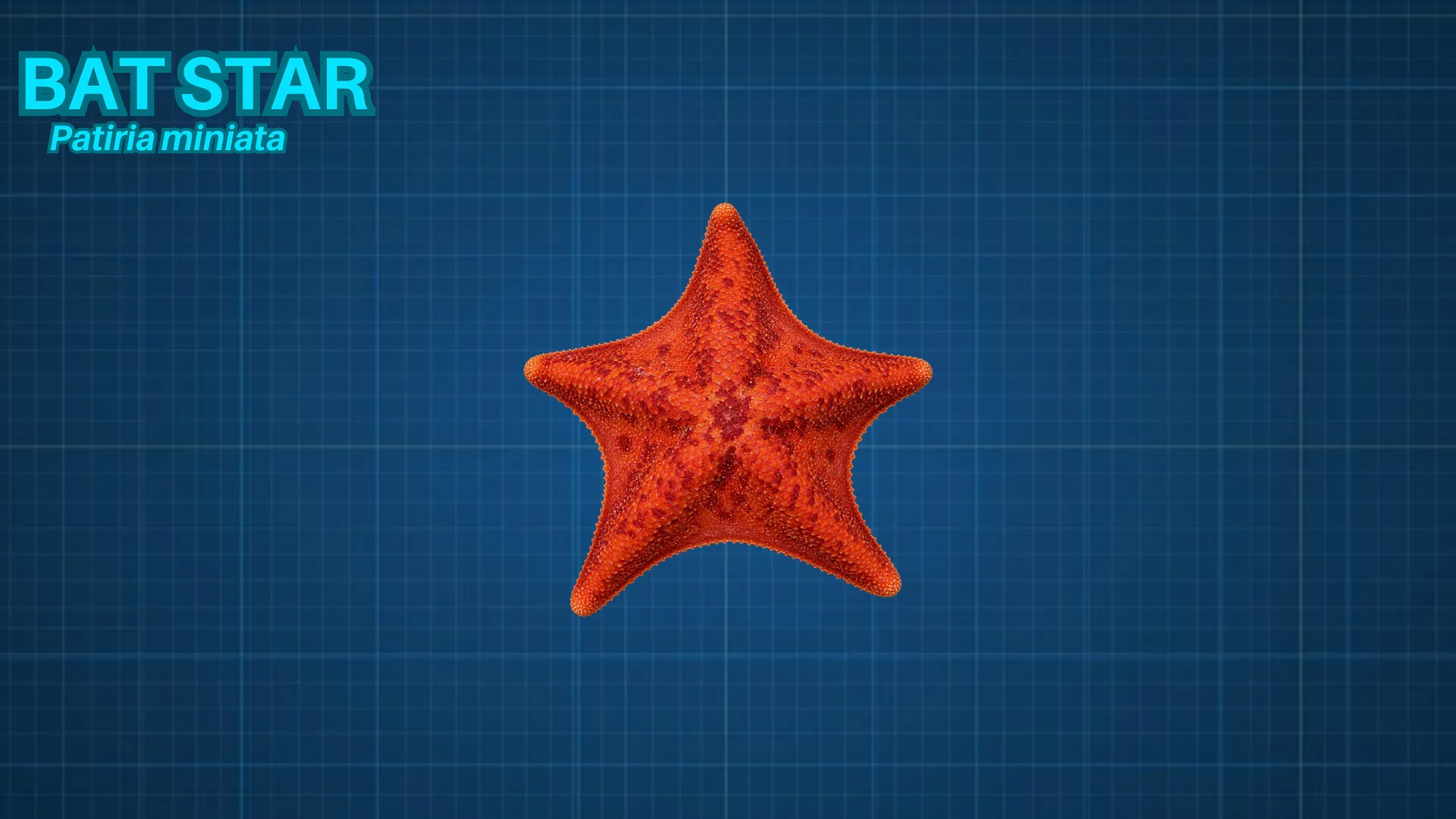
The bat star is easy to tell apart from other sea stars. Its short, triangular arms are joined by webbing. Most bat stars have 5 arms, though 4 to 9 occur, and a large one reaches about 8 inches across. Its color varies widely: red, orange, yellow, brown, green, or purple, either solid or mottled.
Deep Dive
The bat star eats almost anything, living or dead, plant or animal. Like other sea stars, it feeds by pushing its stomach out through its mouth. The stomach wraps over the food, releases digestive enzymes that break it down, and is then pulled back inside to finish digestion. On rock, a bat star presses its stomach flat against the surface to digest the thin growth of algae there. Several bat stars will cover the carcass of a dead fish and eat it together in what Animal Diversity Web, the University of Michigan's species database, calls a slow-motion feeding frenzy. Its scavenging and grazing help clear dead animals and algae from the seafloor.
A small bristle worm lives on some bat stars, in the grooves under the arms, and a single bat star can host as many as 20 of them.
Bat stars reproduce by spawning. Males and females release sperm and eggs from pores near the base of each arm into the water, where fertilization happens. The breeding season is unusually long. Spawning happens throughout the year, and most of it takes place in late winter and spring.
Where to Find Them
Researched habitat and range candidates
San Diego · 15 beaches
Orange County · 10 beaches
Catalina Island · 13 beaches
Los Angeles · 10 beaches
Channel Islands · 24 beaches
Ventura · 17 beaches
Santa Barbara · 10 beaches
San Luis Obispo · 22 beaches
Monterey · 18 beaches
Oregon South Coast · 15 beaches
Oregon Central Coast · 8 beaches
Oregon North Coast · 8 beaches
South Sound · 12 beaches
Hood Canal · 11 beaches
Central Sound · 13 beaches
North Sound · 8 beaches
San Juan Islands · 8 beaches
Strait of Juan de Fuca · 5 beaches
Cape Flattery · 4 beaches
These locations have suitable habitat within the species range. An assignment is a possible encounter, not a confirmed sighting at every beach. Season, depth, and local conditions still matter. Historical habitat without present-day evidence is excluded.