


Taxonomy
Rarity
Abundance rates how many are in suitable habitat. Find difficulty rates how hard it is to locate one on a daylight snorkel or freedive through 50 ft. A higher find score means a harder search. The rarity category also reflects the kind of encounter; it is not an average of the 2 scores.
Seasonality
Location
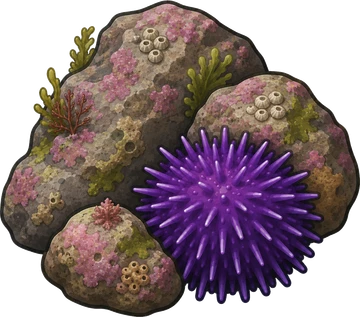
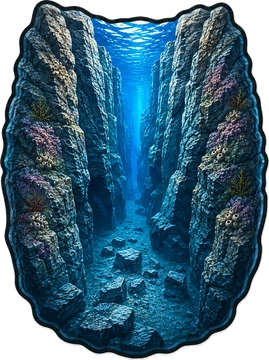
The red gorgonian holds on dimly lit coastal rock in moderate water flow. The habitats named for it are unusually varied for a fixed animal: exposed rocky shore, bays, the continental shelf, submarine canyons, and occasionally the reef inside kelp forests. Depth runs from about 16 feet down to roughly 758 feet, which is a range no other cnidarian on this site comes close to.
The pattern inside that range is worth understanding. Colonies sit shallow in Southern California and deep in central California. The agency description ties the species to dim light rather than to any particular depth, and the water off Southern California carries more in it, so the same light level arrives higher in the water column here than it does up the coast in clearer water. That reading is an inference from the description rather than something the source states, but it fits what the numbers do.
Identification against the golden gorgonian takes 1 look and it is not close. The golden gorgonian is thick-branched and lies entirely in a single plane, a flat fan. The red gorgonian is bushy and lanky, with thin flexible branches about 2 millimeters across, splitting in irregular Y shapes and spreading in every direction, so it reads as a candelabra rather than a fan. The colony is orange-red to salmon pink, and the polyps that stud the branches are white and stick out all the way around them rather than facing 1 way. Colonies reach about 36 inches, though most are under 24.
Deep Dive
The most important thing about this animal is something it does not have. Reef-building corals in the tropics carry zooxanthellae, symbiotic algae living inside their tissue that photosynthesize and feed the coral from the inside. That partnership is the reason tropical reefs need bright, clear, shallow water: the coral is farming, and the farm needs light. The red gorgonian has no zooxanthellae at all, and the agency description says so directly, listing it as what distinguishes the species from true corals.
Everything else about the animal follows from that. A gorgonian with no algae is not farming, so it has no reason to want light, and its entire income comes from catching plankton with hundreds to thousands of polyps. That is why this species can live in dim water, inside submarine canyons, and down to 758 feet, where a tropical coral would starve. The candelabra shape is the tool for it. Branches spreading in 3 dimensions with polyps facing every direction will catch food arriving from any angle, which is the right design when the current is moderate and its direction is not reliable. Compare the golden gorgonian, which builds a flat fan and aims it across a prevailing current. Two animals in the same order, on the same reef, solving the same problem 2 different ways.
This entry has more blank space than most on the site, and the blanks are honest. The agency database that supplies everything above records no reproduction, no growth rate and no maximum age for this species, and nothing else consulted filled them in. For an animal this conspicuous on the California coast, that is a surprising amount of not knowing, and it is a fair illustration of how much less attention invertebrates get than fish. The golden gorgonian at least has a spawning temperature on record. This one has nothing.
Predators are recorded only as a group. Nudibranchs eat it, which is unsurprising, because sea slugs specialize in feeding on cnidarians and several of them go further and store the stinging cells of their prey in their own bodies for defense. No source consulted named which nudibranch species feed on this gorgonian, so this page will not point at any particular one, including the Spanish shawl on this same site.
Fixed animals like this one carry a consequence that is easy to miss underwater. A colony cannot move, cannot flee and cannot regrow quickly, and the thin flexible branches that make it good at catching food also make it easy to break. Anything that snaps a branch off removes years of growth that no source has quantified, from a colony that may have been standing there since well before the diver arrived.
Where to Find Them
Researched habitat and range candidates
San Diego · 13 beaches
Orange County · 10 beaches
Catalina Island · 14 beaches
Los Angeles · 10 beaches
Channel Islands · 24 beaches
Ventura · 15 beaches
Santa Barbara · 10 beaches
San Luis Obispo · 25 beaches
Monterey · 17 beaches
These locations have suitable habitat within the species range. An assignment is a possible encounter, not a confirmed sighting at every beach. Season, depth, and local conditions still matter. Historical habitat without present-day evidence is excluded.