

Also calledpurple-hinged rock scallop

Taxonomy
Rarity
Abundance rates how many are in suitable habitat. Find difficulty rates how hard it is to locate one on a daylight snorkel or freedive through 50 ft. A higher find score means a harder search. The rarity category also reflects the kind of encounter; it is not an average of the 2 scores.
Regulations
CDFW rules verified 2026-08-28
Seasonality
Edibility
The hardest hand harvest on this site, and the difficulty is a timing problem rather than a strength problem. The blade has to go between the shells before the animal closes them, then cut the adductor flush against the underside of the top shell. Scraping the shell recovers the most meat; a cut taken short leaves a third of it behind.
One large, firm, clean muscle with nothing to trim, no bones and no bloodline, though a whole animal yields exactly 1 of them.
Location
Rock scallops live from Sitka in southeast Alaska south to Magdalena Bay in Baja California, cemented to rock the entire length of that range. They want moving water. The animals settle on wave-swept rock, reef walls, crevices, undercut ledges and offshore structure including oil platforms, and they are largely absent from bays where freshwater dilutes the salinity. Laboratory work at California Sea Grant found the larvae survived better in vigorously mixed water than in calm tanks, which lines up with where the adults end up: the exposed outer coast rather than the sheltered inside. Most are between 10 and 150 feet down, with the occasional animal in the intertidal.
The attachment is permanent and it happens early. At about 5 weeks old, when the scallop is between half an inch and an inch across, it forces cement-like shell material into the crevices and irregularities of a rock and fixes itself there for the rest of its life. Before that it swims, clapping its shells together and expelling water the way a free-living scallop does, and after that it never moves again.
Adults commonly run 5 to 6 inches across. An 8-inch animal is a trophy. The California record, set in 1972, measured over 11 inches, and in colder water the species reaches around 9 inches and weights reported as high as 20 pounds, though that upper figure comes from aggregated sources rather than an agency page. Feeding is passive: the scallop filters microscopic phytoplankton, particularly dinoflagellates, along with bits of dead organic matter drifting past. Southern California populations spawn twice a year and some northern populations only once.
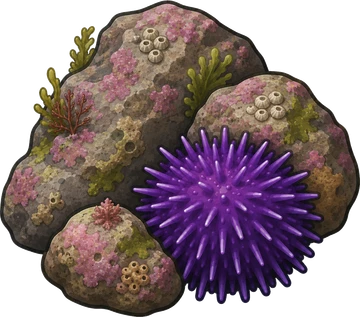
Finding one is a matter of knowing what is not camouflage. Because the animal never moves, its upper shell becomes real estate. Sponges, anemones, limpets, barnacles and algae all colonize it, until CDFW describes the result as a miniature ecosystem growing on the scallop's back. From above it is a lump of reef. The one thing that gives it away is the mantle at the shell gape, a strip of orange, green or purple that CDFW compares to a brightly painted pair of lips fringed with whiskery tentacles. That strip is the whole search image.
Harvest Brief
West Coast current-swept shallow rock, walls and pilings
The take is by hand, dive knife or abalone iron, and California names those tools specifically for this species. There is no spear, no pry bar leverage, and no advantage in strength. Everything about the harvest is a timing problem.
The sequence CDFW itself publishes is short. Slide a butter knife or a similar blade between the shells of a scallop that has not noticed the diver yet, which stops it from closing. Then work the blade toward the underside of the top shell and cut the adductor muscle as close to that shell as possible, scraping the shell to recover the most meat. Do it wrong and there are 2 failure modes, both common. Reach in slowly and the animal shuts, at which point the shells are clamped and a knife will not open them without wrecking the meat. Cut too far from the shell and a third of the muscle stays behind on the top valve.
Finding one rates a 4 on the anchored scale, and it belongs there. The animal is immobile, overgrown, and reduced to a strip of colored mantle in a reef made of colored things. A diver who has not yet built the search image can swim a productive wall and see nothing at all, then find 4 in a minute once the eye adjusts. Cleaning rates a 3, which makes this the fussiest hand harvest on the site so far, above lobster and above urchin.
The rules are open and worth knowing exactly. The daily bag and possession limit is 10 rock scallops, a species-specific limit rather than the 35 that covers invertebrates without one. There is no size limit, and the season is open year-round. Take of all invertebrates is prohibited inside state marine reserves, with further restrictions in state marine parks and conservation areas. The rule most worth carrying is the one about air: in all ocean waters north of Yankee Point in Monterey County, SCUBA may be used to take only sea urchins, rock scallops, and crabs of the genus Cancer. Rock scallop is 1 of those 3. Snorkels are not SCUBA under that section, so freediving is unaffected anywhere. Oregon and Washington rules for this species were not researched and nothing here should be read as covering them.
Deep Dive
Almost every scallop in the world can swim. Clapping the shells together and jetting water is the family's signature move, and it is why a scallop has dozens of small eyes ringing the mantle: an animal that can flee benefits from seeing what is coming. The rock scallop swims too, for about 5 weeks. Then it lies down on a rock, glues one shell to the stone, and gives that up permanently.
That trade is the key to the whole animal. Giving up movement buys a fixed position in current, which for a filter feeder is the only thing that matters, and the species chose the roughest water on the coast to do it in. Everything else follows. The shell thickens and distorts to match the rock it is welded to, so no 2 look alike. The exposed valve becomes a surface for other animals to live on, which is camouflage the scallop did not have to grow itself. The eyes stay, watching from the gape, which is why the animal senses an approaching hand and closes, and why the harvest is a race rather than a struggle.
It also explains why the population behaves the way it does under pressure. A fish that gets shot off a reef is replaced by another fish swimming in. A rock scallop taken off a wall is replaced only when a larva happens to settle there and survive, and Sea Grant's finding that wild spawning is inconsistent and patchy means that does not reliably happen. Add a 25-year lifespan and 2 and a half years to reach 5 inches, and a productive wall is a slow-growing account that a single boatload of divers can draw down in an afternoon.
The meat is the other half of the story, and it is the reason any of this pressure exists. The edible part is the adductor muscle, the same muscle the animal uses to hold its shell shut, and in a species this large it comes out roughly twice the size of a market scallop: firm, marshmallow shaped, cream to pale orange. Sea Grant calls the flavor outstanding, and the small quantities that reach west coast farmers markets and restaurants sell easily. Researchers have been working on the aquaculture problem for exactly that reason, and had a breakthrough with vigorous aeration and reduced feeding that improved larval survival enough to make farming look plausible.
Which is the useful way to think about the 10-scallop limit. It is generous for an animal this slow, and the honest reading of both agency sources is that the rules have not yet caught up with the pressure. A diver who takes 3 large ones and leaves the rest is not being sentimental, and CDFW is on record recommending something close to it.
Where to Find Them
Researched habitat and range candidates
San Diego · 13 beaches
Orange County · 10 beaches
Catalina Island · 14 beaches
Los Angeles · 10 beaches
Channel Islands · 24 beaches
Ventura · 15 beaches
Santa Barbara · 10 beaches
San Luis Obispo · 25 beaches
Monterey · 17 beaches
Oregon South Coast · 15 beaches
Oregon Central Coast · 8 beaches
Oregon North Coast · 8 beaches
South Sound · 12 beaches
Hood Canal · 10 beaches
Central Sound · 13 beaches
North Sound · 8 beaches
San Juan Islands · 8 beaches
Strait of Juan de Fuca · 5 beaches
Cape Flattery · 4 beaches
These locations have suitable habitat within the species range. An assignment is a possible encounter, not a confirmed sighting at every beach. Season, depth, and local conditions still matter. Historical habitat without present-day evidence is excluded.