
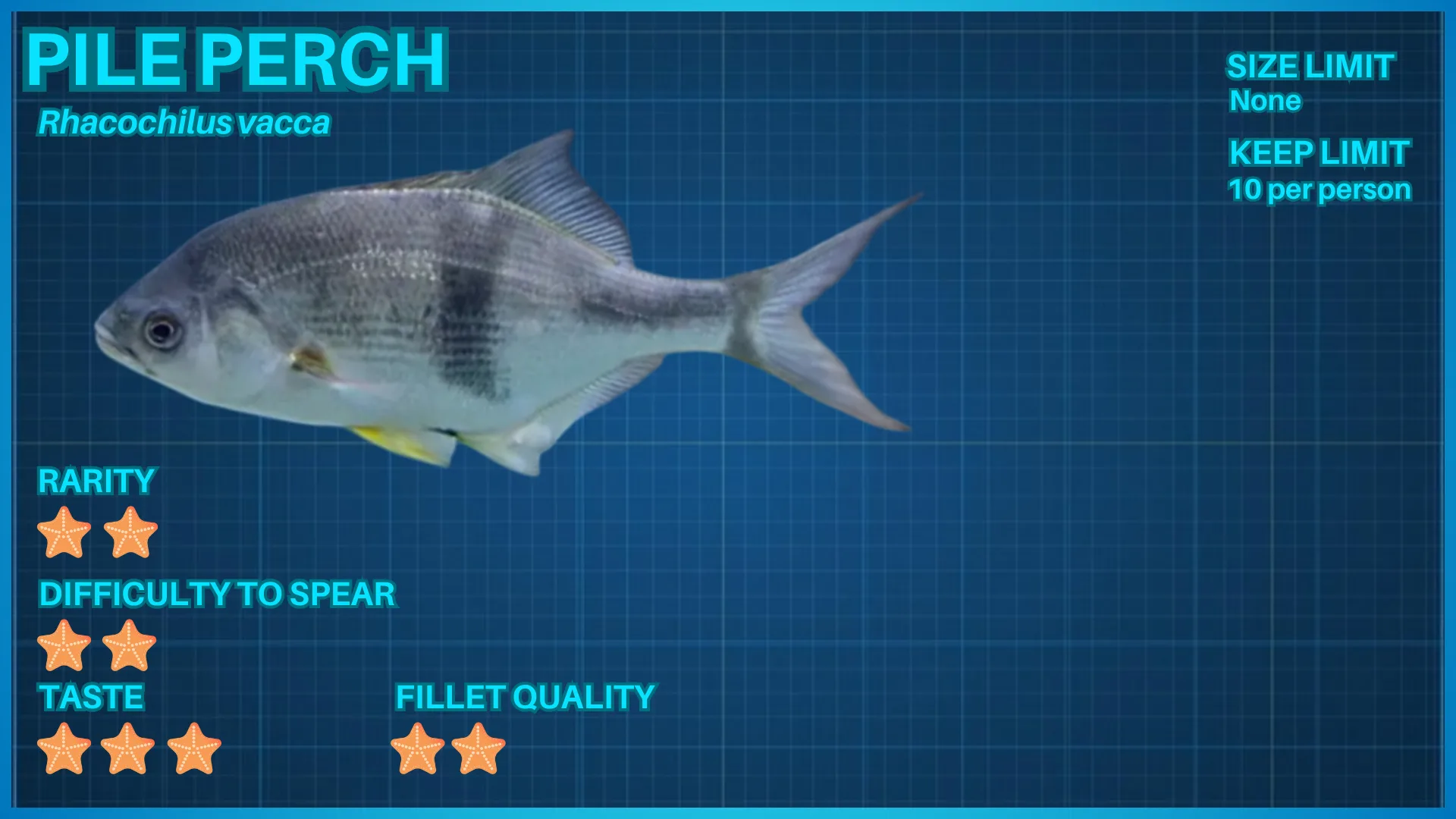
Also calledsplittail perch, forktail perch, dusky perch, piler perch, porgy
 Spearfishing


Spearfishing Stats
Pacific Northwest protected rocky shores, pilings and kelp
Taxonomy
Rarity
Abundance rates how many are in suitable habitat. Find difficulty rates how hard it is to locate one on a daylight snorkel or freedive through 50 ft. A higher find score means a harder search. The rarity category also reflects the kind of encounter; it is not an average of the 2 scores.
Regulations
CDFW rules verified 2026-07-16
Seasonality
Edibility
Thin fillets, a lot of small bones, and soft flesh.
Location
Pile perch live along rocky shorelines from Wrangell, southeastern Alaska, south to Guadalupe Island off north-central Baja California, Mexico, and are most abundant in the central and northern portions of that range. They hold on rocky reef, along the outer edges of kelp beds, over sandy bottom next to structure, around pier pilings and dock structures, and inside protected bays and estuaries. Adults are most often seen from the intertidal down to about 150 feet, and have been recorded as deep as 240 feet. Solid bottom structure matters more to them than any single habitat type, and the species is one of the few surfperch that regularly moves between rocky reef, kelp, and bay pilings.
Adults travel in schools of 50 to 100 fish. In warmer months they hold in deeper water, and when nearshore water temperature drops below about 61 degrees Fahrenheit in winter and early spring, they move into shallower rocky reef and kelp habitat. That seasonal shift is the pattern a diver in Southern California can use, because it puts more of the population inside easy freediving depth in the same months when kelp is thickest along the mainland coast. The fish are daytime feeders that browse the bottom for hard-shelled invertebrates, and a school on a reef tends to work slowly along the structure rather than move across the open water column.
Spearfishing Brief
Locating pile perch is the part of the hunt that takes work in Southern California. Find difficulty rates a 2 on the 1 to 5 scale. They prefer cooler water than most Southern California reef targets. They are less common south of Point Conception than to the north. A diver is much more likely to run into other surfperch, sargo, and opaleye on a shallow rocky reef or in a kelp bed. When a school is found, however, it is unmistakable. The deep oval body, the very tall first soft rays of the dorsal fin, and the single dark bar across the mid-side make pile perch easy to identify from a distance. A school of 50 to 100 fish holding along the bottom or around pilings does not disappear behind a frond the way a calico bass will.
Once a school is located, the shot is not the challenge. Shot difficulty rates a 2. Pile perch are daytime bottom feeders that forage along rocky reef and kelp for hard-shelled invertebrates, not fast open-water fish that flush at range. A slow, controlled approach into the school gets a diver inside a few feet, and there is usually time to pick a fish out of the group before the school drifts on. Winter and early spring are the easiest time of year, when adults move into shallower water and hold there until temperatures rise again.
The weapon choice is simple. A standard shore-diving speargun, 40 to 50 inches with 2 rubber bands, covers the shot at close range, and a pole spear works in the shallowest water around kelp and pilings. No specialized rig is needed, and the same setup a diver carries for calico bass and sargo on the same reef works for pile perch. Pile perch are also, and more prominently, a rod-and-reel fish. They are caught at virtually every pier in California, with the largest catches at Bay Area piers, and the classic tackle is a light bottom rig with a small hook baited with fresh mussel, rock crab, or a pile worm.
Deep Dive
Pile perch belong to the surfperch family, a group of about 20 nearshore fishes on the west coast of North America that share one biological trait that sets them apart from most other reef fish. Surfperches are viviparous, which means the female carries fertilized eggs inside her body and gives birth to live young that are already fully developed and free-swimming. There is no egg-laying, no floating larval stage in the plankton, and no bare-bones hatchling that has to grow fins and pigment in the water column. A newborn pile perch swims off from its mother looking like a small version of an adult. Pile perch mate in the fall and early winter, roughly October through December, and the female gives birth in late spring through summer, roughly June through October, depending on latitude. Brood sizes range from about 7 to 80 young per female, with regional variation, and typical broods fall in the middle of that range. Males and females grow at about the same rate through age 4, after which females continue to grow larger than males. Pile perch live at least 10 years, with some reports as long as 13.
The most distinctive part of the biology is what pile perch eat and how they eat it. Adults feed almost entirely on hard-shelled invertebrates, and they crush the shells with fused throat teeth (pharyngeal teeth) that sit deep in the back of the mouth and grind together like paired millstones. The list of prey is long and heavy on shells: whole mussels, barnacles, crabs, brittle stars, sand dollars, bean clams, limpets, chitons, and small snails. A pile perch swallows an entire mussel, cracks it with the throat teeth, and passes the fragmented shell through the gut. In feeding experiments, mussels took 1 to 4 days to digest at cold water temperatures, and the shell fragments came through intact. To keep the fish's gut lining from being cut by the sharp fragments, a mucous coating envelops the crushed shell as it moves through. The setup is powerful enough that a pile perch can process prey that most other reef fish either avoid or attack in pieces.
Pile perch are among the largest surfperches. Maximum length is about 17 inches, maximum weight about 4 pounds, and the IGFA world record is 2 pounds 8 ounces, caught off Tiburon, in central California, in 2016. Most fish taken are smaller. Ken Jones's pier-fishing records for California put the average pier catch at 10 to 14 inches, and the state angling record, set at Morro Bay in San Luis Obispo County in 2020, stands at 2 pounds 7 ounces. Fish this size can be identified from a distance by a set of field marks that separate pile perch from every other surfperch in California waters. The body is deep and oval and compressed from side to side, with a body depth that runs 41 to 45 percent of the body length measured from the snout to the base of the tail fin. The first soft rays of the dorsal fin are exceptionally tall, roughly twice the height of the last dorsal spines, which gives the dorsal fin a peaked front lobe unlike any other surfperch. A single dusky vertical bar crosses the mid-side at about the high point of that soft dorsal, and the tail is deeply forked. Color is a dark brassy brown to silver-gray, silvering along the belly, often with yellow pelvic fins. A small dark spot sits behind the corner of the mouth. The combination of the deep body, the tall front lobe of the dorsal fin, and the mid-body bar identifies the species.
The species uses more than one habitat type in one lifetime, which is unusual in the surfperch family. Pile perch move between rocky reef, kelp beds, sandy bottom next to structure, pier pilings and dock structures, oil and gas platforms, and inside protected bays and estuaries with brackish water. The name comes from the pilings themselves. Documented predators include rockfishes, lingcod, and osprey, and pile perch are also taken at every stage by human anglers, most often from piers, docks, and rocky shore.
The scientific name has changed. The species was originally described by the American naturalist Charles Girard in 1855, was placed from 1952 onward in one genus alongside the rubberlip surfperch, and was moved into a different genus by a 2018 taxonomic revision by Longo, Bernardi, and Lea that reorganized the surfperch family. Older California field guides and several state and federal agency pages still use the older name. This entry lists the current accepted scientific name. Nothing about the biology or the field marks changed with the reorganization.
On the plate, pile perch is a fair-quality fish. The meat is white and small-flaked, the flavor is mild, and the texture is on the softer side, which is the recurring note across California angler sources. Ken Jones describes the flesh as mild with a soft texture and best outside the spawning season. Some California anglers group pile perch with the "silver-colored" surfperch as noticeably softer than striped or black perch, and a smaller share of the community rates it higher after a milk soak, breading, and a pan-fry. Grilled or fried whole after scoring is the other common preparation. For a diver in Southern California hunting a species that is not the top table fish on the reef, pile perch is a legitimate but middle-of-the-pack take, worth cleaning up when it comes home in the bag and not worth passing up other winter targets for.
Where to Find Them
Researched habitat and range candidates
San Diego · 13 beaches
Orange County · 10 beaches
Catalina Island · 14 beaches
Los Angeles · 10 beaches
Channel Islands · 24 beaches
Ventura · 15 beaches
Santa Barbara · 10 beaches
San Luis Obispo · 25 beaches
Monterey · 17 beaches
Oregon South Coast · 15 beaches
Oregon Central Coast · 8 beaches
Oregon North Coast · 8 beaches
South Sound · 12 beaches
Hood Canal · 10 beaches
Central Sound · 13 beaches
North Sound · 8 beaches
San Juan Islands · 8 beaches
Strait of Juan de Fuca · 5 beaches
Cape Flattery · 4 beaches
These locations have suitable habitat within the species range. An assignment is a possible encounter, not a confirmed sighting at every beach. Season, depth, and local conditions still matter. Historical habitat without present-day evidence is excluded.