


Taxonomy
Rarity
Abundance rates how many are in suitable habitat. Find difficulty rates how hard it is to locate one on a daylight snorkel or freedive through 50 ft. A higher find score means a harder search. The rarity category also reflects the kind of encounter; it is not an average of the 2 scores.
Seasonality
Location
The spotted ratfish ranges from southeastern Alaska south to Baja California and the northern Gulf of California, with records as far as Costa Rica. Depth records run from the surface to about 3,000 feet, and the usual band is 165 to 1,310 feet. In Monterey Bay the species is most common between 98 and 200 feet.
The depth pattern is the useful part, and every source agrees on it. The ratfish is shallow in the northern part of its range and deep in the southern part. In British Columbia and Puget Sound it is an ordinary shallow-water animal. Off Southern California the same species holds well below anything reachable on a dive. Nothing stops it from living here; the water it wants is simply deeper here.
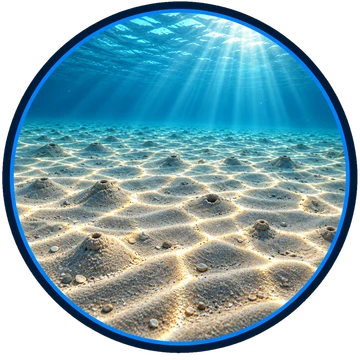
It is a bottom animal but not a buried one. The ratfish cruises just above the seafloor over sand, mud or rocky reef, moving with slow beats of its broad pectoral fins. The night-time shift into shallow water is a feeding movement, and it is the reason the Pacific Northwest night-dive encounter happens at all.
The appearance is unlike anything else on this coast. The body is elongated with an angular cross section rather than the flattened disc of a ray or the tube of a shark, brown to reddish brown, scattered with small white spots over the head and trunk. The snout is short and bluntly rounded, the eyes are large and green, and the face is genuinely rabbit-like. Behind the head a tall first dorsal fin carries a large spine at its leading edge. There is no anal fin, and the tail tapers to a long thin point, which is what earned the animal the rat half of its name. Females grow larger than males and reach about 38 inches.
Deep Dive
Both of this fish's names are arguments about its face, and they disagree. The common name calls it a rat, for the tapering whip of a tail. The genus name means water rabbit, and it was given for the 3 pairs of grinding tooth plates that tend to stick out past the lips like a rabbit's incisors. Those plates are the mouth of an animal that eats hard things: mollusks, crustaceans, worms, sea stars and small fish, all crushed rather than cut. A chimaera does not have replaceable rows of teeth the way a shark does. It has permanent plates that grow throughout life.
The species name honors Alexander Collie, a Scottish naval surgeon and naturalist who sailed on HMS Blossom under Captain Frederick Beechey between 1825 and 1828. The specimen the species was described from came off that ship.
The single strangest thing about the animal is on the male's forehead. Males carry a clublike appendage there, and they use it during mating to grip the female, usually by a pectoral fin. No shark and no ray has anything comparable. It is a clasper in the functional sense, a structure for holding a mate, mounted on the head. If any 1 feature demonstrates how far chimaeras sit from the sharks and rays they superficially resemble, it is that.
Egg-laying is equally unusual, and the sequence is worth describing in order. The female extrudes 2 egg capsules at a time and may take as long as 30 hours to push out the full set. The cases do not drop free. They hang from her body on a long filament for another 4 to 6 days, trailing behind her as she swims. Only then do they settle, ending up either planted upright in mud or lying on the bottom with their filaments tangled together. Females carrying eggs turn up year-round, so there is no breeding season to speak of. No incubation period, hatch size or maximum age was found in any source consulted.
The spine deserves a careful answer because the sources do not give the same one. All 3 consulted agree the spine is large, sits at the front of the first dorsal fin, and can cause a painful wound. They disagree on whether venom is involved. The Monterey Bay Aquarium describes it as a venomous spine. FishBase, which classifies fish specifically by the hazard they present, rates the species traumatogenic rather than venomous, meaning the injury is mechanical, and states that the spine can be dangerous and cause a painful wound without mentioning venom. Washington's wildlife agency describes the spine and does not address the question at all. No primary toxinology work was consulted for this page, so the honest position is that the wound is real and the venom is unsettled.
There is a footnote to that, reported with the hedge its source uses. FishBase notes that fishers are reputed to fear the jaws of the ratfish more than the dorsal spine. Given the grinding plates described above, a hand in the wrong place is easy enough to picture.
Two old uses close the picture out. The flesh is edible and nobody recommends it: bland, with an unpleasant aftertaste. The liver, on the other hand, was once rendered for machine oil, which is a use the species shares with several deep-water sharks whose livers hold large volumes of light oil. Neither use amounts to a fishery today, and the species sits in the regulations because of what trawls happen to catch rather than because anyone is looking for it.
Where to Find Them
Researched habitat and range candidates
San Diego · 21 beaches
Orange County · 15 beaches
Catalina Island · 13 beaches
Los Angeles · 16 beaches
Channel Islands · 24 beaches
Ventura · 23 beaches
Santa Barbara · 15 beaches
San Luis Obispo · 25 beaches
Monterey · 18 beaches
Oregon South Coast · 15 beaches
Oregon Central Coast · 8 beaches
Oregon North Coast · 8 beaches
South Sound · 12 beaches
Hood Canal · 11 beaches
Central Sound · 13 beaches
North Sound · 8 beaches
San Juan Islands · 8 beaches
Strait of Juan de Fuca · 5 beaches
Cape Flattery · 4 beaches
These locations have suitable habitat within the species range. An assignment is a possible encounter, not a confirmed sighting at every beach. Season, depth, and local conditions still matter. Historical habitat without present-day evidence is excluded.