

Taxonomy
Rarity
Abundance rates how many are in suitable habitat. Find difficulty rates how hard it is to locate one on a daylight snorkel or freedive through 50 ft. A higher find score means a harder search. The rarity category also reflects the kind of encounter; it is not an average of the 2 scores.
Seasonality
Location
The monkeyface prickleback lives along the Pacific coast from southern Oregon to northern Baja California. It is common from the eastern Channel Islands north to northern California and becomes rare south of Point Conception. It is a fish of the shoreline. FishBase records it from the intertidal zone down to about 80 feet, but it is usually found in the top 3 feet of water: in tide pools, among rocks at the low-tide line, along jetties and breakwaters, and on shallow reef with kelp.
It is a homebody. The Monterey Bay Aquarium reports that an adult rarely moves more than 15 feet from its home crevice. That habit makes the fish easy to find again once its hole is known, and it is the reason anglers can target one rock at a time.
It can also live out of water for a surprisingly long time. The monkeyface prickleback can breathe air, and a fish kept moist under rocks or seaweed can survive out of water for 15 to 35 hours. That lets it stay in the rocks while the tide is out.
Deep Dive
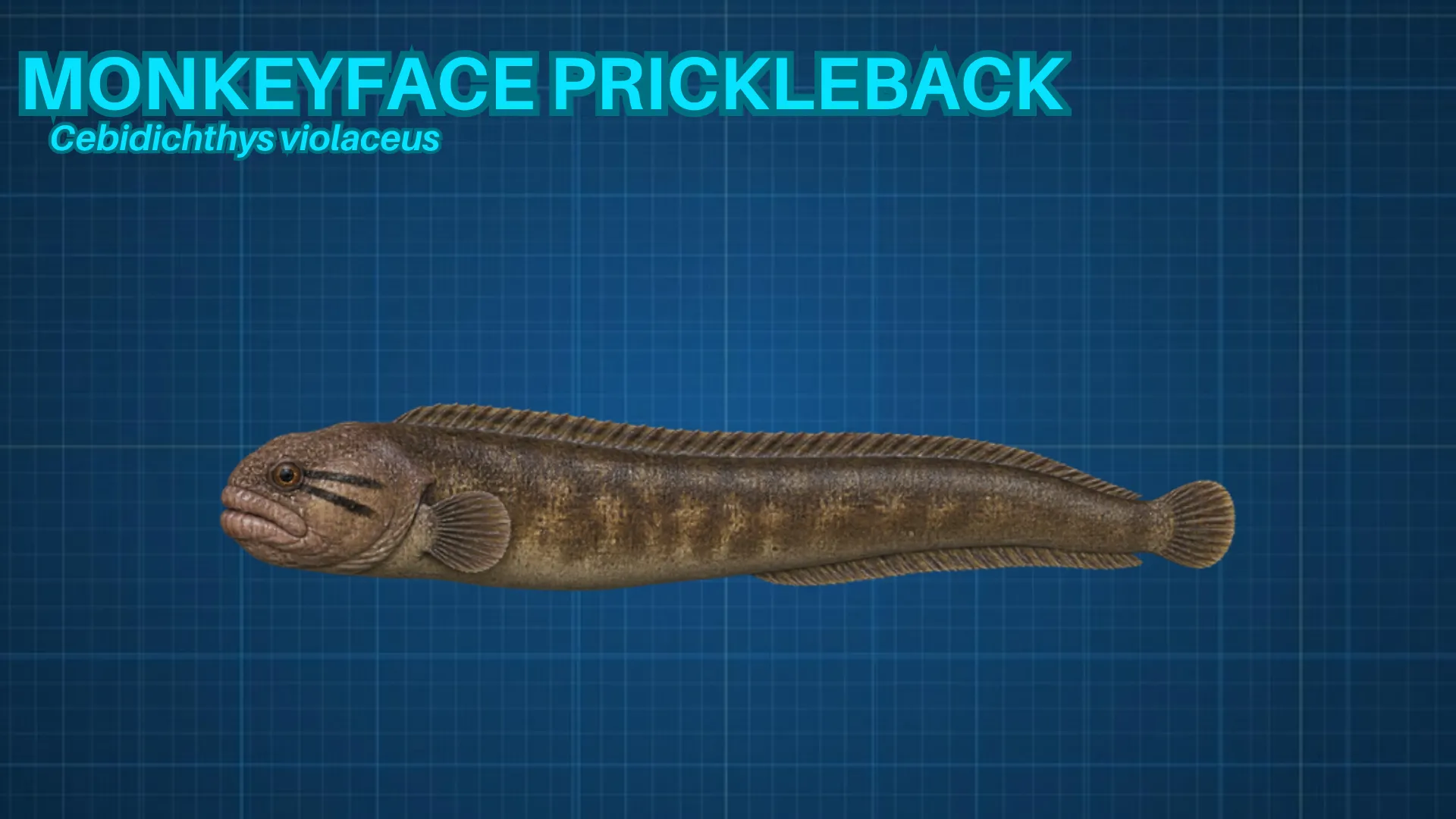
Despite the name "monkeyface eel," the fish is not an eel. It belongs to a group of long-bodied fish related to the eelpouts and pricklebacks, which sit within the large order of perch-like fishes. Older references place it in the prickleback family, and current fish databases give it a family of its own. Anglers also call it the blenny eel and the monkeyface blenny. Adults are dull black, olive or gray, with 2 dark bars running down from each eye. Some carry orange spots on the body or orange edges on the fins. Adults have a lumpy ridge on top of the head.
The species grows to about 30 inches. Pier anglers mostly catch fish of 12 to 24 inches. FishBase gives a maximum age of 18 years, and fish mature at about 16 inches. The California record is 7 pounds 8 ounces, caught at Pescadero in San Mateo County in 2019.
The diet changes as the fish grows. Young monkeyfaces eat small crustaceans and seaweed. Once they reach 2 to 3 inches long, they eat mostly seaweed. In 2020 a team of biologists at the University of California, Irvine published the fish's genome, its full set of genes. They found extra copies of the genes for enzymes that digest starch and fat, which help explain how the fish gets its energy from seaweed. The work drew news coverage for the idea that the species could one day be farmed for food.
Spawning peaks from February to April. Fertilization happens inside the female. She lays a mass of 17,500 to 46,000 eggs on rock below the low-tide line, usually in a crevice. An adult coils its body around the eggs and guards them. Researchers have seen this guarding but have not determined whether it is done by the male, the female, or both.
Young monkeyfaces are eaten by herons and great egrets. Cabezon and grass rockfish also prey on the species.
Monkeyfaces are caught mostly by shore anglers using a method called poke-poling. The angler uses a long pole, usually bamboo, with a very short wire leader and a baited hook at the tip, and pushes the bait into crevices and under rocks in the intertidal zone and the shallows just below it. Pier anglers catch them too, though less often. The fish bites and goes straight back into its hole, so the angler has to set the hook fast and keep pulling. Cut squid, shrimp, pile worms and fresh mussels are the usual baits. Spearing is legal, and Pier Fishing in California, a long-running angler reference, lists a diving record of 7 pounds 5 ounces taken at Carmel in 2013.
California counts the monkeyface toward the general bag limit: no more than 10 per person per day, as part of a total of 20 finfish. There is no size limit and no closed season, and take is prohibited inside state marine reserves. No spear may be used or carried within 100 yards of a stream mouth north of Ventura County. In Oregon it falls under the general marine species daily bag, which was 4 fish in the state's 2026 chart, and most ocean anglers there need an Ocean Endorsement.
The fish is good to eat. FishBase calls it good eating, and anglers describe white, very firm meat with no visible flakes, a mild flavor and little fat. Poaching and steaming are the methods anglers favor.
Where to Find Them
Researched habitat and range candidates
Santa Barbara · 5 beaches
San Luis Obispo · 22 beaches
Monterey · 17 beaches
Oregon South Coast · 15 beaches
Oregon Central Coast · 8 beaches
Oregon North Coast · 1 beach
These locations have suitable habitat within the species range. An assignment is a possible encounter, not a confirmed sighting at every beach. Season, depth, and local conditions still matter. Historical habitat without present-day evidence is excluded.