


Taxonomy
Rarity
Abundance rates how many are in suitable habitat. Find difficulty rates how hard it is to locate one on a daylight snorkel or freedive through 50 ft. A higher find score means a harder search. The rarity category also reflects the kind of encounter; it is not an average of the 2 scores.
Seasonality
Location
Giant keyhole limpets live from Point Conception, Santa Barbara south to Isla Asunción in Baja California Sur, Mexico, according to a 2024 genetic study of the species. Some older sources put the northern limit at Monterey Bay, in central California. They live on rock surfaces in the low intertidal, the lowest band of shore that the tide uncovers, and on rocky reef in kelp forests below the tide line.
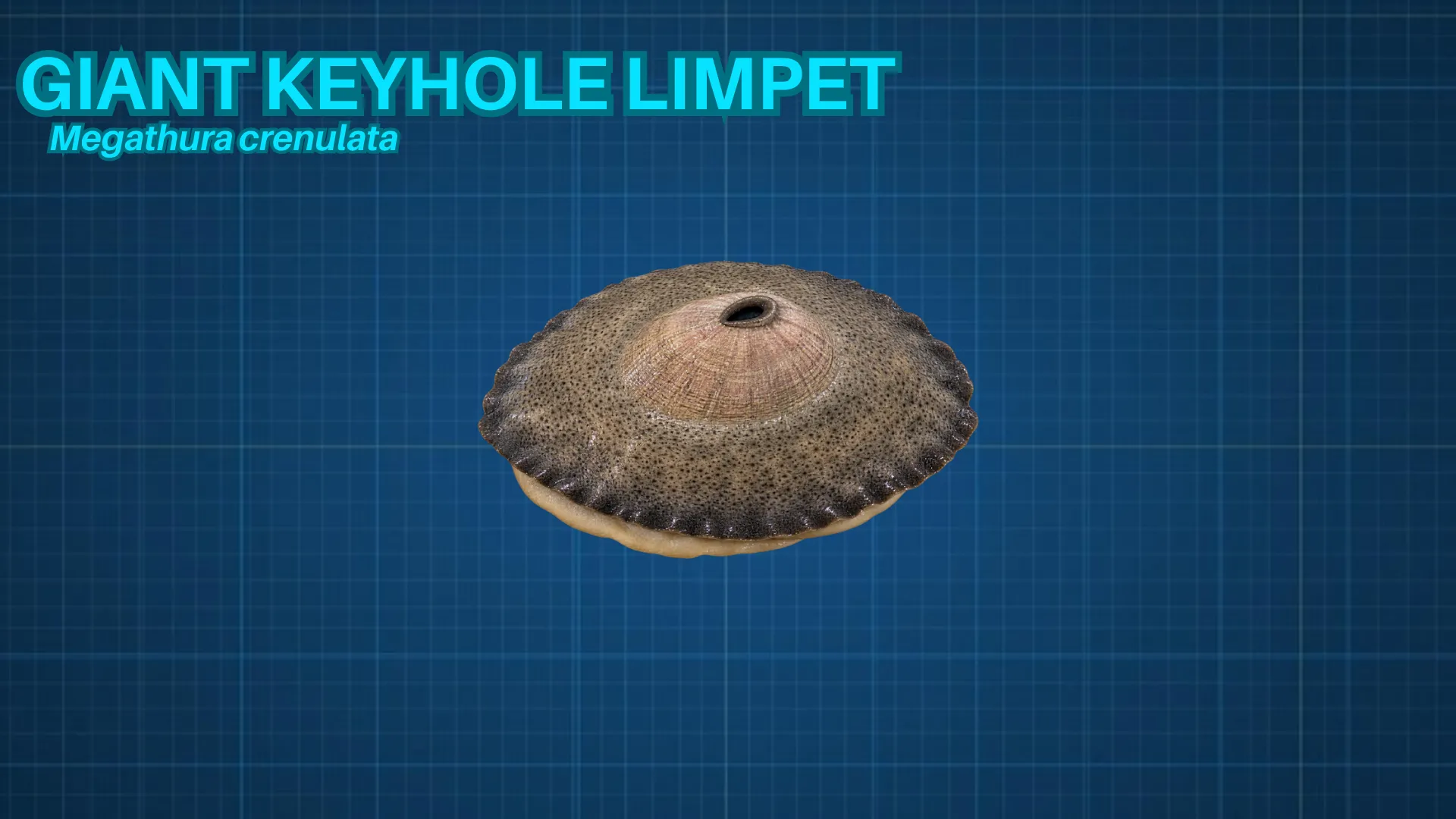
The animal looks unlike a typical limpet. Its mantle, a thick fleshy layer of skin, covers the small shell completely. The mantle is usually solid black and sometimes mottled or tan. The shell ends at the top in a large oval opening, the keyhole that gives the animal its name, and the animal uses that opening both to breathe and to get rid of waste. The bottom of the foot is yellowish-brown. Counting the soft body, the whole animal reaches about 10 inches long.
Deep Dive
Much of the giant keyhole limpet's diet is animals. It feeds on colonial sea squirts, the soft crusts made of many small filter-feeding animals living together, and on other invertebrates that grow as crusts on rock. A 2024 study also calls it a key grazer, an animal that feeds by scraping food off the rock, in the kelp forests of the Baja California peninsula.
Its spawning season has been reported as September to October. The larvae are the kind that do not feed. Each one lives off the yolk packed into its egg until it settles.
Keyhole limpet hemocyanin, known as KLH, is a very large protein collected from the animal's blood, and the human immune system reacts to it strongly. Researchers attach small molecules to it so the immune system will learn to recognize them. That makes KLH a standard tool for getting lab animals to produce antibodies, the proteins the body uses to recognize invaders, and a common ingredient in experimental vaccines. It has also been tested against bladder cancer. In mice, it slowed bladder tumors about as well as BCG, a standard bladder cancer treatment.
Where to Find Them
Researched habitat and range candidates
San Diego · 13 beaches
Orange County · 10 beaches
Catalina Island · 13 beaches
Los Angeles · 10 beaches
Channel Islands · 24 beaches
Ventura · 15 beaches
Santa Barbara · 5 beaches
These locations have suitable habitat within the species range. An assignment is a possible encounter, not a confirmed sighting at every beach. Season, depth, and local conditions still matter. Historical habitat without present-day evidence is excluded.