



Taxonomy
Rarity
Abundance rates how many are in suitable habitat. Find difficulty rates how hard it is to locate one on a daylight snorkel or freedive through 50 ft. A higher find score means a harder search. The rarity category also reflects the kind of encounter; it is not an average of the 2 scores.
Seasonality
Location
The onespot fringehead ranges from Bodega Bay in Northern California to Isla San Martin in northern Baja California. Ken Jones describes its home as the fairly bare sand and mud bottom of bays and shallow coastal water, usually between 10 and 90 feet, and records it to about 180 feet.
What it needs is a place to hide. Ken Jones lists empty shells, bottles, cans, tires, pipes and shoes among its homes, and FishBase and Mexican Fish add rock crevices and abandoned clam burrows. Mexican Fish reports that it backs into its shelter tail first, leaving only its head exposed. Ken Jones lists piers from San Diego Bay to San Francisco Bay where onespots turn up, including Shelter Island, Oceanside Harbor, Redondo, Stearns Wharf, Port San Luis, Morro Bay and Sausalito.
Deep Dive
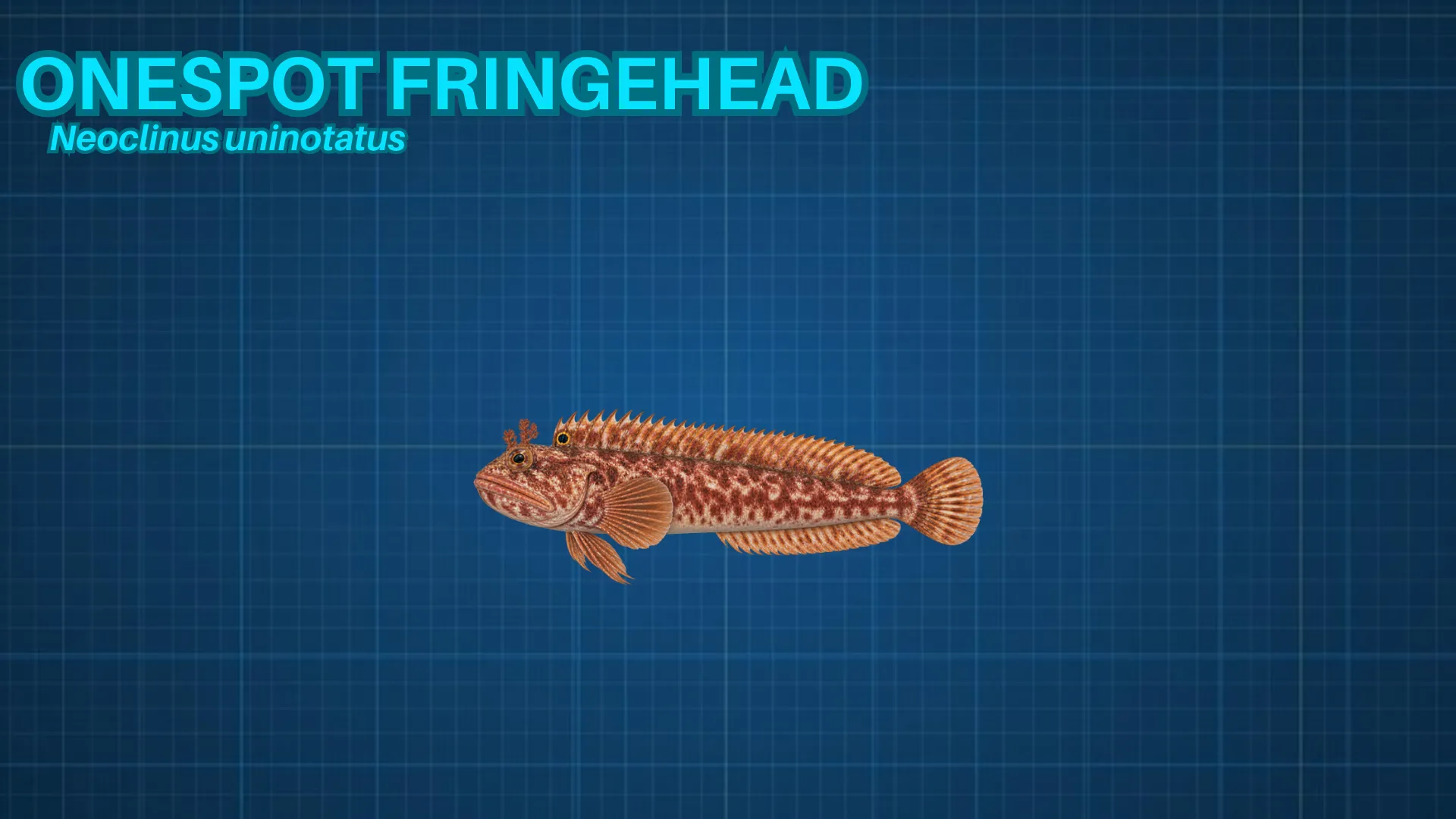
The fish is named for 2 features. The fringe is the set of small fleshy tabs, called cirri, above each eye, and Mexican Fish notes that males have larger ones than females. The onespot is a single eyespot, a dark blue-black spot ringed in yellow, on the dorsal fin between the first and second spines. That spot is the quickest way to tell it from its relatives: the sarcastic fringehead has 2 eyespots on the dorsal fin, and the yellowfin fringehead has none.
It is slender, with a large head and a very large mouth that reaches well past the eyes, full of small cone-shaped teeth. Mexican Fish describes the body as brown with 7 broad dark brown bars. The long dorsal fin runs from the back of the head almost to the rounded tail. It grows to about 10 inches and lives up to 7 years, and Ken Jones reports that most caught from piers are 5 to 7 inches.
It defends its home hard. Ken Jones describes onespots as very territorial and often charging intruders, and Mexican Fish reports that they have poor eyesight and will attack anything, large or small, that comes near the shelter. Anglers know the bite. Ken Jones writes that a hooked onespot will clamp onto a finger and hold on, so that its tiny teeth do not hurt but the hook is hard to remove.
Mexican Fish describes it as an ambush predator, and both Mexican Fish and Ken Jones both describe a diet mainly of small crustaceans such as shrimp and crabs. Rockfishes and sea basses eat it in turn.
The eggs go into the same kinds of shelters the adults live in. FishBase reports that females lay them in abandoned clam burrows, under rocks and inside beer cans and other containers, and that the males guard them until they hatch.
Where to Find Them
Researched habitat and range candidates
San Diego · 15 beaches
Orange County · 10 beaches
Catalina Island · 6 beaches
Los Angeles · 11 beaches
Channel Islands · 21 beaches
Ventura · 16 beaches
Santa Barbara · 12 beaches
San Luis Obispo · 22 beaches
Monterey · 17 beaches
These locations have suitable habitat within the species range. An assignment is a possible encounter, not a confirmed sighting at every beach. Season, depth, and local conditions still matter. Historical habitat without present-day evidence is excluded.