
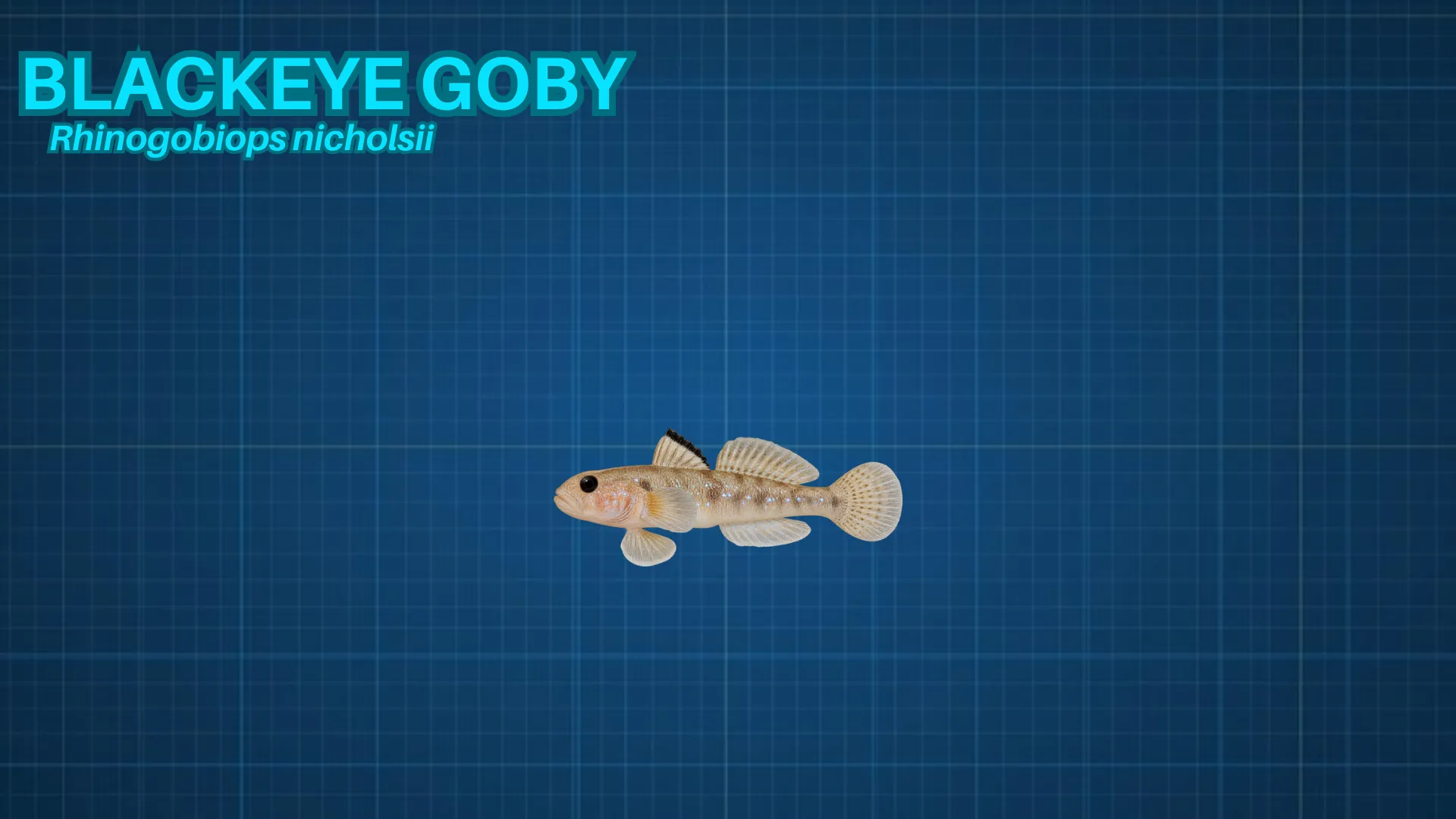
Also calledbluespot goby, onespot goby, crested goby, large scaled goby



Taxonomy
Rarity
Abundance rates how many are in suitable habitat. Find difficulty rates how hard it is to locate one on a daylight snorkel or freedive through 50 ft. A higher find score means a harder search. The rarity category also reflects the kind of encounter; it is not an average of the 2 scores.
Seasonality
Location
FishBase gives its range as Wales Island in northern British Columbia south to Punta Rompiente in central Baja California, Mexico. It lives from the intertidal zone to about 350 feet, and Ken Jones records it as deep as 640 feet. FishBase describes it usually on sand near rocks, and Mexican Fish adds bays, kelp forests and both exposed and sheltered rocky shores.
It stays close to cover. FishBase notes that it retreats into rocks or holes when approached, and Mexican Fish describes it as a daytime hunter that keeps near shelter and hides at night.
Deep Dive
A goby is a small bottom fish, and the blackeye goby has the family shape: a long, rounded body with 2 dorsal fins close together along the back. Its pelvic fins, underneath, are joined into a disk that reaches back to the vent. The fish is pale tan to cream, with brown or green speckling, and it can darken to blend with the background. The marks that identify it are on the head and back: large black eyes, an iridescent blue spot under each eye, and a black edge on the first dorsal fin. It grows to about 6 inches and lives about 5 years.
Every blackeye goby begins life as a female. The species is a protogynous hermaphrodite, which means a fish matures as a female and later becomes a male. FishBase puts the change at about 2.7 inches long and says it takes less than 5 months. The fish live in permanent harems, each made up of 1 male and several smaller females.
Nesting runs from April to October. The male cleans out a spawning site under a rock, then courts females by rising off the bottom to display his black pelvic disk. According to Mexican Fish, each female lays 3,300 to 4,800 tiny pink eggs, and the male guards them for several weeks. The young drift offshore. California's 2001 marine status report notes that blackeye goby larvae turn up regularly in plankton samples from the open ocean, unlike the larvae of most California gobies, which stay near the coast.
It hunts by day, eating limpets and snails along with amphipods, copepods and shrimp, which are all small crustaceans. Mexican Fish names albacore, rockfishes and 3 kinds of cormorants among its predators.
The fishing rules differ by state. California counts it toward the general bag limit: no more than 10 per person per day, as part of a total of 20 finfish, with no size limit and no closed season. Take is prohibited inside state marine reserves. In Oregon it falls under the general marine species daily bag, which the state sets during the season, and anglers fishing for it in the ocean need an Ocean Endorsement. Washington's rules do not list it as a food fish or a game fish, and every one of the state's marine areas closes fish in that category to fishing, keeping and possession.
Where to Find Them
Researched habitat and range candidates
San Diego · 15 beaches
Orange County · 10 beaches
Catalina Island · 13 beaches
Los Angeles · 11 beaches
Channel Islands · 24 beaches
Ventura · 16 beaches
Santa Barbara · 12 beaches
San Luis Obispo · 24 beaches
Monterey · 17 beaches
Oregon South Coast · 15 beaches
Oregon Central Coast · 8 beaches
Oregon North Coast · 8 beaches
South Sound · 12 beaches
Hood Canal · 9 beaches
Central Sound · 13 beaches
North Sound · 8 beaches
San Juan Islands · 8 beaches
Strait of Juan de Fuca · 5 beaches
Cape Flattery · 4 beaches
These locations have suitable habitat within the species range. An assignment is a possible encounter, not a confirmed sighting at every beach. Season, depth, and local conditions still matter. Historical habitat without present-day evidence is excluded.