

Taxonomy
Rarity
Abundance rates how many are in suitable habitat. Find difficulty rates how hard it is to locate one on a daylight snorkel or freedive through 50 ft. A higher find score means a harder search. The rarity category also reflects the kind of encounter; it is not an average of the 2 scores.
Seasonality
Location
The 2021 checklist of the region's fishes by Milton Love and colleagues gives its range as San Miguel Island south to Isla Asuncion in Baja California Sur and the offshore rocks of Rocas Alijos, extending into the Gulf of California. FishBase places the northern limit at Santa Cruz Island. It lives on the bottom in rocky areas, and the checklist records it from the intertidal zone to 298 feet.
Deep Dive
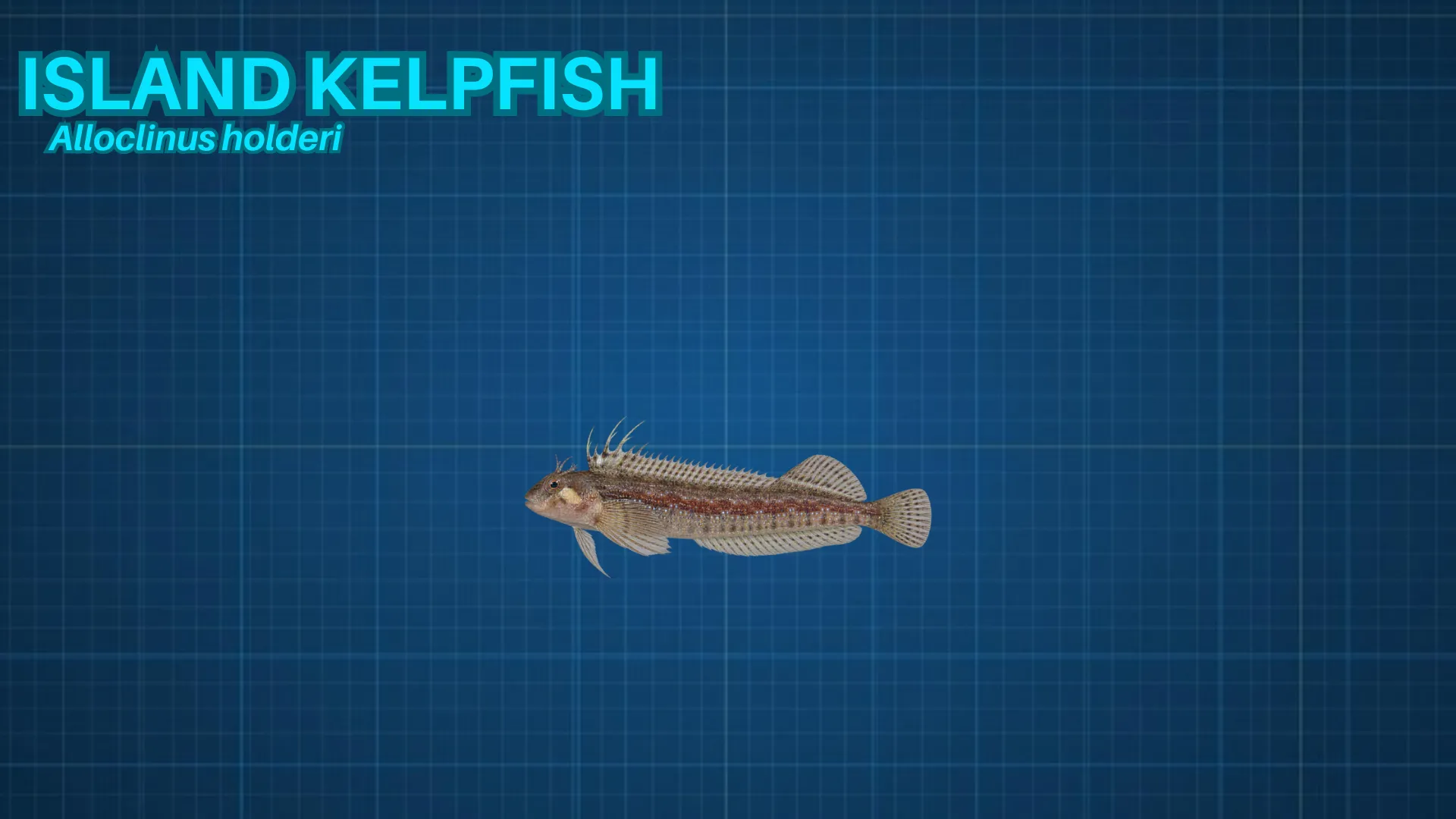
The island kelpfish is a labrisomid, a member of a family of small blennies, and it is the only species in its genus. Mexican Fish describes a 3-pronged cirrus, a small fleshy tab, above each eye. The body is barred and striped in shades of red to maroon, lavender, orange and tan, covered in small pale spots, with a row of dark blotches along each side and bright orange fins. A pale round blotch running from the lower corner of the eye onto the cheek is one of its identifying marks. It can change color to match its background.
It is a small fish. FishBase gives a maximum length of about 4 inches and Mexican Fish 4.5 inches, while the Love checklist gives about 6 inches.
Mexican Fish describes it as a solitary, territorial hunter that is active by day and shelters at night, eating crustaceans on the bottom. It also works as a cleaner, picking parasites off other fish, including giant sea bass. Each female lays 200 to 1,400 eggs in a sheltered spot. Beyond those details the species is poorly studied.
Its name honors Charles Frederick Holder, an American naturalist and writer who founded the Tuna Club of Avalon on Santa Catalina Island.
California counts it toward the general bag limit: no more than 10 per person per day, as part of a total of 20 finfish, with no size limit and no closed season. Take is prohibited inside state marine reserves, including several at the Channel Islands.
Where to Find Them
Researched habitat and range candidates
San Diego · 13 beaches
Orange County · 10 beaches
Catalina Island · 13 beaches
Los Angeles · 10 beaches
Channel Islands · 24 beaches
Ventura · 5 beaches
These locations have suitable habitat within the species range. An assignment is a possible encounter, not a confirmed sighting at every beach. Season, depth, and local conditions still matter. Historical habitat without present-day evidence is excluded.