


Taxonomy
Rarity
Abundance rates how many are in suitable habitat. Find difficulty rates how hard it is to locate one on a daylight snorkel or freedive through 50 ft. A higher find score means a harder search. The rarity category also reflects the kind of encounter; it is not an average of the 2 scores.
Regulations
CDFW rules verified 2026-08-21
Seasonality
Edibility
Not a fillet. The animal yields uni, the 5 gonads, which are soft and creamy with no bones or bloodline in the way.
Location
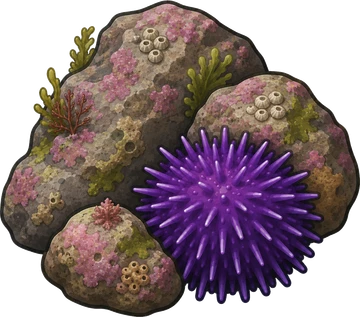
The red sea urchin lives in the northeastern Pacific, from Kodiak Island in the Gulf of Alaska south to the tip of Baja California, Mexico. It holds on rocky reef, tucked under ledges and inside cracks, from the low-tide line down to about 300 feet. Adults are most common along the outside edge of a kelp bed, where drift kelp piles up and feeds them. The spines of the largest adults reach 3 inches, and the dense canopy those spines form over the animal shelters juvenile urchins, small crabs, brittle stars, shrimp, and small fish that would otherwise have nothing to hide in on the open reef.
Where kelp holds up, the urchins graze the edges of the bed. Where kelp fails, they change behavior. The species can survive a long time on almost no food, and dense patches of urchins on stripped-bare rock, called urchin barrens, are the result. In southern California these barrens usually follow an El Niño kelp die-off. In northern California since 2013 the driver has been the smaller purple sea urchin, a related species that exploded in numbers once the sunflower sea star was gone and grazed the north-coast kelp beds down. Red urchin populations in the same range declined at the same time, because they lost the same food and caught the same disease as everything else on the reef.
Harvest Brief
West Coast suitable shallow rocky reefs, locally variable
The take is by hand. On a healthy reef the finding is quick, because the red sea urchin is large, brightly colored, and sits in the open or tucked just under a ledge. The work is in the handling. Long, hard spines punch through skin without effort, so most divers wear kevlar or cut-resistant gloves and pry each urchin off the rock with the fingers or with a short hand rake, then drop it into a mesh catch bag. Sport divers freedive or SCUBA on rocky reef, usually in 15 to 60 feet of water. The California recreational rules are open. The daily limit is 35 red sea urchins per person, there is no minimum size, there is no closed season, and no restriction on which hand tool the diver uses. A California sport fishing license is required for anyone 16 or older, and an Ocean Enhancement Validation is additionally required south of Point Arguello in Santa Barbara County.
The commercial rules run tighter, because the fleet targets the same reefs for the export market and would strip them if the take were unlimited. South of the Monterey and San Luis Obispo county line, commercial divers must return red urchins under 3.25 inches across the shell. North of that line the minimum is 3.5 inches. Commercial harvest is by hookah rig, a surface-supplied breathing system fed by a compressor and a hose down to the diver, at depths usually less than 120 feet.
The value on the reef is the roe inside. The 5 gonads that sit against the underside of the shell are the edible part of the animal. They are called uni in Japanese and roe in English. Cleaning is slow but simple. A knife or a pair of shears cracks the shell open; a spoon or a small spatula lifts the 5 wedges out; a rinse in salt water washes off the loose material; and tweezers pick the thin intestinal membranes off the wedges before they go on the plate. Uni is eaten fresh from the shell, laid over rice as sushi, stirred into pasta, or added to broth. Buyers grade the wedges by size, color, texture, and firmness, and grade A pays several times what a lower grade will bring. The highest prices of the year hit around Japanese New Year, when the gonads are ripe just before the southern California winter spawn.
Deep Dive
The red sea urchin is the largest of the more than 900 sea urchin species in the world. Adults reach about 7 inches across the shell, called a test, and their spines reach about 3 inches. The color runs pink, red, burgundy, and purple, and deepens with age. The animal is built around a spherical calcium shell covered in movable spines, with hundreds of thin tube feet between the spines used for movement and for passing food up to the mouth. The mouth sits on the underside and consists of 5 plates that form a jaw structure called Aristotle's lantern, which scrapes and grinds algae off rock.
Life history explains most of what is unusual about the species. Red sea urchins reach sexual maturity at about 2 inches across the shell, roughly 2 years old. They then spawn each year for the rest of their lives, and they live a long time. In California, individuals older than 50 years are common, and in Alaska and Washington some are estimated to be older than 100. Tag and radiocarbon studies by Ebert and Southon in 2003 put the oldest at over 200 years. The species shows no drop in reproductive output with age, so the largest old animals are the biggest spawners on the reef.
Fertilization happens in the water. Males and females release sperm and eggs into the current, and success depends on being close together. Below about 2 urchins per square meter, most eggs are never fertilized. A single female spawns up to several million eggs at a time. The larvae drift as plankton for 6 to 8 weeks before settling onto rock, a long enough phase that a single spawning event can seed reefs many miles away. Juveniles settle in shallow rocky habitat and usually spend their first years tucked under the spine canopy of an adult, safe from the small predators that eat everything else that size on the reef.
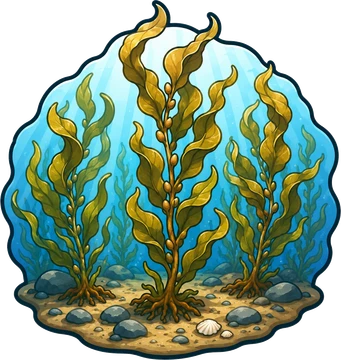
Adult red sea urchins are grazers. In southern California the preferred food is giant kelp, which builds the tall kelp forests off the mainland and off the Channel Islands off Santa Barbara. In northern California the food is bull kelp, which dies back each winter, and other brown algae. Urchins catch drift blades with their spines and hold them against the mouth. When kelp is scarce they can shift to almost anything organic that reaches them, and they can go a long time on very little. That tolerance is why they persist in the bare-rock patches called urchin barrens. A single warm-water year can flip a bed into a barren that then holds for years.
Documented predators include sea otters, sunflower sea stars, California sheephead, wolf eels, spiny lobsters, crabs, and the smaller white sea urchin. Sea otters take the biggest urchins, crushing them against the belly with a rock, and the otter zone from south of San Francisco to Point Conception in Santa Barbara County holds so few adult red urchins that no commercial fishery can operate there. Sunflower sea stars fed heavily on urchins along the whole west coast until the 2013 sea star wasting outbreak eliminated them from most of the range. California sheephead and wolf eels crack them in their teeth, and lobsters and crabs take the smaller ones. Juveniles are vulnerable to a much longer list of small predators, which is why the adult spine canopy is such an important nursery.
The 2013 to 2015 collapse changed the northern California reefs more than any earlier event on record. Sea star wasting disease removed the sunflower sea star. The 2014 warm blob and the 2015 El Niño weakened the kelp beds. The smaller purple sea urchin exploded in numbers on the north coast and grazed the remaining kelp down. Northern California kelp forests measured 93 percent smaller in CDFW surveys after the event, and the University of California, Santa Cruz satellite analysis put the loss at roughly 95 percent. Red sea urchins in the same range declined too, from disease and from starvation once their food was gone.
The commercial fishery was built on this animal. In 1971 the National Marine Fisheries Service opened it in southern California as an "underutilized species" program, with a second motive of thinning grazers off giant kelp. Boats and divers from the collapsing abalone dive fishery moved over. Southern California landings peaked at 25 million pounds in 1981. A gold rush followed in the north from 1985 to 1988, and statewide landings peaked at 52 million pounds in 1988, worth about 13 million dollars at the dock. From 2000 to 2014 the fishery was stable, at 10 to 15 million pounds a year. From 2015 on the same collapse that hit the north-coast kelp cut the catch in half by 2016 and to 3.1 million pounds in 2018, the lowest total on record. Access has been restricted since 1989. The current permit target is 150, down from a peak near 900 in the late 1980s. Historically the port of Santa Barbara has handled 57 percent of the state's landings, followed by Fort Bragg in Mendocino County at 23 percent, Los Angeles at 9 percent, Bodega Bay in Sonoma County at 6 percent, and San Diego at 5 percent.
Most of the catch has always gone to Japan, where uni is a premium food. Domestic demand grew from about 2000 on, as Japan's economy weakened and California-grade uni reached more sushi bars and restaurants at home. Prices at the dock swing hard on gonad quality, and grade A wedges pay several times what a lower grade brings. Recreational take is small and untracked; CDFW lists sport-side data as a low-priority gap in its 2019 management report on the fishery.
Where to Find Them
Researched habitat and range candidates
San Diego · 13 beaches
Orange County · 10 beaches
Catalina Island · 14 beaches
Los Angeles · 10 beaches
Channel Islands · 24 beaches
Ventura · 15 beaches
Santa Barbara · 10 beaches
San Luis Obispo · 25 beaches
Monterey · 17 beaches
Oregon South Coast · 15 beaches
Oregon Central Coast · 8 beaches
Oregon North Coast · 8 beaches
South Sound · 12 beaches
Hood Canal · 10 beaches
Central Sound · 13 beaches
North Sound · 8 beaches
San Juan Islands · 8 beaches
Strait of Juan de Fuca · 5 beaches
Cape Flattery · 4 beaches
These locations have suitable habitat within the species range. An assignment is a possible encounter, not a confirmed sighting at every beach. Season, depth, and local conditions still matter. Historical habitat without present-day evidence is excluded.