


Taxonomy
Rarity
Abundance rates how many are in suitable habitat. Find difficulty rates how hard it is to locate one on a daylight snorkel or freedive through 50 ft. A higher find score means a harder search. The rarity category also reflects the kind of encounter; it is not an average of the 2 scores.
Regulations
CDFW rules verified 2026-09-09
Seasonality
Edibility
The shell has to be broken or the animal extracted whole, then the foot trimmed and tenderized by freezing, pounding or pressure cooking. More work than a scallop and less than an abalone, and the tenderizing step is not optional.
One clean muscle per animal with nothing else worth keeping, from a shell that reaches 7 inches. The yield is honest but small for the size of the animal.
Location
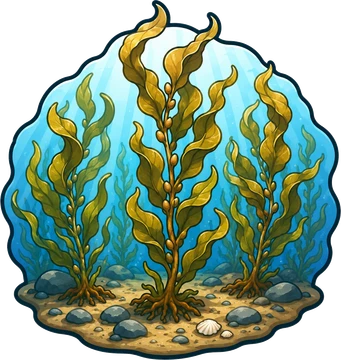
Kellet's whelk lives in kelp forests and on rocky reef, and also on sand next to reef structure, where it sometimes buries itself under sand or shell debris. Depth runs from the low intertidal, where it is rare, down to about 230 feet. Historically the range ran from central Baja California north to Point Conception, which is the boundary between warm-temperate and cool-temperate water on this coast and the northern wall for a long list of southern species.
Then it moved. In 1980 and 1981, adult Kellet's whelks turned up in Monterey County, roughly 250 miles north of any previously known record, 3 in Monterey Bay and 2 at Big Creek. Forty-five years later they are still there, with a breeding population, their own published ecology, and genetic work identifying where the founders came from. That work analyzed more than 40,000 genetic markers and traced larvae from Point Loma in San Diego hundreds of kilometers north, most likely carried during an El Nino event, the recurring Pacific warming cycle that pushes warm water and everything drifting in it up the coast.
This site treats that as a genuine range change rather than a curiosity, and the contrast with the banded guitarfish on this same site is the reason to explain it. The guitarfish has 1 record north of its limit: a single animal on video, once, in 2020. That is a record, and its range on this site was not moved. The whelk has 45 years, an established population, and genetics identifying the source and the mechanism. That is a range.
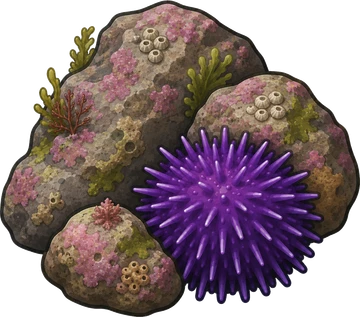
The shell is robust, spindle-shaped and spiraled, reaching about 7 inches, and it is white to tan underneath. Underneath is the operative word. Live whelks are usually covered in encrusting bryozoans, sponges and algae, so the animal on the reef looks like a lump of the reef until it moves.
Harvest Brief
Southern California shallow kelp forest, rocky reef and adjacent sediment.
Finding them is easy and rates a 2. They are common on Southern California kelp reef, they move slowly, and they gather. During the March through May spawning season, aggregations of 15 to 20 mating pairs are ordinary, and CDFW records reports of 200 to 300 animals inside a single patch of about 215 square feet. A diver who finds one of those has found a season's worth in one spot, which is precisely the problem with taking them then. Legal, and the least defensible timing available.
The method is bare hands and a mesh bag. Take by hand is the legal method for recreational divers, so no tool changes the outcome. Abundance rates a 4 for Southern California on the strength of the fishery landings, though the northern population is much thinner and much newer.
At the table only 1 part is worth keeping, the muscular foot, which California Sea Grant compares directly to abalone. The meat is juicy and salty and becomes firm and tender once tenderized, and the tenderizing is not optional: freezing, pounding or pressure cooking, then 10 to 15 minutes in boiling salted water and no more. Overcooking a whelk is the standard way to ruin one. Nearly all of the commercial catch is sold live in fish markets rather than processed, which is a fair signal of where the quality lives.
Deep Dive
The number that should govern how anyone thinks about this animal is a negative result from a tagging study. Researchers tagged and recaptured 188 Kellet's whelks in Southern California over a year, and the majority of them showed no measurable growth at all. Not slow growth. None.
The rest of the growth picture fits. Juveniles manage something like a third of an inch a year until they reach sexual maturity, and after that growth slows so far that reaching 3.5 inches is estimated to take at least 20 years. Females mature at about 2.6 to 2.8 inches and are the larger animal in a mating pair. So a 7-inch whelk, the maximum size, has been on that reef for a length of time nobody has managed to measure, and no maximum age has ever been published for the species.
Set that against a fishery that grew fortyfold in 13 years and the concern writes itself. An animal that replaces its own size that slowly cannot respond to fishing pressure the way a fast-growing species can, and 89 percent of the commercial catch is not even targeted. Whelks climb into lobster and crab traps to eat the bait and the injured crustaceans inside, and get landed as bycatch.
That trap behavior is a good introduction to how the animal feeds. Kellet's whelks are opportunistic carnivores that scavenge dead and dying animals, often gathering in feeding groups, and they also actively hunt live prey including several species of turban snails. The tool is a proboscis, a muscular tube that extends from the mouth and can reach up to 3 times the length of the shell. At the end of it is a radula, a tongue-like band covered in rows of teeth, which scrapes tissue out while the proboscis applies suction. A predatory snail does not need speed when it can reach 21 inches into a crevice.
Reproduction has a detail worth picturing. Fertilization is internal, and females deposit oval egg capsules in clusters on any hard surface, including reef rock, discarded shells, and the shells of other Kellet's whelks. CDFW notes, with its own hedge, that egg laying appears to be favored on surfaces that already carry Kellet's whelk capsules, so the clusters build on each other. Each capsule holds 400 to 1,200 eggs and occasionally as many as 2,200, and the bigger the female, the more eggs per capsule. There is also an inverse relationship worth noting: smaller capsules produce larger larvae.
How long those larvae spend drifting is unknown, and CDFW says so outright. Independent work has measured 37 to 55 days from laying to emergence from the capsule, depending on water conditions, with most larvae still carrying yolk reserves when they leave. That is time inside the capsule, not time in the plankton, and the 2 should not be confused. The gap matters more than it looks, because the length of the drifting stage is what determines how far larvae travel, and how far they travel is the entire explanation for how this animal reached Monterey.
What eats them: moon snails, sea stars, octopus, and in central California, sea otters. The last of those is a recent addition to the list, and it exists because the whelk moved north into otter country.
Where to Find Them
Researched habitat and range candidates
San Diego · 22 beaches
Orange County · 15 beaches
Catalina Island · 14 beaches
Los Angeles · 16 beaches
Channel Islands · 24 beaches
Ventura · 23 beaches
Santa Barbara · 13 beaches
San Luis Obispo · 26 beaches
Monterey · 18 beaches
These locations have suitable habitat within the species range. An assignment is a possible encounter, not a confirmed sighting at every beach. Season, depth, and local conditions still matter. Historical habitat without present-day evidence is excluded.