
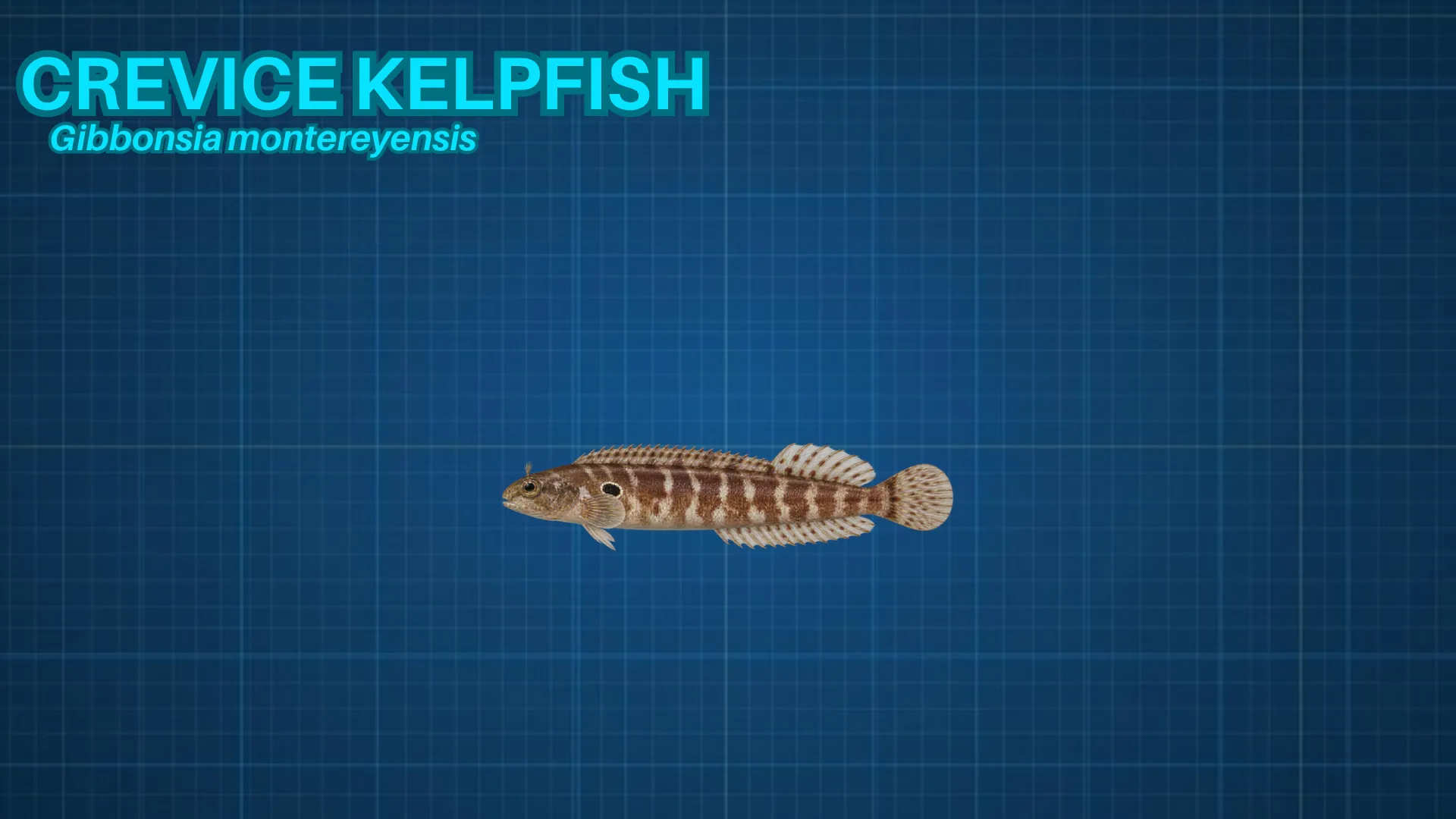
Also calledcrevice klipfish

Taxonomy
Rarity
Abundance rates how many are in suitable habitat. Find difficulty rates how hard it is to locate one on a daylight snorkel or freedive through 50 ft. A higher find score means a harder search. The rarity category also reflects the kind of encounter; it is not an average of the 2 scores.
Seasonality
Location
Jones gives the range as Ucluelet on Vancouver Island south to Bahia San Carlos in central Baja California, including Isla Guadalupe and Isla Cedros. FishBase gives British Columbia to northern Baja California. It lives among rocks and seaweed from the intertidal zone into shallow water. FishBase notes that it is usually found on exposed coast, and Jones records it as deep as 162 feet.
Jones lists the Oceanside Harbor Pier, the Cabrillo Mole in Avalon on Santa Catalina Island and the Monterey Coast Guard Pier among the places it has been caught.
Deep Dive
The crevice kelpfish is a clinid, a member of the kelp blenny family, with a long, flattened body, a pointed head and a small mouth. Mexican Fish describes a small tuft of skin by each eye. Jones gives a maximum length of 7.2 inches, with most fish caught from piers around 4 to 5 inches. FishBase lists a smaller maximum of about 4.3 inches.
Its color is unreliable. FishBase describes reddish, green, dark and silver-barred phases that mix freely, and Jones adds brown and lavender fish, some plain, some spotted and some striped. Most have a strong dark eyespot high on the side behind the pectoral fin, and many have dark bars radiating from the eye.
It is easily mistaken for the spotted kelpfish. Both have soft rays set wide apart at the rear of the dorsal fin. Mexican Fish names the difference: the spotted kelpfish has scales on the base of its tail fin, and the crevice kelpfish does not. Jones even lists spotted kelpfish among this fish's alternate names.
Mexican Fish reports that it eats algae, small crustaceans, mollusks and marine worms, that seabirds, marine mammals and other fish eat it, and that it lives about 3 years. The same guide calls it poorly studied. The genus name honors William P. Gibbons, an early naturalist from Alameda, and the species name refers to Monterey, an early collection point, according to Jones.
Where to Find Them
Researched habitat and range candidates
San Diego · 13 beaches
Orange County · 10 beaches
Catalina Island · 13 beaches
Los Angeles · 10 beaches
Channel Islands · 24 beaches
Ventura · 15 beaches
Santa Barbara · 10 beaches
San Luis Obispo · 22 beaches
Monterey · 17 beaches
Oregon South Coast · 15 beaches
Oregon Central Coast · 8 beaches
Oregon North Coast · 8 beaches
South Sound · 12 beaches
Hood Canal · 9 beaches
Central Sound · 13 beaches
North Sound · 8 beaches
San Juan Islands · 8 beaches
Strait of Juan de Fuca · 5 beaches
Cape Flattery · 4 beaches
These locations have suitable habitat within the species range. An assignment is a possible encounter, not a confirmed sighting at every beach. Season, depth, and local conditions still matter. Historical habitat without present-day evidence is excluded.