

Also calledgrumpy, ground bass, rock bass, sugar bass, Johnny Verde bass
 Spearfishing
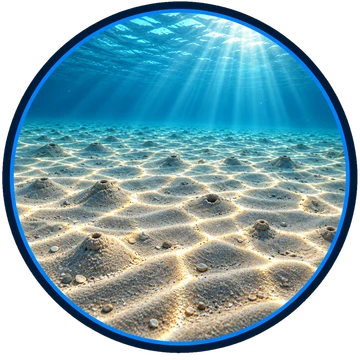
Photo: Allison Wylot, Marine Room, La Jolla
Spearfishing Stats
Southern California reef–sand margins
Taxonomy
Rarity
Abundance rates how many are in suitable habitat. Find difficulty rates how hard it is to locate one on a daylight snorkel or freedive through 50 ft. A higher find score means a harder search. The rarity category also reflects the kind of encounter; it is not an average of the 2 scores.
Regulations
CDFW rules verified 2026-07-16
Seasonality
Edibility
Firm, clean white meat with very few bones, and it holds together in the pan.
Location
Barred sand bass range from Santa Cruz in central California south to Magdalena Bay in Baja California Sur, with an outlier record from as far south as Acapulco, Mexico. Most of the population lives in Southern California and Baja. North of Point Conception in Santa Barbara County the species is uncommon. The most useful thing to know about where they hold is that the common name is accurate. Non-spawning adults spend their time on the sand side of the sand and reef interface, typically within about 6 feet of the seafloor, held to a small individual home range on the order of 32,000 square feet, or about three-quarters of an acre. The same fish returns to the same patch year after year. The structure they hunt next to is the full nearshore list: rocky reef, kelp edges, low-profile rock piles, artificial reefs, wrecks, outfall pipes, jetties, and breakwaters. Juveniles grow up in shallow bays, harbors, and eelgrass beds along the coast before moving out to join the adults on open sand. Depths run from a few feet in a bay channel to about 200 feet on offshore reef, with the reliable diving band from 15 to 60 feet, and rare records to roughly 600 feet. In summer, most of the adult population migrates offshore to spawn on mud and sand flats in 60 to 120 feet of water. Fish tagged on a non-spawning home range are recaptured an average of 11 miles away during the spawning season, with a maximum recapture distance of 57 miles. After the spawn breaks up in early fall, the fish return to their non-spawning sand and structure edges, and tag-and-recapture data show most fish returning to the same aggregation site the following year.
Spearfishing Brief
Barred sand bass are the fish where the sand meets the rock. That single fact carries almost everything a spearo needs to know about hunting them. On calico bass a diver hangs inside the kelp stringers and against boulders and waits for the fish to come back to the structure. On barred sand bass a diver drops onto the sand next to the structure and looks along the edge itself. Non-spawning fish typically sit about 6 feet off the sand at that interface, in individual home ranges so small that a good sand and rock edge holds the same fish for months. The address, in other words, is dependable. Finding them still rates a 2 on the 1 to 5 scale, because knowing where a fish is and seeing it are separate problems, and the camouflage is what costs the time. The species is present in normal shore-diving depths of 15 to 40 feet from spring through fall, and in San Diego Bay, Mission Bay, and Newport Bay it holds as shallow as 5 to 15 feet on jetty rocks, riprap, dock pilings, and channel edges. A diver who searches only the reef itself misses them. A diver who covers the sand within a few gun-lengths of the reef edge sees them. The visual cue is a gray-brown, faintly barred fish holding still just off the sand at the base of a rock pile or along the shadow line of a pipe or jetty. Against that substrate the camouflage matches well, so a diver often picks the fish up by outline first, not color.
The shot itself is the easy half and rates a 1. Community sources across Southern California describe barred sand bass as cooperative targets. They are not particularly skittish. They sit still on the sand and rely on camouflage rather than flight, and they tolerate a slow approach from the side. A barred sand bass holds position under a diver in a way calico bass do not. One community guide puts the best shot range at 4 to 6 feet, well inside the reach of any short speargun. The approach that works is to drop into the sand off to one side of a fish rather than directly on top of it, level out just off the bottom, and ease in with slow fin movement. Scratching on the rocks or tossing a handful of sand draws a fish within range while the diver waits. Inside about 10 feet the fish turns alert, so the diver closes the last few feet ready to shoot, placing the shot behind the gill plate broadside or between the eyes head-on.
The weapon of choice is a 75 to 90 centimeter speargun with a single band and a standard flopper tip. The gun does not need to be long or powerful. A barred sand bass is a small to medium reef fish that does not force a long shot and does not fight hard enough to justify a heavier setup. A quality pole spear works in shallow bay water. A diver already carrying a shore-diving rig for calico bass and sheephead is already carrying the right gun for sand bass.
The season with the best combination of finding and shooting is fall. Fish are back off the offshore spawning grounds, hungry and dispersed on shallow structure after the spawn. Summer is the aggregation, and most of the recreational catch comes on rod and reel from the hook-and-line fleet fishing 60 to 120 foot mud flats offshore, which is out of range for most shore diving. Barred sand bass is one of Southern California's main rod-and-reel gamefish; a spearo on a shallow reef edge in October and a party-boat angler over Huntington Flats in July are hunting the same species in very different phases of its year.
Deep Dive
The barred sand bass is one of 3 California species in its genus, alongside the calico bass and the spotted sand bass. California groups all 3 under a single 5-fish combined recreational bag limit with a 14-inch minimum size. The 3 fish divide the coastal habitat between them. The calico bass lives in kelp and on rock, the spotted sand bass lives in sheltered bays, and the barred sand bass lives on the open sand adjacent to structure and moves offshore to spawn. Physically, adult barred sand bass are elongated and gray-brown, with faint dark vertical bars along the sides and a whitish belly. The distinguishing mark against a similar-size kelp bass is the third spine of the dorsal fin, which stands roughly twice as long as the second spine; kelp bass has dorsal spines of equal length. Small golden-brown spots on the cheeks are a secondary field mark. Maximum reported length is about 26 inches and maximum weight about 13 pounds, with a California state record of 13 pounds 3 ounces, taken at Huntington Flats in 1988.
The species grows slowly. The oldest fish on record is 31 years old, and a recent California Department of Fish and Wildlife age-and-growth study using yearly bands in the ear bones aged the oldest fish in a Southern California sample at 25 years. Fish grow at roughly 2 inches per year, and reach sexual maturity between 7 and 10.5 inches at 3 to 5 years of age. A barred sand bass at the 14-inch legal size is about 5 or 6 years old, and has already been through at least 2 spawning seasons before it is legal to keep. The species inherited the ability to change sex from female to male, which is common in the sea bass and grouper family, but in barred sand bass the ability is dormant. Of 436 Southern California specimens examined in one reproductive study, only 2 individuals, less than 0.5 percent, were caught in the middle of the transition. In practice the fish are separate sexes for life.
Diet shifts with size. Juveniles eat small crabs, worms, clams, and small shrimp-like crustaceans in shallow bay nurseries. Adults hunt fish, especially the plainfin midshipman, a bottom-dwelling species that shares the sand flats and vibrates its swim bladder as a mating call. Adults also eat crabs, octopus, and squid. Documented predators include the giant black sea bass, which shares the same nearshore sand and reef edges and is now recovering under its own protection, along with larger reef fish and sharks. Because barred sand bass hold close to the sand and often just off the edge of structure, they are exposed to whatever mid-sized predator hunts the same interface.
The most consequential thing about the biology is the spawn. Adults gather in dense aggregations on specific offshore mud and sand flats every summer, from May through September, with the peak from June through August. Individual fish migrate up to 22 miles from their home range to reach an aggregation site, and tag-and-recapture data show that they return to the same aggregation the following year. The aggregations are pelagic spawning events. Males and females rise up off the bottom together and release eggs and sperm into the open water column. That behavior is what shaped both the fishery and its collapse.
For most of the 20th century, Southern California's private-boat and party-boat fleet turned Huntington Flats and similar aggregation sites off Orange, Los Angeles, and San Diego counties into a summer institution. Barred sand bass were the top species by numbers on party-boat trips through much of the 1990s and early 2000s. In 2011, a paper in the Canadian Journal of Fisheries and Aquatic Sciences titled "The illusion of plenty," led by researcher Brad Erisman, documented what had happened. Catch per angler on the sand bass and kelp bass fisheries had stayed high while the underlying stocks were collapsing, because the fleet kept fishing the spawning aggregations and the aggregations kept concentrating the remaining fish into dense, predictable schools. The catch rate looked stable because the fish were bunched up, not because there were still plenty of them. The paper is a widely cited example of a phenomenon called hyperstability, where catch-rate data can hold up while the stock is falling.
California responded in March 2013. The Department of Fish and Wildlife raised the minimum size from 12 to 14 inches, moving the size cutoff above the average size of a first-spawn fish, and cut the daily bag limit for all 3 saltwater basses combined from 10 to 5. Kelp bass rebounded in the years that followed. Barred sand bass did not. In April 2025, the Fish and Game Commission adopted a further restriction. Within the 5-fish combined bass bag limit, no more than 4 may be barred sand bass. The rule took effect on June 1, 2025, and carries a sunset date of June 1, 2028, when the Department expects to review the population data and either extend, tighten, or relax the sub-limit. The Commission had considered options ranging from allowing no barred sand bass at all during the June through August spawning season to leaving the bag limit unchanged, and settled on the modest 4-fish sub-limit as the interim step.
On the plate, barred sand bass is a good everyday reef fish. The meat is white, firm, mild, and low in oil, in modest fillets similar to calico bass. The fillet is a standard job along the backbone, with no spines or armor to work around. It handles a pan, a grill, and a tortilla well, and it takes to ceviche. Barred sand bass is a shared target for spearos and rod-and-reel anglers in Southern California, and today most of the recreational catch still comes from the summer spawning grounds by hook and line. A diver bringing a legal fish or 2 home from a fall dive on a shallow sand and rock edge is taking a fish that has been through several spawns, and belongs to a stock the state is still working to rebuild.
Where to Find Them
Researched habitat and range candidates
San Diego · 22 beaches
Orange County · 15 beaches
Catalina Island · 13 beaches
Los Angeles · 16 beaches
Channel Islands · 24 beaches
Ventura · 23 beaches
Santa Barbara · 13 beaches
San Luis Obispo · 23 beaches
Monterey · 18 beaches
These locations have suitable habitat within the species range. An assignment is a possible encounter, not a confirmed sighting at every beach. Season, depth, and local conditions still matter. Historical habitat without present-day evidence is excluded.