



Taxonomy
Rarity
Abundance rates how many are in suitable habitat. Find difficulty rates how hard it is to locate one on a daylight snorkel or freedive through 50 ft. A higher find score means a harder search. The rarity category also reflects the kind of encounter; it is not an average of the 2 scores.
Seasonality
Location
Blue-banded gobies live in the eastern Pacific from Morro Bay, California south through the Gulf of California and on to the Galapagos Islands, with records reaching northern Peru. Morro Bay is the commonly cited northern limit, though a minority of sources push it as far as Monterey Bay. Worth noting for anyone checking: FishBase gives the range as the Gulf of California to Ecuador and omits California entirely, which is a gap in that database rather than a real absence. The fish is a fixture of Catalina and Channel Islands reefs and has been studied there for decades.
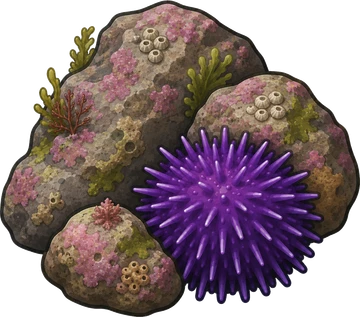
Depth records run from the shallows to about 250 feet, and the water the species holds in runs 64 to 72 degrees, which is the warm end of the Southern California range and part of why the islands hold more of them than the mainland does. The habitat is specific in a way that shows in every photograph of the species: open rock, in plain view, with a crevice within a body length. A blue-banded goby perches on the exposed face of a rock and darts into a hole the instant anything moves toward it. Where crevices are short, the fish uses a substitute that is hard to believe until it is seen. It backs into the spines of a living sea urchin and sits there, protected by an animal that has no interest in it either way.
Deep Dive
A fish this small and this bright ought to be a footnote. Instead the blue-banded goby is one of the most studied fish in California, and the reason is what it does with sex.
Most fish that change sex go one direction. A wrasse or a sheephead starts female and becomes male, and that is the end of it. The blue-banded goby goes either way, repeatedly, depending entirely on where it sits in the social order of the moment. Bidirectional sex change was first described in this species by St. Mary in 1993, and later work established that the switch is under social control rather than being driven by age or size on a schedule.
The rule that governs it is positional. A goby that is subordinate in its group expresses female. A goby that is dominant expresses male. Remove the male from a group and the dominant female begins the change to male within days. Put a male back into a position of subordination and the change can run the other way. The animal is not committed to a sex; it is committed to a rank, and the sex follows.
What makes the mechanism genuinely strange is the order of operations. The behavior changes first. A female moving into the dominant slot escalates her aggression, and the neural changes that go with that aggression happen before the gonad reorganizes. The fish acts male, and then becomes male. Underneath, the gonad is not a simple ovary or testis at all: it is an ovotestis, carrying both kinds of reproductive tissue at once, with the balance shifted rather than replaced. FishBase describes the species as a simultaneous hermaphrodite with varying allocation of reproductive tissue, which is a precise way of saying that a blue-banded goby is always partly both.
Researchers have found serotonin, the same signaling molecule that carries social and mood information in vertebrate brains generally, involved in the link between social status and sex change in this species. That combination, a fish small enough to keep in numbers, quick to reorganize, and reading its own social rank through a neurochemical system shared with the rest of the vertebrates, is why the blue-banded goby ended up in so many laboratories. Stable social groups sort themselves into a linear hierarchy within about 5 days in a tank, which means the whole cycle can be run and rerun.
The ordinary parts of the life are ordinary. The fish reaches 2.5 inches at most. It eats small crustaceans picked off the rock. It is territorial at the scale of a few inches of reef. Males guard the eggs, which are laid in empty shells or against the walls of a small brood chamber, and the guarding is the male's contribution. What a diver sees is none of that. What a diver sees is a spot of orange and blue on grey rock that vanishes into a crack when the camera gets close, and then reappears 30 seconds later in exactly the same spot.
Where to Find Them
Researched habitat and range candidates
San Diego · 13 beaches
Orange County · 10 beaches
Catalina Island · 14 beaches
Los Angeles · 10 beaches
Channel Islands · 24 beaches
Ventura · 15 beaches
Santa Barbara · 10 beaches
San Luis Obispo · 18 beaches
These locations have suitable habitat within the species range. An assignment is a possible encounter, not a confirmed sighting at every beach. Season, depth, and local conditions still matter. Historical habitat without present-day evidence is excluded.