
Also calledC-O turbot, mottled turbot, popeye sole
 Spearfishing


Spearfishing Stats
Sitka or Prince William Sound, Alaska, to northern or central Baja California; common central Baja to Vancouver Island.
Taxonomy
Rarity
Abundance rates how many are in suitable habitat. Find difficulty rates how hard it is to locate one on a daylight snorkel or freedive through 50 ft. A higher find score means a harder search. The rarity category also reflects the kind of encounter; it is not an average of the 2 scores.
Regulations
CDFW rules verified 2026-10-15
Seasonality
Edibility
A small flatfish that is hard to fillet, so it is often cooked whole.
Location
FishBase gives the range as Sitka in southeastern Alaska to Bahia San Quintin in northern Baja California. Jones gives a wider range, from Prince William Sound in Alaska to Punta Abreojos in Baja California, and describes it as common from central Baja California to Vancouver Island. Mexican Fish puts its southern limit in Mexico near Guerrero Negro, on the central Baja coast.
It lives on soft bottom near hard structure. Mexican Fish describes it over sand and mud beside reefs and breakwaters, normally shallower than about 100 feet. Jones adds that it sometimes sits near rocks and algae and is common in shallow bay water, and the Oregon Coast Aquarium reports that it usually lives shallower than 66 feet and ranges from estuaries out to the continental slope. Jones records it as deep as about 1,146 feet. FishBase notes that young fish are common in shallow water in summer, while adults often live deeper.
Spearfishing Brief
Finding a C-O sole rates a 3. It is a camouflaged ambush hunter. Mexican Fish describes it lying half buried on the bottom, and notes that its color varies from off-white to almost black, with heavy mottling. Taking one rates a 2, because it lies in wait on the bottom. The fish is small, reaching about 14 inches and 1 pound.
California has no special rules for it. The C-O sole is not on either of the state's federal flatfish lists, so it falls under the general limit of 20 finfish, with no more than 10 of any 1 species, and no size limit. Take is prohibited in state marine reserves, and north of Ventura County spears may not be used within 100 yards of a stream mouth. Oregon counts it in a limit of 25 flatfish in aggregate and allows spears. Washington counts it as a flatfish within its bottomfish limits, which differ by marine area.
It is a good fish to eat. Jones rates its food value as excellent, with white, mild, soft flesh that is low in fat, and suggests simply pan-frying it. Mexican Fish calls it a high-quality food fish but notes that it is small and difficult to fillet.
Deep Dive
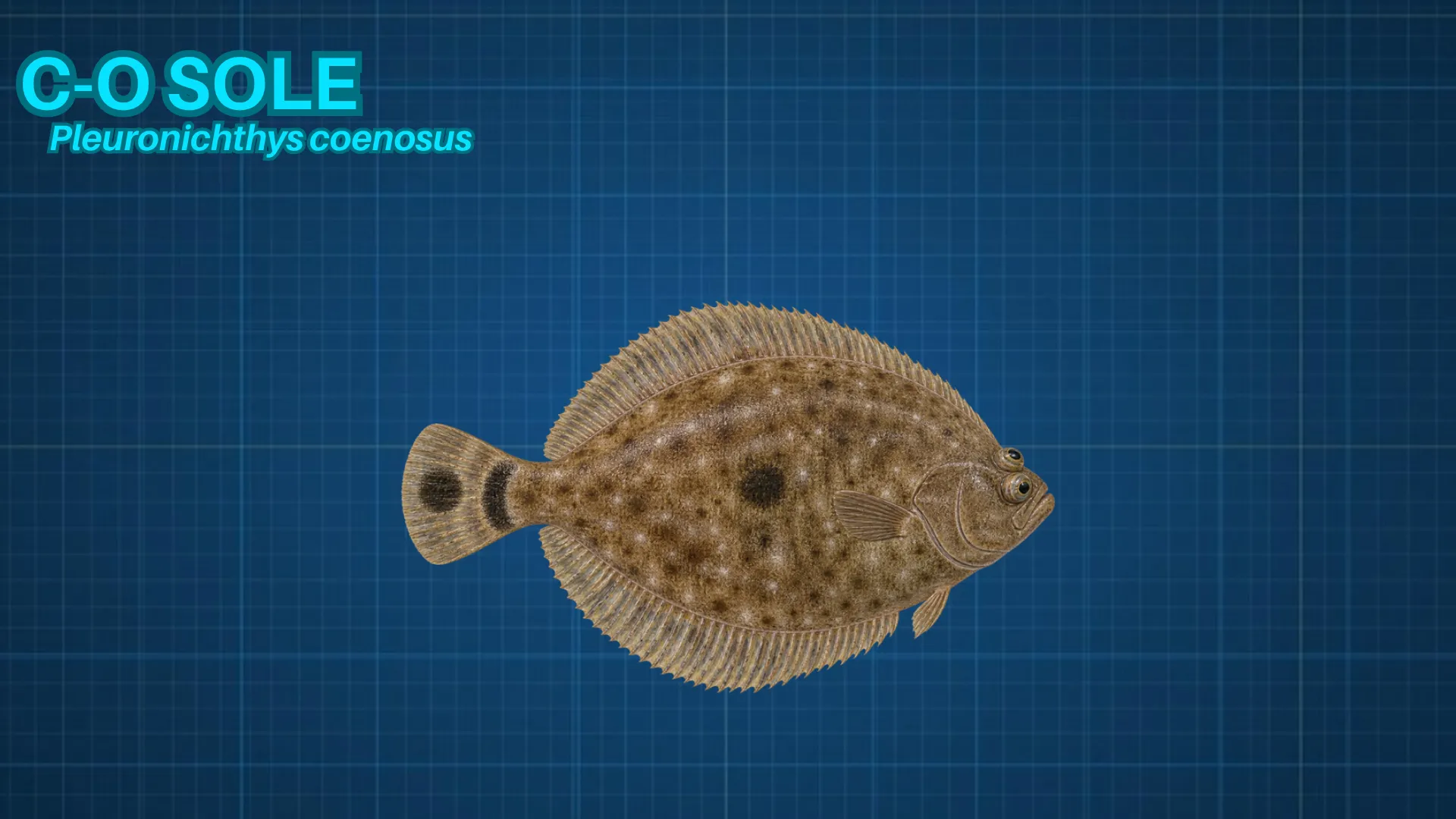
The C-O sole takes its name from its tail. Mexican Fish describes a dark spot in the center of the tail fin and a crescent where the tail meets the body, together forming the letters C and O. The markings are hard to see on some fish. A second dark spot, about the size of an eye, often sits in the middle of the body. The eyes are large and raised, with a bony ridge between them.
It is a righteye flounder, meaning that both eyes sit on the right side of the head, which faces up as the fish lies on the bottom. The mouth is small, with thick lips. Mexican Fish reports that it eats brittle stars, clams, crabs, marine worms, shrimp and small fish, and that bottlenose dolphins and copper rockfish eat it. The Oregon Coast Aquarium describes how it hunts worms: it swims up off the bottom and then dives headfirst into the sand. The aquarium adds that it can live more than 6 years.
That small mouth makes it hard to catch on a hook. Mexican Fish recommends hooks of size 4 or smaller, baited with bloodworms, lugworms or ghost shrimp, and notes that C-O sole is only rarely sold at dockside markets in California.
Where to Find Them
Researched habitat and range candidates
San Diego · 15 beaches
Orange County · 10 beaches
Catalina Island · 6 beaches
Los Angeles · 11 beaches
Channel Islands · 21 beaches
Ventura · 16 beaches
Santa Barbara · 12 beaches
San Luis Obispo · 22 beaches
Monterey · 17 beaches
Oregon South Coast · 15 beaches
Oregon Central Coast · 8 beaches
Oregon North Coast · 8 beaches
South Sound · 12 beaches
Hood Canal · 9 beaches
Central Sound · 13 beaches
North Sound · 8 beaches
San Juan Islands · 8 beaches
Strait of Juan de Fuca · 5 beaches
Cape Flattery · 3 beaches
These locations have suitable habitat within the species range. An assignment is a possible encounter, not a confirmed sighting at every beach. Season, depth, and local conditions still matter. Historical habitat without present-day evidence is excluded.