
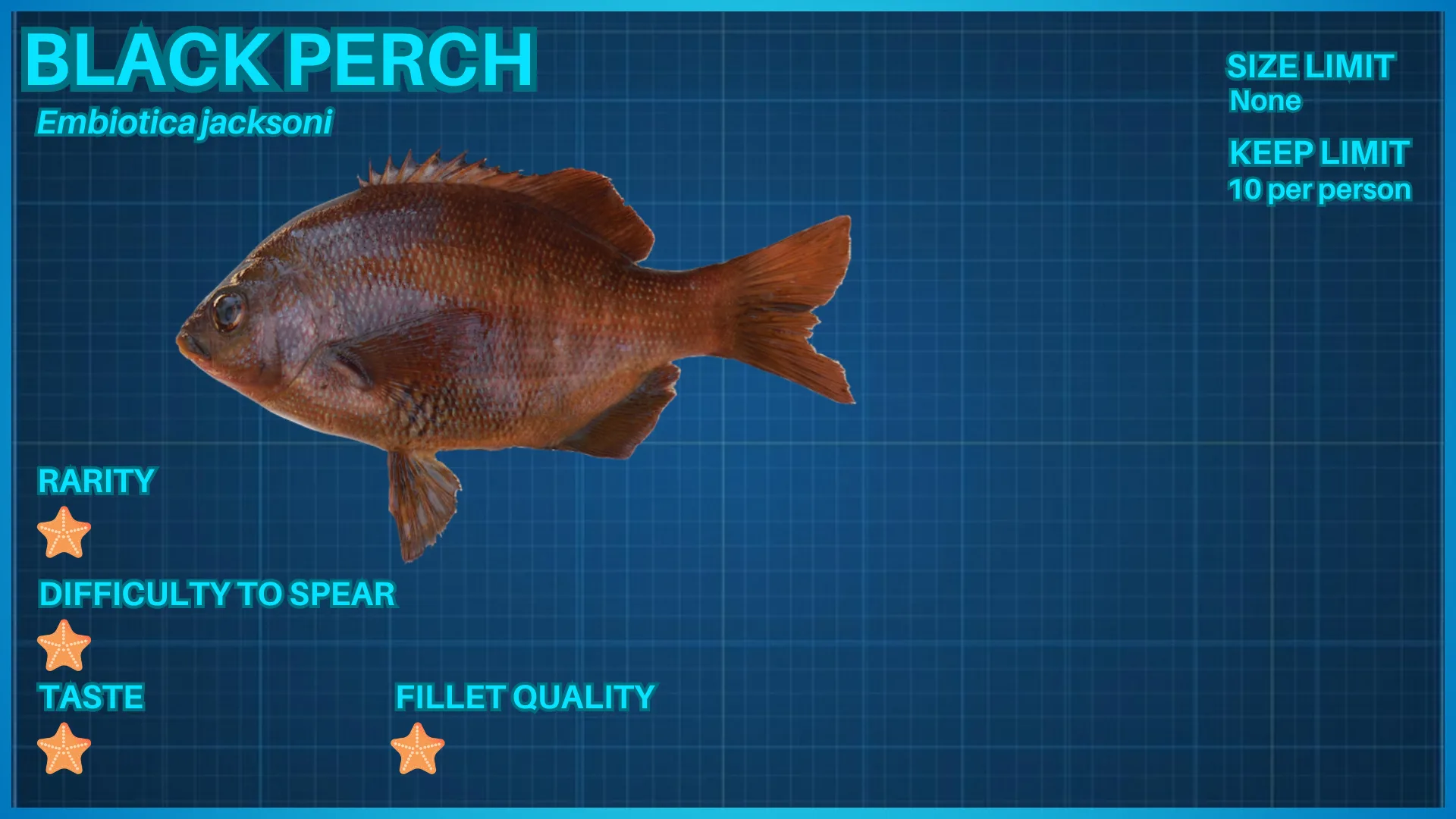
Also calledbutterlips, buttermouth perch, black surfperch, black seaperch, pogie
 Spearfishing

Photo: Marrisa Shaw, Marine Room deep reef, La Jolla
Spearfishing Stats
Southern California rocky reef bottom
Taxonomy
Rarity
Abundance rates how many are in suitable habitat. Find difficulty rates how hard it is to locate one on a daylight snorkel or freedive through 50 ft. A higher find score means a harder search. The rarity category also reflects the kind of encounter; it is not an average of the 2 scores.
Regulations
CDFW rules verified 2026-07-16
Seasonality
Edibility
Small and bony for the size of the fish, and the flesh goes soft without careful handling.
Location
Black perch range from Fort Bragg in Mendocino County, California, south to central Baja California, Mexico, including Guadalupe Island offshore of Baja California. They are most abundant south of central California. Adults live on rocky reef near kelp, in kelp forest itself, and in eelgrass beds inside coastal bays. They sit occasionally over sandy bottom near piers and pilings, and almost never in the open surf. Most are seen in 10 to 30 feet of water. They are rarely found below about 80 feet, and reach a maximum of about 150 feet. Single fish or small clusters of 3 or 4 stay close to cover, and a fish that drifts off when a diver approaches tends to circle back to the same spot. The species shows strong site attachment. Individual fish often remain within a small patch of reef for years, and a section of reef with black perch on it tends to keep the same group across seasons.
Spearfishing Brief
Most black perch taken in California are caught on hook and line. The species is one of the primary targets for shore, jetty, and pier anglers, and among the surfperches it is one of the most commonly caught fish statewide. The classic tackle is a size 6 or size 8 hook fished on the bottom with a high-low leader, and the classic bait is fresh mussel, bloodworm, pile worm, small pieces of shrimp, or a small rock crab. For a diver, black perch is a legal spear target on the same reefs a shore spearo already searches for calico bass and California sheephead, but it is a bycatch fish rather than the reason for the dive. The community spearfishing guides for California do not feature it, and the Cast and Spear list of 21 California target fish leaves it off while including rubberlip perch and pile perch. A 2020 spearfishing catch-and-cook video treats the species as an experiment rather than a trophy, and its maker judged a pan-seared fillet passable in soup and no better.
Find difficulty rates a 1. Normal searching along rocky reef and the outer edges of kelp beds in 10 to 30 feet of water turns them up, and the fish is visually distinctive. Thick yellow lips with a darker mustache band above the upper lip give the fish its nickname butterlips. The body is a deep oval, flat side to side, dark reddish-brown to tan with darker vertical bars, and the tail and pelvic fins are orange to red. A patch of enlarged scales sits between the pectoral and pelvic fins and stands out at close range. The species can shift its color for camouflage, but the change is subtle and does not reach the near-invisible camouflage of a scorpionfish or a buried halibut. Kelp plants anchor to rock with a root-like base called a holdfast. A diver who scans the reef and looks under ledges and into those holdfasts will see the fish.
Shot difficulty rates a 1. Black perch stay close to cover and tolerate a slow approach. Larger males defend small territories on the reef during the spring courtship season in Southern California and do not leave them for a passing diver. Because the same fish returns to the same rock, a target that spooks off does not disappear from the dive. A controlled slow approach into the reef puts a diver inside a few feet of the fish, with time to line up the shot. The right weapon is small. A pole spear or a short single-band speargun handles the fish without difficulty, and community consensus for small nearshore reef fish is that neither a reel nor a float is needed. A larger speargun is no help when every shot is this close, and it is harder to maneuver into the kelp holdfasts where the fish sits.
Deep Dive
Black perch is a surfperch, and the family sets it apart from almost every other California reef fish in one central way. Surfperches do not lay eggs. The female carries her young inside her body for months, and the fish are born as fully formed miniature adults that swim on their own within minutes of birth. In most reef fish, adults release eggs and sperm into open water. The eggs hatch into tiny larvae. Those larvae drift as plankton in the currents for weeks or months before the survivors settle onto the reef. Black perch skip that stage entirely. The family name comes from Greek and means persistent birth, which refers to this trait.
The species is one of the best-studied members of the family. Females carry about 10 to 50 embryos in a specialized pouch inside the ovary. The young are nourished by yolk at first and later by contact with the mother's bloodstream. The developing embryos extend the vein-rich edges of their fins against the ovary wall and draw oxygen and nutrients across that tissue. Gestation runs about 5 to 6 months. In Southern California, mating peaks in spring, several months earlier than in central California. Males and females meet in courtship groups of up to 20 fish, and larger males stake out small territories on the reef where the pairings happen. Pairs that stay together longest are closely matched in size, and mismatched pairs court only briefly before separating. During the mating season, males grow a pair of small nipple-like organs on the anal fin that transfer sperm to the female for internal fertilization. Sexual maturity comes at about 6 inches long and 1 or 2 years of age. The species lives up to about 10 years, and a maximum-sized fish reaches about 15 inches, though most fish an angler or diver brings home are under 12 inches.
Because black perch never spend a plankton stage in open water, their populations are unusually local. A juvenile born on a specific reef starts life on that same reef, and adults tend to stay near where they were born. Genetic work in the species has identified a distinct break in the population off Los Angeles County, with northern and southern black perch showing clear genetic differences that would not persist in a fish whose larvae drift for weeks in open ocean currents. This is why a reef with a group of black perch on it keeps that group year after year. The fish are not moving in from elsewhere in any given season.
Diet and feeding change with age. Juveniles are small enough that they can only take small prey, and they pick items one at a time off the surface of leafy algae. Adults shift to a distinctive habit. They take a mouthful of substrate or gravel, filter out any small animals hidden in it, and spit out the shells, sand, and debris. Black perch eat small invertebrates at every age. Gammarid amphipods, small shrimp-like crustaceans that live among algae and sand, are the main prey. Marine worms, brittle stars, bryozoans (the small crust-forming animals that grow on rock and algae), small crabs, and mollusks fill out the menu. Young black perch also serve as documented cleaner fish. Juveniles and smaller adults will feed on external parasites picked from the bodies of larger reef fish. Hobson documented the behavior in his 1971 survey of cleaning symbiosis among California inshore fishes and listed black perch juveniles among the reef fishes that clean other fish. Cleaner behavior is not the main way the fish makes a living, but it is a documented and often observed side habit.
Documented predators of black perch include kelp bass, grass rockfish, larger rockfishes generally, barred sand bass, lingcod, California halibut, harbor seals, and cormorants. Laboratory and field experiments by Holbrook and Schmitt in the late 1980s showed that first-year young black perch avoid patches of reef where kelp bass or grass rockfish are present. The young fish spend less time feeding in a patch with a predator in it, though they do not slow their feeding rate. Larger adults face fewer predators once they reach a size where a kelp bass cannot swallow them, but they remain prey for the larger reef predators through their lives.
On the plate, black perch is an ordinary panfish. California Sea Grant and pier fishermen describe the meat as white, small-flaked, mild, and low in oil, with a soft texture. Reviews split on texture rather than flavor. Sources report little to no fishy aftertaste, and anglers disagree mainly on whether the flesh is too soft. The soft-texture problem is what most of the negative reports come back to. Community advice for surfperch generally is to ice and bleed the fish immediately after catch to firm up the meat, and to fry the fillets quickly in hot oil rather than let them sit or cook slowly. Small yields per fish, soft meat, and the split reviews put black perch at Poor for eating quality. A diver who takes one alongside a calico bass or a sheephead gets a small mild fillet, best when the fish is iced and bled soon after the shot and cooked quickly in hot oil.
Where to Find Them
Researched habitat and range candidates
San Diego · 13 beaches
Orange County · 10 beaches
Catalina Island · 14 beaches
Los Angeles · 10 beaches
Channel Islands · 24 beaches
Ventura · 15 beaches
Santa Barbara · 10 beaches
San Luis Obispo · 25 beaches
Monterey · 17 beaches
These locations have suitable habitat within the species range. An assignment is a possible encounter, not a confirmed sighting at every beach. Season, depth, and local conditions still matter. Historical habitat without present-day evidence is excluded.