
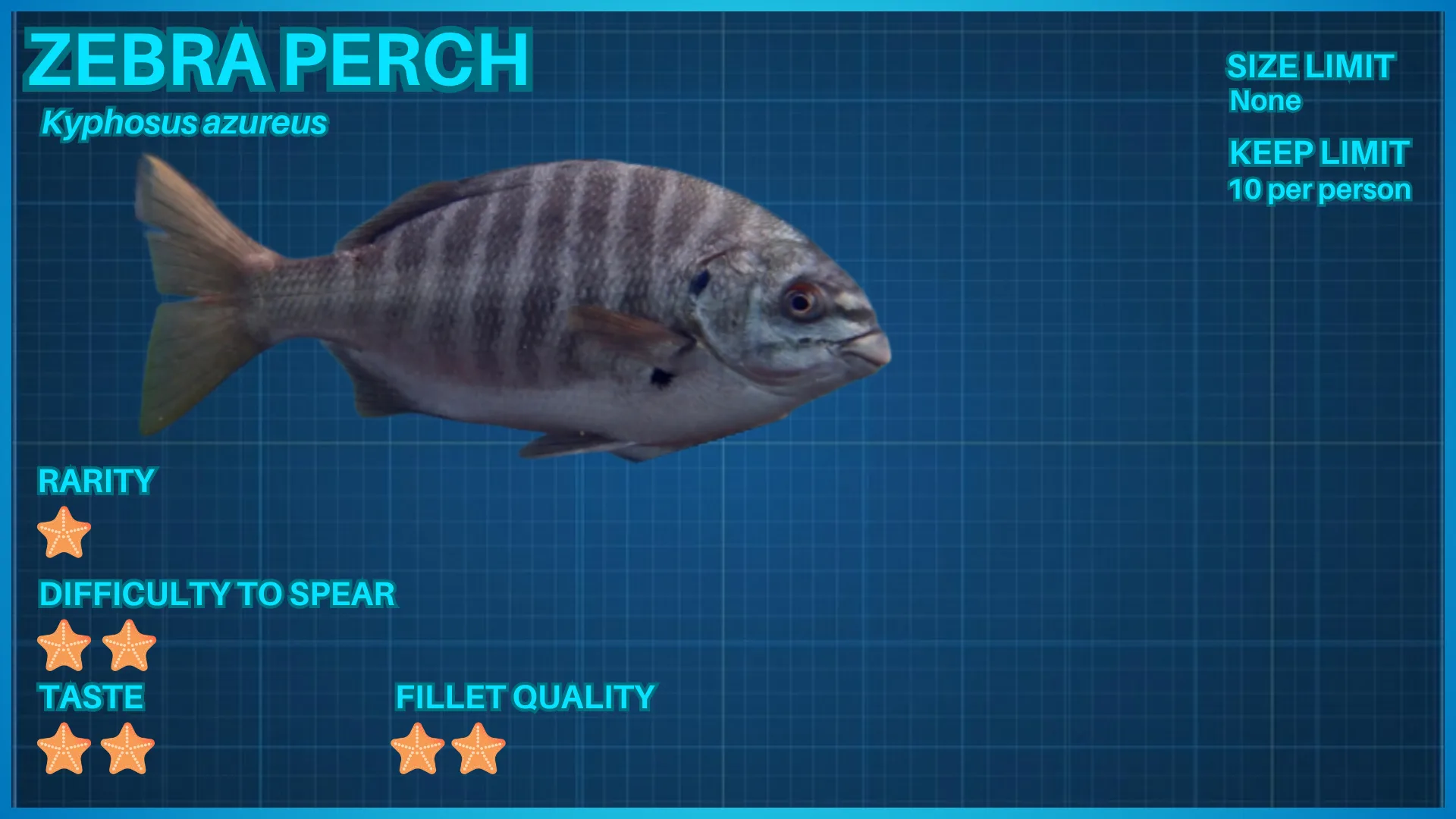
Also calledzebra sea chub, convict fish
 Spearfishing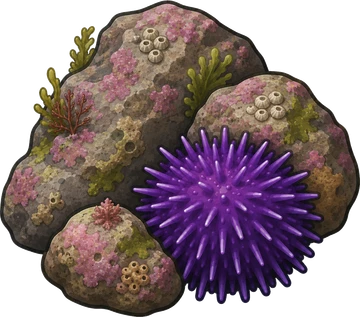

Spearfishing Stats
Southern California shallow rocky reefs
Taxonomy
Rarity
Abundance rates how many are in suitable habitat. Find difficulty rates how hard it is to locate one on a daylight snorkel or freedive through 50 ft. A higher find score means a harder search. The rarity category also reflects the kind of encounter; it is not an average of the 2 scores.
Regulations
CDFW rules verified 2026-07-16
Seasonality
Edibility
Poor structure off an algae-eating fish, and the flesh carries the earthy note of that diet.
Location
Zebra perch range along the eastern Pacific from Monterey Bay in California south to Baja California and into the Gulf of California, Mexico, with the largest concentrations in the northern and central parts of the gulf. In California, the fish is most common south of Point Conception, Santa Barbara, and it is especially reliable around the Channel Islands, where the shallow rocky reefs match its preferred habitat. Adults hold on reef and reef flats with algal cover, mostly from the intertidal down to about 25 feet, though they turn up as deep as 50 feet. Juveniles live in rocky tide pools during their first year, then move down onto the subtidal reef. Adults gather in schools during the day, often mixed with halfmoon and opaleye. At night they retreat into crevices in the reef. Spawning aggregations have been documented on Catalina Island, Los Angeles County, though the specific spawning season for California waters is not well established in the peer-reviewed literature.
Spearfishing Brief
Zebra perch are common on the shallow reef and easy to spot, and neither half of the hunt asks much of a diver. Finding a school is straightforward. The fish gather in daylight, often mixed with halfmoon and opaleye, and their pattern makes them easy to identify: a silvery body carrying about 10 narrow dark bars, with a bright blue spot on the gill cover behind the eye and a black spot at the base of the pectoral fin. A slow pass along a reef flat or the outer edge of a kelp bed south of Point Conception, Santa Barbara, usually turns up a mixed school within the first few minutes of the dive. Find difficulty rates a 1.
The shot rates a 1 as well. Zebra perch hold in loose schools on shallow structure and let a diver ease in close, so the working approach is a controlled drift into the school and a shot taken as the fish circle back or pass through cover. A slow descent to the bottom near a school also works, the same way it works for opaleye. Overall difficulty is 1.
The weapon is small. A pole spear or a short single-band speargun in the 60 to 90 centimeter range is enough for a fish that tops out at about 18 inches and 3 pounds. Most zebra perch on the reef run 10 to 14 inches, and the shots come at a few feet in shallow water. Zebra perch are also a hook-and-line target for California pier and rocky-shore anglers, who catch them on small hooks and light line, with baits that suit an herbivorous fish: moss, peas, and fresh mussels. Snag-hooking accounts for a share of the pier catch as well, which reflects the difficulty of getting an herbivorous fish to take a baited hook.
The reason more divers do not target zebra perch has nothing to do with the difficulty and everything to do with the plate. Zebra perch are one of very few near-strict herbivores on the California reef, and the algae-heavy diet leaves an earthy undertone in the meat that a majority of California spearfishers find off. The fish does not appear on the widely referenced California spearfishing target list. A minority of divers defend the meat as fair and mild, though the same angling source that rates it fair places it below opaleye and halfmoon. The mainstream picture is that a diver on a shallow reef will see zebra perch often and pass most of them over for halfmoon, opaleye, or sargo.
Deep Dive
The zebra perch is a sea chub, and a near relative of the halfmoon and the opaleye. All 3 are shallow-reef fish of Southern California and northern Baja California. They are unusual on the California coast for eating mostly algae rather than other animals. The family name matters, because the common name for this fish is misleading in two ways. First, it is not a true perch. Second, and more importantly, it is not a surfperch, so it does not carry the live-bearing biology that surfperch are known for and it does not fall under California's surfperch regulations. Zebra perch spawn like most reef fish, by releasing eggs and sperm into open water. The name comes from the vertical dark bars along the flank, not from any relationship to the surfperch family. The halfmoon, sometimes called Catalina blue perch, is a sea chub in the same boat, another algae-eating reef fish with "perch" in a common name it never earned biologically.
The species was first described in 1889 from a specimen collected off Guaymas, Sonora, Mexico, and was placed for more than a century in a separate genus of its own. In 2013, a taxonomic review folded that genus into the larger sea chub genus, which is why older sources and field guides use a different scientific name for the same fish. Zebra perch is one of several common names for the animal. Zebraperch, zebra sea chub, and the Spanish chopa bonita all describe the same species.
Adults reach a maximum of about 18 inches in total length and about 3 pounds in weight, though the typical fish on the reef and on the pier runs 10 to 14 inches. The body is deep and oval, silvery-gray on the back, paler underneath, and marked with about 10 narrow dark vertical bars running down each flank. A bright blue spot sits on the upper gill cover behind the eye, and a black spot sits below the base of the pectoral fin. The dorsal fin carries 11 spines that can fold down into a scaly groove along the fish's back. The head lacks the small scales that cover the head of the related sea chubs, which is a distinguishing feature under water and in the hand.
The diet is what makes this fish biologically interesting. Very few marine fish in California eat as little animal matter as the zebra perch. A peer-reviewed study of zebra perch stomach contents off Catalina Island by Sturm and Horn, published in Marine Biology in 1998, found that animal matter accounted for less than 0.01 percent of the dry weight of the diet. Red algae made up 88 percent, brown algae 8 percent, and green algae 4 percent. The single most important food item was a fine, thread-like red algae found in more than 78 percent of the stomachs sampled. To handle a diet of tough, low-nutrient plant matter, the zebra perch grows a digestive tract that averages 4 times the length of its own body. A follow-up study by Fidopiastis and colleagues, published in Marine Biology in 2006, showed that the hindgut and its blind pouch house a dense and diverse community of fermentative bacteria that appears to break down the algal sugars in the fish's diet. That fermentation, combined with acid digestion in the stomach, is how the fish extracts calories from a diet that would starve almost any other reef fish in these waters.
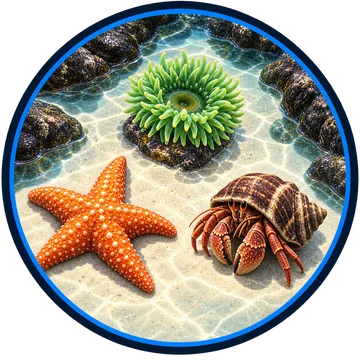
Juveniles behave differently from adults. Young zebra perch live in rocky tide pools during their first year of life, where they occasionally act as cleaner fish for other tide pool species. A Catalina Island naturalist observed young zebra perch removing parasites or scales from topsmelt, and the same cleaning behavior has been recorded on opaleye and shiner perch. Some animal protein enters the diet at this age, though the adults are almost entirely herbivorous. Once the young fish move from the tide pools onto the subtidal reef, they join the schools that adults keep with halfmoon, opaleye, and Pacific sergeant major.
Spawning is pelagic. Adults gather to release eggs and sperm into open water. The eggs and larvae then drift with the plankton for a stretch of time before settling in shallow rocky habitat. A Catalina Island naturalist documented what appeared to be a spawning aggregation at Long Point in Los Angeles County, with possibly thousands of the fish schooling together. Larval sampling off California and Baja California shows that zebra perch larvae are the most coastal of the 3 sea chubs in the region, keeping close to shore. The specific timing of the spawn in California is not well established in the peer-reviewed literature.
Documented predators of small schooling reef fish in Southern California include kelp bass, California barracuda, yellowtail, larger sharks, and California sea lions. Zebra perch fall within the size class those predators take, and no study specific to zebra perch predation was located. What is documented is that the species is not commercially fished at any scale, and California recreational take is incidental. Pier anglers catch the occasional fish on peas, moss, or fresh mussels, on light tackle and small hooks. Snag-hooking accounts for a share of the pier catch as well, which reflects the difficulty of getting a plant-eating fish to take a baited hook.
On the plate, the community verdict on zebra perch is honestly split, and the split has a biological reason behind it. A majority of California spearfishers describe the meat as earthy or muddy and pass the fish over for halfmoon, opaleye, or sargo. A regional Mexican fish reference calls zebra perch a subsistence catch rather than a food fish. Both of those verdicts trace to the same source: a diet built almost entirely on algae, digested in a hindgut that ferments the algae the way a cow's rumen ferments grass. The byproducts of that fermentation show up on the plate as an earthy undertone that some people dislike and others do not mind. A minority of divers and anglers rate the meat as fair eating: mild, small-flaked, and firm, comparable to other sea chubs. The California pier-fishing literature places the fish somewhere in the middle, worth taking and mild but not the equal of opaleye or halfmoon.
Where to Find Them
Researched habitat and range candidates
San Diego · 13 beaches
Orange County · 10 beaches
Catalina Island · 14 beaches
Los Angeles · 10 beaches
Channel Islands · 24 beaches
Ventura · 15 beaches
Santa Barbara · 10 beaches
San Luis Obispo · 25 beaches
Monterey · 17 beaches
These locations have suitable habitat within the species range. An assignment is a possible encounter, not a confirmed sighting at every beach. Season, depth, and local conditions still matter. Historical habitat without present-day evidence is excluded.