

Taxonomy
Rarity
Abundance rates how many are in suitable habitat. Find difficulty rates how hard it is to locate one on a daylight snorkel or freedive through 50 ft. A higher find score means a harder search. The rarity category also reflects the kind of encounter; it is not an average of the 2 scores.
Regulations
CDFW rules verified 2026-09-26
Seasonality
Edibility
Location
California mussels live along the eastern Pacific from the Aleutian Islands in Alaska south to Baja California. They hold the upper-middle part of the intertidal zone, the band of shore that the tide covers and uncovers each day, and they favor the open coast where waves hit hardest. They also grow on pier pilings. Below the tide line they become less common, though they have been recorded to about 80 feet.
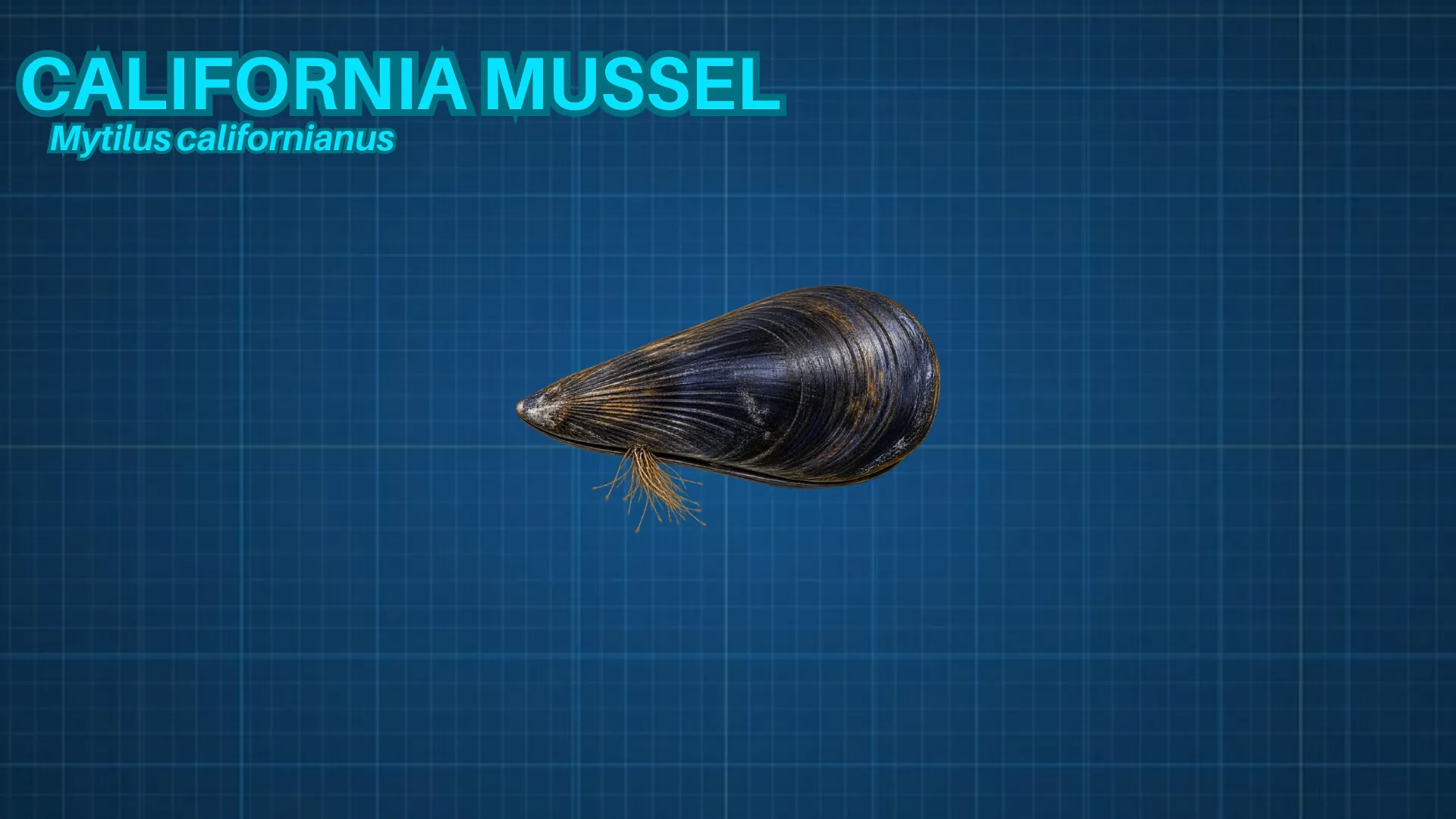
Each mussel anchors itself with byssal threads, tough fibers made by a gland at the base of its foot. The gland releases the material as a liquid, which hardens into a thread when it meets seawater. A mussel can even move slowly across the rock by breaking old threads and making new ones.
The shell is thick and blue-black, pointed at the front, and marked with strong ridges that run outward from the hinge. Those ridges separate it from the bay mussel, whose shell is smooth. Adults usually reach 5 to 6 inches, and a shell nearly 10 inches long has been recorded in Baja California.
Harvest Brief
The whole California coast; the range runs from the Aleutian Islands, Alaska to Baja California.
Mussels are gathered by hand, on foot at low tide, because the beds sit on surf-exposed rock in the intertidal. California lets people take saltwater mollusks only by hook and line or by hand. Anyone 16 or older needs a sport fishing license to gather tidepool animals. The daily bag limit is 10 pounds in the shell, counting California mussels and bay mussels together.
Mussels are on the short list of animals that may be taken from the rocky intertidal. That permission does not apply inside state marine reserves, where no invertebrate may be taken, and some other protected areas close their tidepools. Collecting worms from a mussel bed is also prohibited, except for worms taken by accident while harvesting the mussels themselves.
Each year the state quarantines every species of mussel taken by the public anywhere on the California coast, including bays and harbors. The quarantine exists because mussels can build up paralytic shellfish poison and domoic acid, 2 natural toxins produced by plankton. Paralytic shellfish poison begins with tingling and numbness in the lips and tongue and can lead to paralysis and death. Domoic acid can cause vomiting, permanent loss of short-term memory, coma, or death. Cooking destroys neither toxin. The quarantine does not apply to commercial shellfish from approved sources, which are tested often. For a sport harvester, that leaves November through April, unless the state issues another health warning. The California Department of Public Health keeps a shellfish toxin line at 1-800-553-4133.
Deep Dive
A mussel bed is home to far more than mussels. Thick beds trap material from the water, and that gives food and shelter to a wide range of other animals. One study counted 625 mussels and 4,096 other invertebrates in a single clump of about 4 square inches. Another identified 610 species of animals and 141 species of algae from mussel beds.
Each mussel feeds by filtering the water. It draws seawater over its gills and strains out plankton and fine particles of organic matter, filtering 2 to 3 quarts of water an hour.
The sexes are separate. Males and females release sperm and eggs into the water, where fertilization happens, and in California spawning goes on all year with peaks in July and December. A mussel reaches full size in about 3 years and is mature by the same age. Some live to 8 years or more.
Many animals eat mussels. Small ones are taken by shiner surfperch, crabs, shorebirds, and predatory snails such as dogwinkles. Large ones are eaten by sea stars, sea otters, and people. Sea stars take most of their mussels from the lower edge of a bed, which is where one of the most famous experiments in ecology comes in. In the 1960s, the ecologist Robert Paine removed ochre sea stars from a stretch of Washington shore and kept them out. Without the sea stars, the California mussel spread across the rock and crowded out 7 other species. The mussel was the stronger competitor for space, and only the predator had kept the shore diverse. That result gave ecology the term keystone species, and the ochre sea star entry tells that story in full.
People have eaten California mussels for a long time. Native American coastal tribes ate them, and the species is still taken for food and for bait today.
Where to Find Them
Researched habitat and range candidates
San Diego · 13 beaches
Orange County · 10 beaches
Catalina Island · 6 beaches
Los Angeles · 10 beaches
Channel Islands · 21 beaches
Ventura · 15 beaches
Santa Barbara · 10 beaches
San Luis Obispo · 20 beaches
Monterey · 17 beaches
Oregon South Coast · 15 beaches
Oregon Central Coast · 8 beaches
Oregon North Coast · 8 beaches
South Sound · 12 beaches
Hood Canal · 9 beaches
Central Sound · 12 beaches
North Sound · 8 beaches
San Juan Islands · 8 beaches
Strait of Juan de Fuca · 5 beaches
Cape Flattery · 3 beaches
These locations have suitable habitat within the species range. An assignment is a possible encounter, not a confirmed sighting at every beach. Season, depth, and local conditions still matter. Historical habitat without present-day evidence is excluded.