


Taxonomy
Rarity
Abundance rates how many are in suitable habitat. Find difficulty rates how hard it is to locate one on a daylight snorkel or freedive through 50 ft. A higher find score means a harder search. The rarity category also reflects the kind of encounter; it is not an average of the 2 scores.
Seasonality
Location
The rock prickleback ranges from Port San Juan in southeastern Alaska south to Santa Cruz Island, one of the Channel Islands off Santa Barbara County. FishBase records it in rocky areas from the intertidal zone down to about 60 feet, mostly along the exposed outer coast. The Victoria High School guide adds that it favors shores that take moderate waves.
The fish is built for life between the tides. It can breathe air, and a rock prickleback kept moist under rocks or seaweed can survive out of water for 17 to 23 hours. That lets it stay in the rocks through a low tide instead of following the water out.
Deep Dive
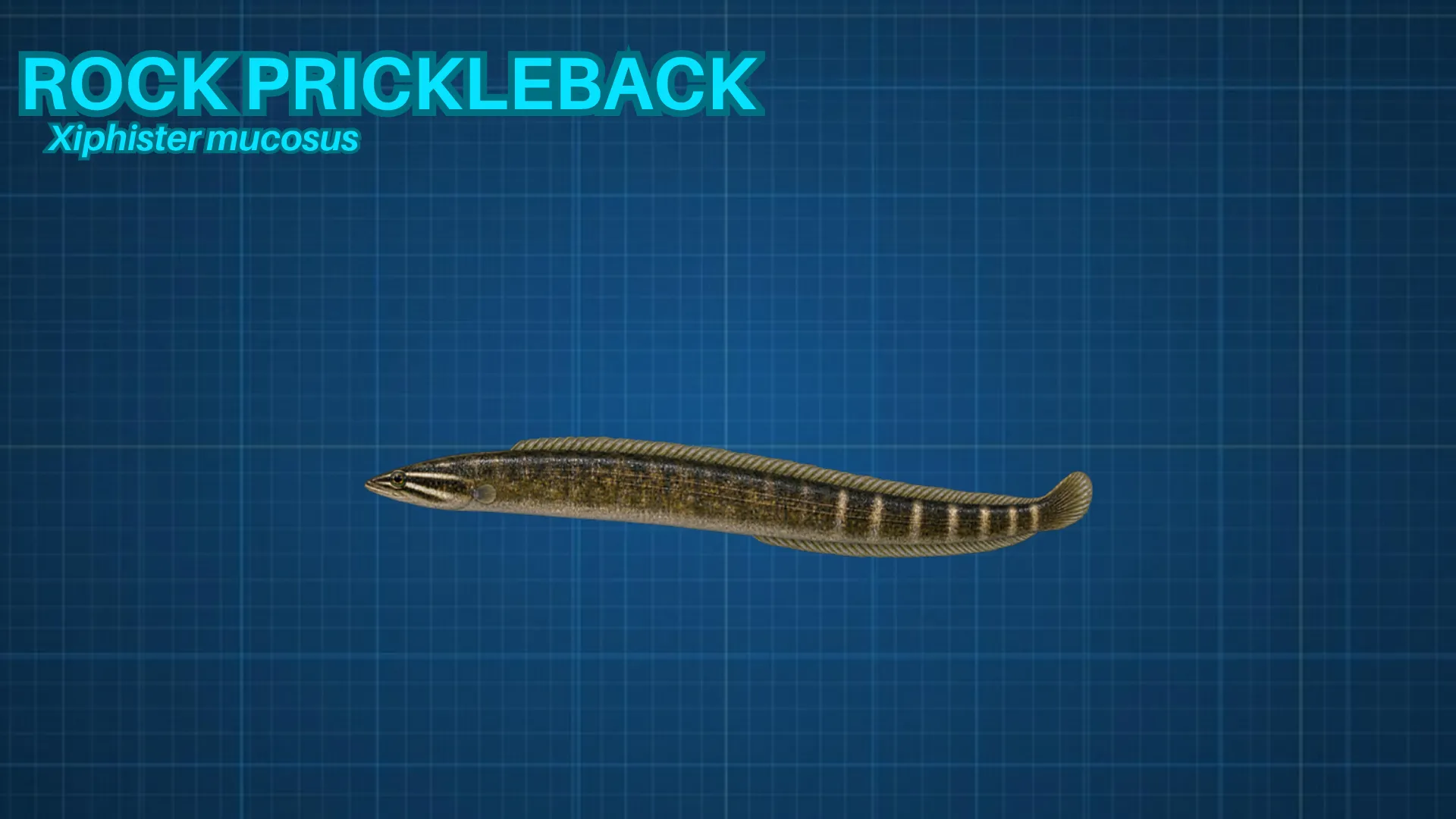
Despite its long, eel-like shape, the rock prickleback is not an eel. It belongs to the prickleback family, a group of long-bodied fish related to the eelpouts, which sit within the large order of perch-like fishes. The name comes from the dorsal fin, the fin along the back. On this fish it runs from just behind the head to the tail and is made of 71 to 77 sharp spines. The fins on its sides are reduced to tiny flaps, it has no pelvic fins at all, and the tail is small, rounded and angled upward.
The body is greenish black, with several pale bars toward the tail. From each eye, 2 dark bands run back and apart, and each band is doubled, with a paler stripe down its center. The Victoria High School guide notes that the fish is often confused with the black prickleback, a close relative whose face bands are solid black.
The species grows to about 23 inches. FishBase gives a maximum age of 11 years, and the Victoria High School guide reports that a fish takes 4 to 5 years to reach maturity.
The rock prickleback eats seaweed and very little else. Studies of its stomach contents over about 40 years have found that seaweed makes up more than 98% of its diet, with sea lettuce and red seaweeds such as laver among the common items. A 2022 study in the Journal of Comparative Physiology B compared it with 3 related pricklebacks collected at low tide on San Juan Island, Washington. The rock prickleback had the longest gut of the 4, both in wild fish and in fish kept for 4 weeks in the lab on meat-based or mixed diets.
The species breeds in winter. The female lays her eggs in clumps under rocks, and the male coils his body around the egg mass and guards it until the eggs hatch.
People have eaten the rock prickleback for a long time. According to the Victoria High School guide, skeletal remains in shell middens, the refuse heaps left at old village sites, show that coastal First Nations used it as food for hundreds of years.
The fishing rules differ by state. California counts it toward the general bag limit: no more than 10 per person per day, as part of a total of 20 finfish, with no size limit and no closed season. Take is prohibited inside state marine reserves. In Oregon it falls under the general marine species daily bag, which the state sets during the season, and anglers fishing for it in the ocean need an Ocean Endorsement. Washington's rules do not list it as a food fish or a game fish, and every one of the state's marine areas closes fish in that category to fishing, keeping and possession.
Where to Find Them
Researched habitat and range candidates
Los Angeles · 4 beaches
Channel Islands · 13 beaches
Ventura · 15 beaches
Santa Barbara · 10 beaches
San Luis Obispo · 20 beaches
Monterey · 17 beaches
Oregon South Coast · 15 beaches
Oregon Central Coast · 8 beaches
Oregon North Coast · 8 beaches
South Sound · 12 beaches
Hood Canal · 9 beaches
Central Sound · 12 beaches
North Sound · 8 beaches
San Juan Islands · 8 beaches
Strait of Juan de Fuca · 5 beaches
Cape Flattery · 3 beaches
These locations have suitable habitat within the species range. An assignment is a possible encounter, not a confirmed sighting at every beach. Season, depth, and local conditions still matter. Historical habitat without present-day evidence is excluded.