

Taxonomy
Rarity
Abundance rates how many are in suitable habitat. Find difficulty rates how hard it is to locate one on a daylight snorkel or freedive through 50 ft. A higher find score means a harder search. The rarity category also reflects the kind of encounter; it is not an average of the 2 scores.
Regulations
CDFW rules verified 2026-09-05
Seasonality
Edibility
Location
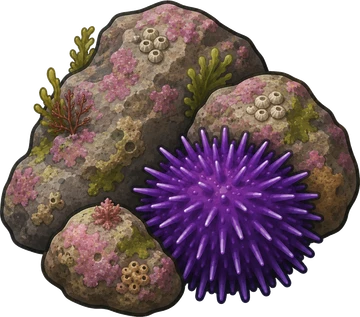
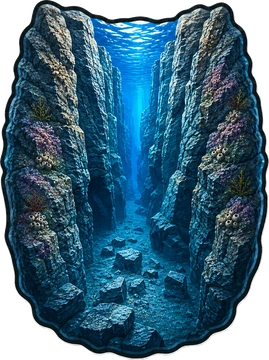
Verrill's two-spot octopus lives in the eastern Pacific from Point Conception, California south into Mexico, which makes it a Southern California animal almost exactly. It holds on rocky reef, in crevices, small holes in ledges, and regularly in human debris: discarded pipe and bottles get colonized as readily as natural rock. Records run from the low intertidal down to about 165 feet, though most of what a diver meets is shallower than 50 feet.
The animal does not hold a fixed home. It moves from one den to another every few days, and it varies both its daytime movement patterns and the distances it travels, which researchers read as predator avoidance. That has a practical consequence for anyone who finds one: the same hole is often empty a week later. The animal is nocturnal, denning by day and coming out at night to hunt across the reef.
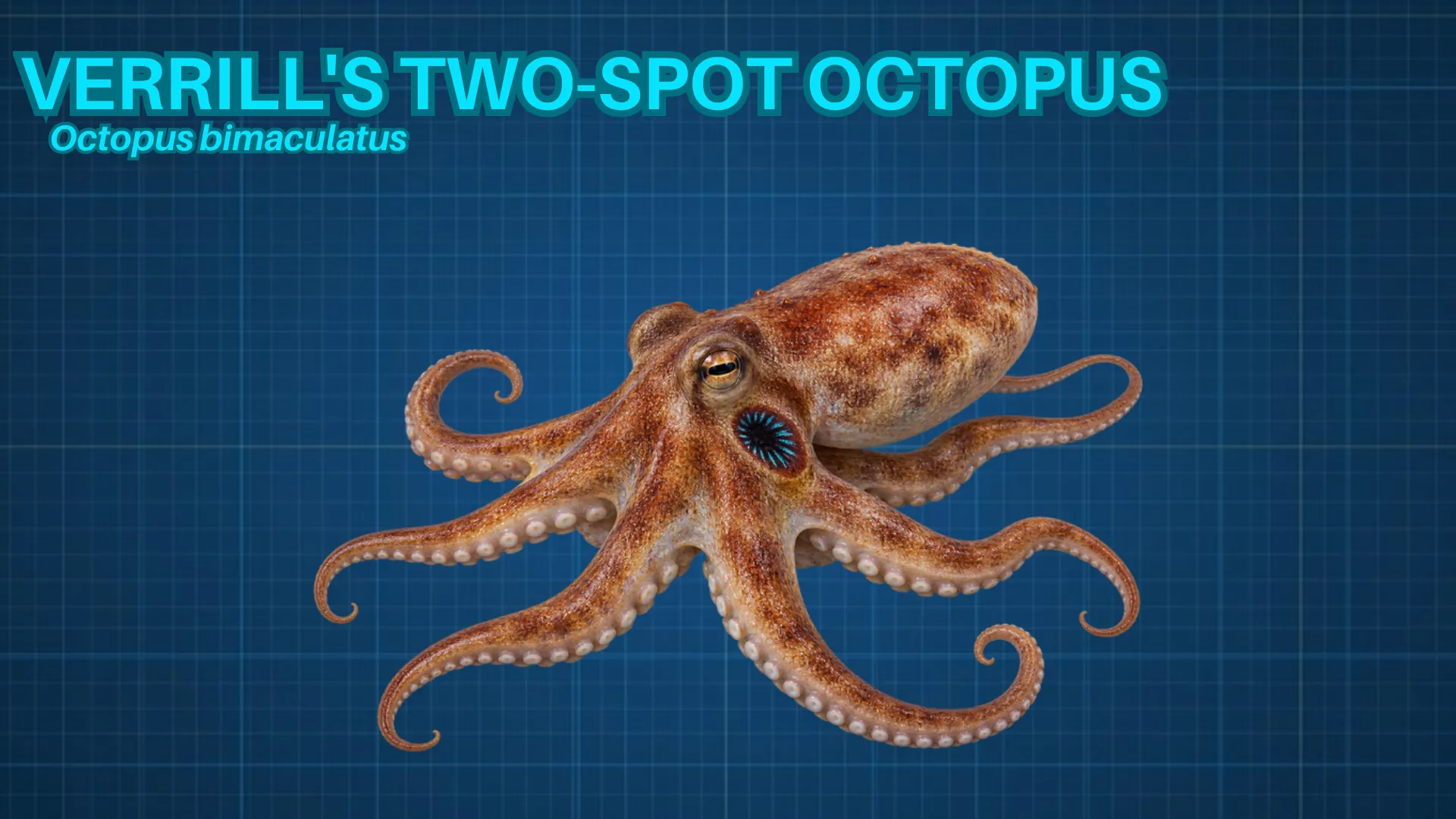
The name is the other thing to get right, because 2 nearly identical octopuses live on this coast. This entry covers the larger, deeper one, which lives on reef from Point Conception south and reaches an arm span of about 4 feet. The second, smaller species is the California two-spot octopus. It lives shallower, often on sand and mud, ranges further north to San Simeon, and tops out under 2 pounds. Both carry the mark the name refers to: a false eyespot, called an ocellus, below each real eye, ringed in iridescent blue. Most published accounts of either animal quietly mix the 2, and some sources even swap the names. Several of the most repeated facts about California octopuses, including the famous 2015 genome sequencing, belong to the smaller species and not to this one.
Harvest Brief
Southern California rocky reefs, especially Catalina Island, Los Angeles County.
Take is legal, and the method is the whole story. California regulation 29.10 states that saltwater mollusks, naming octopus specifically, may be taken only on hook and line or with the hands. No spear, no gaff, no snare, no hooked device of any kind. Regulation 29.05 sets the daily limit at 35 per person, with no size limit and no closed season, and prohibits the take of all invertebrates inside state marine reserves. Octopuses are on the short list of tidal invertebrates that may be taken in the band between the high tide line and 1,000 feet seaward, where that band is not inside a Marine Protected Area. A single area rule catches divers out: north of Yankee Point in Monterey County, scuba may be used only to take sea urchins, rock scallops and Cancer crabs, which puts octopus off limits to a scuba diver there. Snorkels are not scuba, and the restriction does not apply anywhere in Southern California. A sport fishing licence is required for anyone 16 or older.
The find rates a 4 on the 1 to 5 scale and the reason is camouflage rather than scarcity. A denned octopus is a color-matched, texture-matched lump inside a shadow, and it does not move. The reliable tell is the midden, the accumulation of empty crab carapaces, clam shells and urchin tests that builds up outside an occupied den because the animal carries prey home and discards the shells at the entrance. A tidy scatter of empty shells in one spot on an otherwise clean patch of reef is an address. Beyond that, divers look for a single visible eye, a curled arm tip, or the smooth curve of a mantle where the rock should have an edge.
Night is the difference. After dark the animal leaves the den and moves across open reef, and a diver working a light finds it in the open rather than having to read a hole. A bright beam held directly on an octopus prompts it to jet away and ink, so the practice is the same as for lobster: keep the animal at the edge of the light halo rather than in the center of the beam.
Handling is where the animal earns respect. A two-spot octopus paralyzes prey with a toxic secretion from its posterior salivary glands, and for shelled prey it rasps a small hole through the shell with its radula, a tongue-like ribbon of teeth, and injects the poison through it. That apparatus works on a hand as well as on a crab. The bite is delivered by a hard beak at the center of the arms, and the wound bleeds and swells out of proportion to its size. Gloves are worn. The other half of the handling problem is grip: an octopus of this size can generate enough suction across 8 arms to hold itself to rock more strongly than a person can pull, and the practiced approach is to break the seal at the arm tips rather than pull on the body.
The eating is genuinely good and requires one step people skip. Octopus muscle is dense with collagen and turns to rubber if it is cooked fast. The standard treatment is a long slow simmer until a knife slides into the thickest part of an arm without resistance, and only then a short pass on a hot grill for char. Handled that way the meat is firm, mild and faintly sweet, and it carries a marinade well. Skipped, it is inedible in a way that gets blamed on the animal.
Deep Dive
An octopus is a mollusk, in the same broad group as clams, snails and abalone, and it has abandoned nearly everything that group is known for. There is no external shell, no internal skeleton, and no rigid part of the body at all except the beak. That is why an animal with a 4-foot arm span can pour itself through a hole the size of its own eye: the beak is the only thing that will not compress. It gives the species its den options and it explains why so many of them end up living in discarded pipe.
The life is short and ends abruptly. A two-spot octopus reaches sexual maturity and dies within roughly 12 to 18 months of hatching, and death follows reproduction directly. The female lays an average of about 70,000 eggs in strings inside a den, and then stops hunting. For the 2 to 4 months the eggs take to develop, she stays with them, siphoning clean cool water over the clutch to keep it oxygenated and free of fouling, and she does not feed. She dies at or shortly after the hatch. Every generation of this species is therefore raised by a parent who starves to do it, and no adult ever meets its own offspring.
Those 70,000 eggs are small, and small eggs mean the hatchlings enter the plankton as tiny drifting paralarvae rather than crawling away as miniature adults. It is a completely different reproductive bet from the one made by the smaller California two-spot, which lays far fewer, far larger eggs whose young skip the plankton stage entirely and start life on the bottom. The trade is the standard one in the ocean: many small young scattered wide, most of them eaten, against few large young that start with better odds. The 2 species are close enough to confuse in a photograph and are running opposite strategies.
Hunting is chemical as much as mechanical. The octopus takes crabs, clams, snails and occasionally fish, and it does not rely on force to open a shell. The posterior salivary glands produce a toxin that paralyzes prey, and where the prey is armored the animal drills a small hole through the shell with its radula and injects the toxin directly, so a clam that would resist any amount of pulling simply relaxes and opens. Shells drilled this way carry a neat round bore hole, and a midden outside a den is a readable record of what the resident has been eating.
Toward divers the animal is described as shy by default and curious enough to reach out and investigate a hand or a camera. That combination, along with the color and texture changes it runs through while it decides what to do, is why octopuses are the animal most divers remember from a night dive. The color change itself is worth understanding. It comes from chromatophores, pigment sacs in the skin that muscles pull open and let snap shut, under direct nervous control rather than hormonal control, which is why the change happens in a fraction of a second rather than over minutes. Texture changes are separate and mechanical: small muscles raise the skin into bumps and spikes called papillae, so the animal can match not only the color of a rock but its roughness.
Where to Find Them
Researched habitat and range candidates
San Diego · 13 beaches
Orange County · 10 beaches
Catalina Island · 14 beaches
Los Angeles · 10 beaches
Channel Islands · 24 beaches
Ventura · 15 beaches
Santa Barbara · 9 beaches
These locations have suitable habitat within the species range. An assignment is a possible encounter, not a confirmed sighting at every beach. Season, depth, and local conditions still matter. Historical habitat without present-day evidence is excluded.