
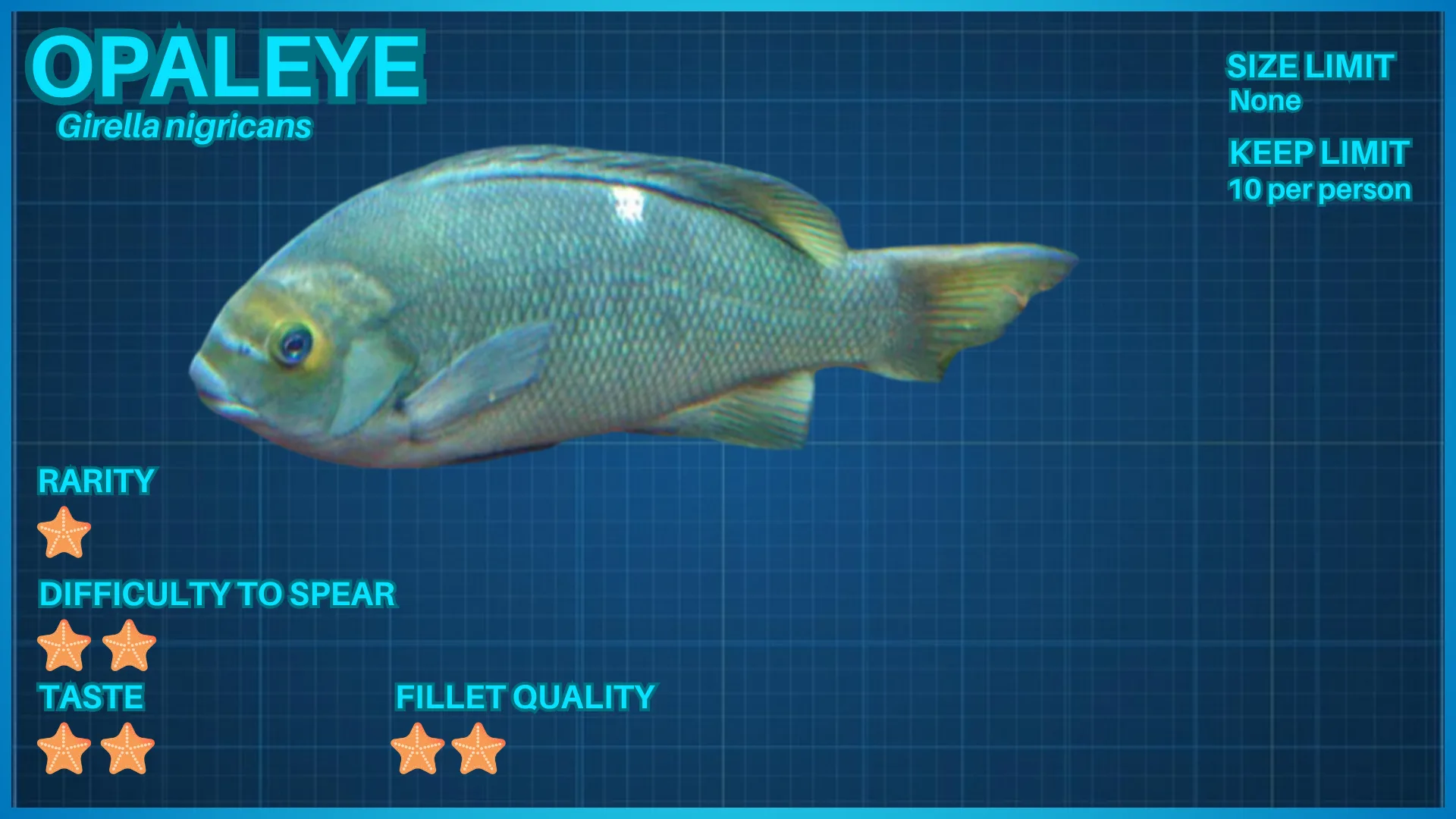
Also calledblue-eye perch, green perch, opaleye perch, Catalina perch, button-back, button bass
 Spearfishing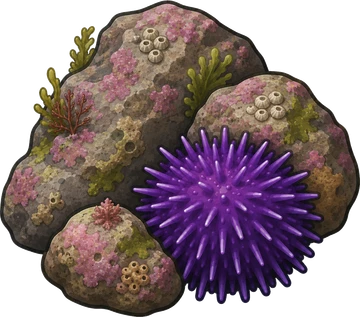
Photos: Leslie Roolvink, Marine Room deep reef, La Jolla
Spearfishing Stats
Southern California shallow rocky reefs
Taxonomy
Rarity
Abundance rates how many are in suitable habitat. Find difficulty rates how hard it is to locate one on a daylight snorkel or freedive through 50 ft. A higher find score means a harder search. The rarity category also reflects the kind of encounter; it is not an average of the 2 scores.
Regulations
CDFW rules verified 2026-07-09
Seasonality
Edibility
A small fillet off a deep-bodied fish, so the yield is poor for the size.
Location
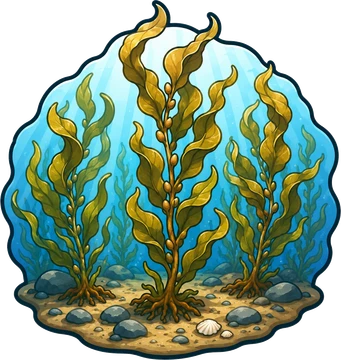
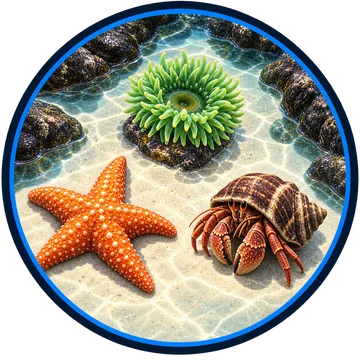
The opaleye lives along the eastern Pacific from San Francisco south to southern Baja California, Mexico, and is most abundant south of Point Conception, Santa Barbara. Adults hold on shallow rocky reef and in kelp beds, from about 6 feet down to roughly 100 feet, but the bulk of the population is in the top 20 feet. Juveniles live somewhere entirely different for the first 1 to 2 years of their life. Not long after hatching in open water, the young fish move ashore in small schools of about 2 dozen and settle into intertidal tide pools. They can pull a limited amount of oxygen from the air, an adaptation that keeps them alive when the tide leaves a pool cut off from the sea. Young opaleye also show homing behavior. A juvenile removed from a tide pool tends to make its way back to the same pool. They stay in that world for 1 to 2 years, then move offshore to deeper rocky reef where the adults live. Adults are non-migratory. A reef with a good school of opaleye tends to hold that school year after year.
Spearfishing Brief
Opaleye are the fish to shoot on a first spearfishing dive. They are common, they hold in water shallow enough to freedive with almost no bottom time, and they tolerate a slow approach better than almost any other California reef fish. Find difficulty rates a 1. They school over boiler rocks and reef shelves in the top 20 feet, and along the surf zone, where they dart in and out of the surge to feed on algae torn loose by the waves. On calm, sunny days the schools push up into the kelp canopy and hold at the surface, where a diver easing slowly through the fronds finds them without dropping at all. A diver on a shallow reef south of Point Conception, Santa Barbara will usually find them within the first few minutes of the dive. Shot difficulty rates a 2. They are alert to fast movement and will drift away from a diver who charges in. A diver who moves slowly along the reef, or who settles onto the bottom in water deeper than 10 feet and waits, lets the school circle back into range on its own. Overall difficulty is 2, driven by the shot.
The right weapon is a small one. A short pole spear or a single-band speargun without a reel or float is the community consensus, and it fits the size of the fish. Opaleye are compact fish, most adults in the 12 to 16 inch range, and the shots come at a few feet of distance in shallow, protected water. The reasoning is about what the fish does after the shot. Opaleye rarely run far and hold to tight structure rather than tearing off across open water, so a slip-tip buys nothing and a plain flopper on a 60 to 75 cm gun covers every shot the fish offers. The spawning window from April to June is the easy season, though the practical dive season runs wider, roughly May through October, when warm water and calm, sunny days bring the fish up near the surface. Large schools push into the shallows to release eggs into open water, and a diver in a good spot can see dozens of fish at a time.
On the plate, opaleye are worth taking. The fillets are white, small-flaked, firm, and low in fat, with a mild flavor often compared to sargo. Whether a fish ends up that way depends on how it is handled after the shot. Opaleye graze algae, and the gut cavity smells strongly of it, so the fermenting contents can taint the surrounding meat when the belly is nicked or the fish sits before cleaning. Community practice is to bleed and gut within 1 hour of landing, rinse the fillets in cold water about twice as long as with other fish, and skin them, since the skin carries a slight algae flavor. Cooked within 24 to 48 hours of the dive, the meat is mild and clean. Some divers dismiss opaleye as a trash fish and pass them over for larger targets, but that reputation says more about the culture of chasing size than about the actual meat. The California angling community, which has been catching opaleye from piers and rocky shore for a century, treats them as a legitimate table fish, most often grilled or fried whole.
Deep Dive
The opaleye is a herbivore, and that alone sets it apart from most of what a California spearo brings home. Nearly every other target on the shallow reef is a predator, chasing squid, sardine, small fish, or crab. Opaleye graze algae. A study by Behrens and Lafferty, published in PLOS ONE in 2012, sampled opaleye stomachs across sites in California and Baja California and found that algae and seagrass averaged 82 percent of the diet, with individual sites ranging from 45 to 99 percent. The fish get more herbivorous as the water gets warmer, a pattern that held across the 15 sites the study sampled from the Channel Islands and mainland Southern California down into northern Baja California. The study found no shift in diet with collection date, though every sample came from late spring through late summer, which could mask a longer seasonal pattern. Their preferred foods are red and green algae along with sea lettuce and small marine plants growing on the reef. Despite what older accounts sometimes say, opaleye do not seem to eat much giant kelp. Behrens and Lafferty found brown algae underrepresented in the gut even at kelp-dominated sites, which suggests the fish graze the understory rather than the canopy.
The jaws match the diet. Opaleye have hinged, three-pointed teeth, small chisel-shaped scraping blades set in rows, well suited to peeling algae off rock. Along with the halfmoon, the other common herbivorous fish on the same reefs, opaleye play a documented role in kelp forest ecology by keeping algal growth in check on the reef floor.
The name comes from the eye. Adults have opalescent blue-green eyes that stand out against an olive-green body, and the fish carry 1 or 2 small pale spots on each side of the back just below the dorsal fin. Juveniles are bluer above and silvery below, and their spots are more visible. Adults reach a maximum of about 26 inches and 13 pounds, though a fish over 2 pounds is a good one and the typical shore catch is less than 14 inches. Opaleye live to about 10 years and grow fastest from hatching through about age 4, after which growth slows as energy shifts into reproduction. Sexual maturity comes around age 2 or 3, not long after the young fish move from the tide pools out to the adult reef.
Spawning happens in April, May, and June in the shallows, when adults gather into dense schools and release eggs and sperm into open water. The eggs and larvae drift offshore for their first weeks of life, then the surviving young settle in around late June, at about an inch long, and move into the intertidal. In the tide pools, the young fish change diet and color within a week of arrival, switching from a plankton-based diet in open water to the algae-scraping habit of the adult. Juveniles have also been seen removing scales and small parasites from other tide pool fish, a form of cleaning behavior that is not their main way of feeding but is documented enough to note.
Because opaleye are common, live in shallow water, and hold in a well-fished zone, they are a familiar species to Southern California anglers as well as divers. They are one of the primary targets of pier and rocky-shore fishermen from Santa Barbara to the Mexican border. The classic tackle is a light float rig with a small hook, fished at mid-water depth, and the classic bait is a frozen pea, a piece of moss, or a mussel. Chumming with peas is how a shore angler pulls a school in close enough to hook. Known predators include larger reef fish, sea lions, and diving birds, though the peer-reviewed literature on opaleye predation is thin. In California waters, the biggest pressure on the species is habitat rather than take. Rocky reef and kelp forest are what opaleye need. Where those hold, so do the fish.
Where to Find Them
Researched habitat and range candidates
San Diego · 13 beaches
Orange County · 10 beaches
Catalina Island · 13 beaches
Los Angeles · 10 beaches
Channel Islands · 24 beaches
Ventura · 15 beaches
Santa Barbara · 10 beaches
San Luis Obispo · 22 beaches
Monterey · 17 beaches
These locations have suitable habitat within the species range. An assignment is a possible encounter, not a confirmed sighting at every beach. Season, depth, and local conditions still matter. Historical habitat without present-day evidence is excluded.