

Taxonomy
Rarity
Abundance rates how many are in suitable habitat. Find difficulty rates how hard it is to locate one on a daylight snorkel or freedive through 50 ft. A higher find score means a harder search. The rarity category also reflects the kind of encounter; it is not an average of the 2 scores.
Seasonality
Location
The zebra goby ranges from Carmel Bay in Central California south to Isla Clarion in Mexico's Revillagigedo Islands, reaching just into the Gulf of California. The 2021 checklist of the region's fishes by Milton Love and colleagues records it from the intertidal zone to 318 feet. Limbaugh found it from tidepools to about 110 feet, at an average depth of about 27 feet.
It is a reef fish that lives inside the reef. Wiley found that it stays under rocks, in caves or far back in crevices, often deeper in the same crack or hole a blue-banded goby is using. That habit is why it is seen less often than its brighter, more exposed relative.
Deep Dive
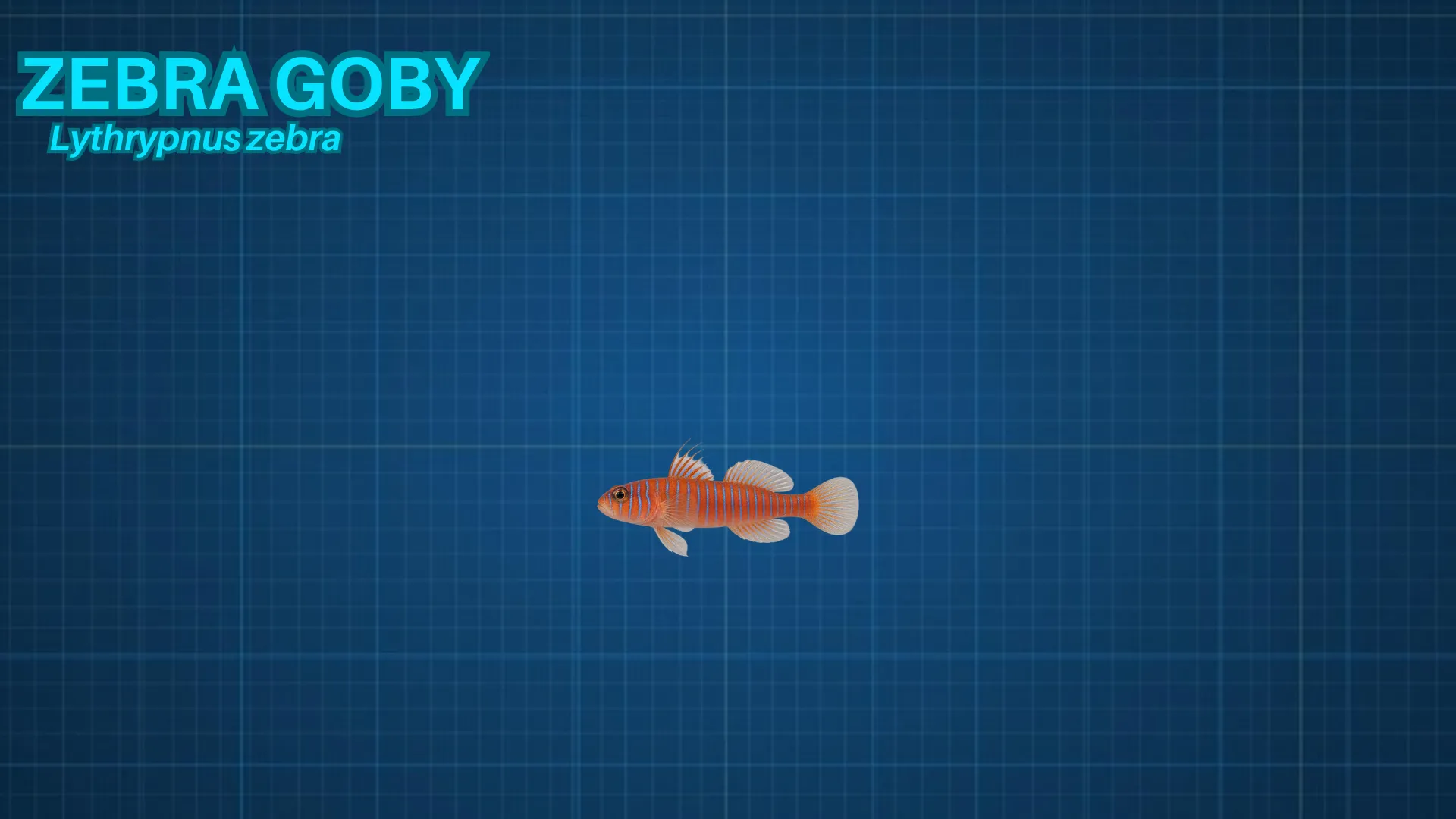
The zebra goby is a tiny fish, growing to about 2.3 inches. Wiley describes it as cherry red to brick red, with 13 to 18 narrow blue bars across the head and body. The blue-banded goby, by contrast, has 5 to 9 blue bars on the front of its body. California's 2001 marine status report describes the pair as striking fish in orange with neon blue stripes, colors that make them attractive aquarium fish. Both are occasionally sold in aquarium stores and are often used in educational displays.
Each fish is both male and female at once. The zebra goby is a simultaneous hermaphrodite, carrying working male and female reproductive tissue at the same time. Wiley found ripe fish from April through October, with females laying an average of about 627 eggs. The eggs are attached to the roof of the shelter or inside empty shells, and the male guards them alone, fanning them with his pectoral fins and rushing at fish that enter the nest.
It lives fast. Wiley found that the species breeds in its first year and lives about 2 years, while FishBase gives a maximum reported age of 1 year.
Its food is mostly copepods, tiny crustaceans. Both species defend their shelters from intruders, and Wiley saw occasional chases with nips on the reef and in the lab. He also noted that during collections kelp bass and California sheephead readily ate gobies poisoned by the collecting chemical, which suggests the bright colors are not a warning of bad taste.
California counts it toward the general bag limit: no more than 10 per person per day, as part of a total of 20 finfish, with no size limit and no closed season. Take is prohibited inside state marine reserves.
Where to Find Them
Researched habitat and range candidates
San Diego · 13 beaches
Orange County · 10 beaches
Catalina Island · 13 beaches
Los Angeles · 10 beaches
Channel Islands · 24 beaches
Ventura · 15 beaches
Santa Barbara · 10 beaches
San Luis Obispo · 22 beaches
Monterey · 10 beaches
These locations have suitable habitat within the species range. An assignment is a possible encounter, not a confirmed sighting at every beach. Season, depth, and local conditions still matter. Historical habitat without present-day evidence is excluded.