


Taxonomy
Rarity
Abundance rates how many are in suitable habitat. Find difficulty rates how hard it is to locate one on a daylight snorkel or freedive through 50 ft. A higher find score means a harder search. The rarity category also reflects the kind of encounter; it is not an average of the 2 scores.
Seasonality
Location
Red abalone live along the eastern Pacific from Oregon south to Baja California, but the range on paper is a poor guide to where the animal actually thrives. The productive populations and the entire former recreational fishery were north of San Francisco Bay, on the Sonoma and Mendocino coast, where cold water and bull kelp gave the species what it needs. They are uncommon in the low intertidal and become more abundant subtidally, most of them above about 130 feet, with records reaching roughly 590 feet. The habitat is rocky bottom with kelp on it.
The animal itself is a snail, and everything about it follows from that. It grips rock with a single large muscular foot, which is the part people eat and the part that makes an abalone almost impossible to remove without a flat iron bar. The shell reaches 12 inches, brick red to pink on the outside and usually overgrown with other life, and lined inside with the iridescent layer that made abalone shell a trade good long before it was a fishery. Along one edge of the shell sits a row of 3 or 4 open oval pores, raised slightly above the surface, which the animal uses to vent water it has passed over its gills. Underneath, the mantle is black.
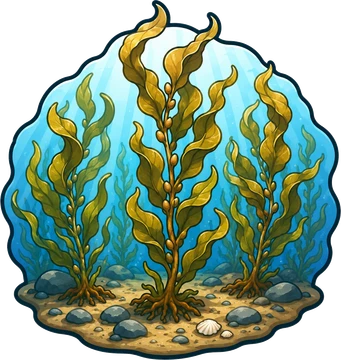
Red abalone do not hunt. They graze, rasping algae with a radula, a ribbon of teeth, and adults live mostly on drift kelp, catching pieces that tumble past and pinning them under the foot. That single fact explains the collapse better than anything else in this entry: an animal that eats kelp that has broken loose is entirely dependent on there being kelp upstream.
Deep Dive
The collapse of the red abalone fishery is the clearest case on the California coast of a chain of separate events that only becomes fatal in sequence.
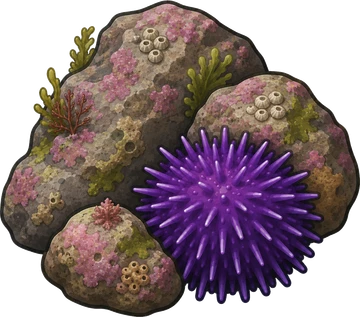
It starts in 2013 with sea star wasting disease, which killed sea stars from Mexico to Alaska and hit the sunflower star hardest. Sunflower stars are the main predator of purple sea urchins. Then came the 2014 to 2016 marine heatwave and a strong El Nino, which stressed kelp directly. With their predator gone and their competitor weakened, purple urchins increased sharply and grazed the bull kelp forests of northern California down to bare rock. Bull kelp canopy in Sonoma and Mendocino counties fell to under 1 square mile with no meaningful recovery through 2019.
Bull kelp is what red abalone eat in that region. The abalone did not die of disease or of fishing in that stretch. They starved. CDFW closed the recreational fishery in 2017, after a commercial closure that had already been in place since 1997. The recreational fishery had been unusually restricted even before it closed: north of San Francisco Bay only, free divers and rock pickers only, with scuba prohibited outright, a report card required, and a legal minimum size of 7 inches.
That 7-inch minimum is worth sitting with, because it explains why closure has not produced a quick recovery. A red abalone takes 6 to 12 years to reach 7 inches. It matures somewhere between 3 and 7 years old and can live 35 to 54 years. This is an animal that operates on a decadal clock, and a population knocked down does not bounce.
Reproduction makes it worse. Red abalone are broadcast spawners: eggs and sperm are released into open water and fertilization happens there or not at all. That works when adults are packed close together on a reef and fails when they are scattered, because gametes released 30 feet apart dilute past the point of meeting. A thinned abalone population is not simply a smaller version of a healthy one. It is a population that has partly lost the ability to reproduce, and thinning it further pushes it past a threshold rather than down a slope. Larvae that do get fertilized develop best between 57 and 61 degrees and settle preferentially on crustose coralline algae, the hard pink crust that coats rock in healthy reef, which is one more thing an urchin barren removes.
Disease is the other pressure and it interacts with temperature. Withering syndrome is a chronic wasting disease caused by a bacterium that infects the gut lining, including the digestive gland, and progressively destroys the animal's ability to digest food. An infected abalone shrinks, loses its grip on the rock and eventually cannot hold on. Warm water accelerates it: exposed abalone that are also starving are far more likely to become infected at 64 degrees than at 54. A marine heatwave therefore does not just remove the food. It turns a survivable infection into a fatal one, in animals that are already starving.
The fishery was scheduled to reopen on April 1, 2026. It did not. The Fish and Game Commission extended the closure by a decade in December 2025, and the current regulation carries the closure to April 1, 2036, unless a later amendment changes that date again. It is the third extension since 2017. CDFW's stated reason is that despite the moratorium the population has shown no sign of significant recovery. A Red Abalone Fishery Management Plan is in development and would guide any future reopening.
The last thing worth saying is what the animal represents. Red abalone was not an exotic delicacy in California. It was a coastal ritual: a cold-water free dive on a low tide, an iron bar, a limit, and a family that had done it for 3 generations at the same cove. The closure took a way of life off the north coast as surely as it took a food source. That is worth stating plainly rather than sentimentally, because it is the reason the debate over reopening is as long-running and as bitter as it is, and the reason the biology in this entry matters to people who have never opened a scientific paper.
Where to Find Them
Researched habitat and range candidates
San Diego · 13 beaches
Orange County · 10 beaches
Catalina Island · 14 beaches
Los Angeles · 10 beaches
Channel Islands · 24 beaches
Ventura · 15 beaches
Santa Barbara · 10 beaches
San Luis Obispo · 25 beaches
Monterey · 17 beaches
Oregon South Coast · 15 beaches
Oregon Central Coast · 8 beaches
Oregon North Coast · 7 beaches
These locations have suitable habitat within the species range. An assignment is a possible encounter, not a confirmed sighting at every beach. Season, depth, and local conditions still matter. Historical habitat without present-day evidence is excluded.