
 Kelp
Kelp Kelp
KelpKelp Forest
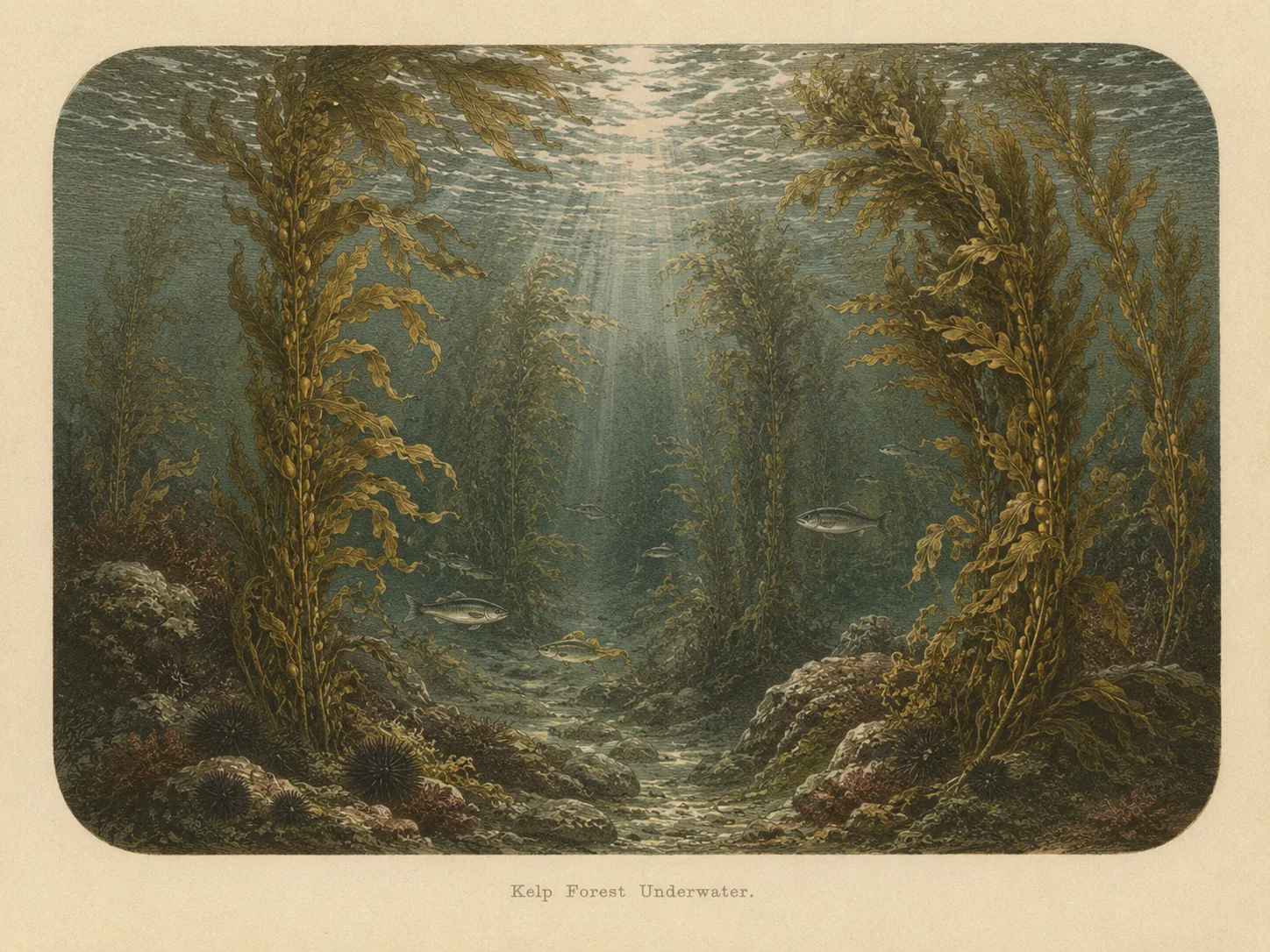
Giant kelp anchored to rock, growing up through the water column.
About
The Kelp Forest biome is an underwater forest built by large brown algae, fast-growing seaweeds that anchor to rocky seabed in cool, sunlit coastal water and grow upward toward the surface. Where conditions are right, these algae form dense stands tens of meters tall that shelter and feed a community much the way a forest on land does. Kelp forests are among the most productive ecosystems in the world, according to NOAA, partly because the kelp itself grows so fast, sometimes as much as 50 centimeters (about 20 inches) in a single day.
What builds the forest
The biome's forests are dominated by 2 kelp species. Giant kelp (Macrocystis pyrifera) builds the largest stands along the Eastern Pacific coast and can reach about 60 meters (200 feet) from the seabed to the surface. Bull kelp (Nereocystis luetkeana) dominates in colder northern waters. Each plant grips the rock with a holdfast, a root-like tangle that anchors the kelp to stone rather than drawing nutrients from soil the way a true root does. From the holdfast rises a stipe, the stem-like stalk, which carries the blades, or fronds, the leaf-like surfaces where photosynthesis takes place. Gas-filled floats called pneumatocysts hold the blades up near the surface, where the light is strongest, so the kelp shades out competitors below.
The tall growth divides the forest into layers. At the surface, the blades spread into a dense canopy, the shaded roof of the forest. Beneath it lies open water threaded with stipes, then an understory of shorter algae, and finally the rocky floor and the holdfasts, which are packed with small animals.
How the forest works
Kelp forests are powered by primary production, the process by which the algae build tissue from sunlight and carbon dioxide. Some of that growth is eaten directly by grazing animals, but a large share breaks off as drift, loose pieces of kelp that wash through the forest and out to deeper water, feeding filter feeders on the reef and animals far offshore.
The forest is also a classic example of trophic control, the way predators near the top of the food chain shape the whole community. Sea urchins graze on kelp, and where their numbers go unchecked they can strip a forest down to bare rock, a state called an urchin barren. What holds urchins back is their predators. Sea otters (Enhydra lutris) are the textbook case: by eating large numbers of urchins, an animal that is not especially abundant itself exerts an outsized effect on the entire forest, which is what ecologists call a keystone species. In southern California, where otters are absent, the California sheephead and the spiny lobster fill part of that predatory role.
What lives there
The layered structure supports animals at every level. Around the canopy and mid-water, temperate fish such as kelp bass, señorita, and rockfish (Sebastes species) hold among the blades, and the bright orange garibaldi is a familiar resident of California forests. Holdfasts shelter brittle stars, crabs, snails, and other small invertebrates, while the rock supports abalone, sea stars, and anemones. Sea otters, harbor seals, and sea lions hunt through the forest. When kelp tears loose it can form a floating mat at the surface called a kelp paddy, which drifts in open water and draws pelagic species, the fish of the open sea, including sharks and the ocean sunfish (Mola mola). Because the kelp absorbs wave energy, the water inside a forest is noticeably calmer than the open coast around it.
Why the biome matters
Kelp is a foundation species, an organism whose own body builds the habitat that the rest of the community depends on. The forest exists because the kelp exists: its structure creates the shelter, and its fast growth supplies the food. Kelp forests are among the most species-rich habitats in temperate seas, and a single forest can host up to 1,000 species of fish, invertebrates, and algae, from grazing snails to sea otters, according to the Kelp Forest Foundation.
That structure also makes the forest a nursery, a place where young fish grow before moving to adult habitat, and its influence reaches past its own edges, since fish that never enter the kelp still feed on animals that grew there. The forest protects the coast as well. By slowing currents and absorbing wave energy, kelp reduces the wave action that reaches the shore and the erosion that comes with it, according to NOAA. Many of the fish that draw anglers and divers, including kelp bass and several rockfish, depend on the forest.
Where the biome occurs
Kelp needs cool, clear, nutrient-rich water and hard bottom to anchor to. The canopy species generally require water below about 20 degrees Celsius, so the biome fringes cool temperate and subpolar coasts and is absent from the tropics. On the Eastern Pacific coast, kelp forests run from Alaska and Canada south to Baja California, according to NOAA, and similar forests grow along temperate coasts in southern South America, South Africa, southern Australia, and New Zealand. Clear water matters because the kelp needs light to reach the seabed, so kelp forests thrive on rocky reefs and struggle where sediment clouds the water.
Threats and conservation
Because kelp depends on cool water and on its predators, the biome can collapse quickly when either one fails. The clearest recent example is Northern California. Beginning in 2013, a disease known as sea star wasting killed sea stars along the West Coast, including the sunflower star (Pycnopodia helianthoides), a major urchin predator. A marine heatwave, an extended period of abnormally warm ocean water, then settled over the region from 2014 to 2016. With their predators gone and the warm water stressing the kelp, purple sea urchins (Strongylocentrotus purpuratus) exploded, increasing roughly 60-fold between 2014 and 2015. Surveys by the California Department of Fish and Wildlife and the University of California, Davis found that more than 90 percent of the bull kelp canopy along over 350 kilometers (220 miles) of coast was lost, and satellite imagery later put the loss above 95 percent, leaving urchin barrens in its place.
Warming water is the broad threat, since marine heatwaves both starve and stress the kelp. Pollution and sediment from coastal runoff can also smother young kelp and the rock it needs to attach to. Where predators such as sea otters and sunflower stars recover, kelp can return, which is why protecting them is central to keeping the forests standing.
How divers can help the forest
Spearfishers and divers who use these forests can help keep them healthy in 2 main ways: by harvesting urchins and by hunting the urchins' predators carefully.
The urchin that does the most damage is the purple sea urchin (Strongylocentrotus purpuratus), a relentless grazer of kelp. It is native to California rather than introduced, but its recent behavior resembles that of an invasive species. Its populations have boomed, and by 2021 the explosion had helped wipe out more than 90 percent of the bull kelp canopy in Northern California. Taking urchins legally, within the state's recreational limits, removes some of that grazing pressure.
The purple urchin has 4 natural predators in California: the sea otter (Enhydra lutris), the California spiny lobster (Panulirus interruptus), the California sheephead (Bodianus pulcher), and the sunflower star (Pycnopodia helianthoides). All 4 are under pressure. Sea otters were nearly exterminated by the historical fur trade and are still recovering. Sunflower stars were devastated by sea star wasting disease, the epidemic described above. Spiny lobster and sheephead are both popular targets for divers, so fishing further reduces their numbers. Together these losses have taken the brakes off the urchin population, which is a large part of why urchins have gotten out of hand. Hunting these predators selectively, or leaving them alone, helps keep that brake in place.
California allows divers to take spiny lobster by hand only, with no spear or hook. A lobster carrying eggs, called a berried female, has visible eggs on the underside of its tail and carries the next generation with it. California protects spawning lobsters through the closed season rather than through a release rule, so returning a berried female is a diver's choice rather than a legal requirement, and it leaves the most productive animals in the water.
California sheephead are protogynous hermaphrodites, meaning every fish is born female and only the largest, oldest individuals later change into males. Because the biggest fish are the rare males, and removing them skews the population's sex balance, the most sustainable approach is to take females and pass on the largest fish. A long-term study by Hamilton and colleagues found that size-selective fishing, which strips out the biggest sheephead, alters the sex ratio and the life history of the whole population.
Marine Life
Listed here are many of the aquatic species that you can find in this biome.
 Spearfishing
Locations with kelp forest habitat
Every tracked location whose detail page carries the kelp forest tag.