

Also calledmonkfish, squat, squato
Taxonomy
Rarity
Abundance rates how many are in suitable habitat. Find difficulty rates how hard it is to locate one on a daylight snorkel or freedive through 50 ft. A higher find score means a harder search. The rarity category also reflects the kind of encounter; it is not an average of the 2 scores.
Seasonality
Location
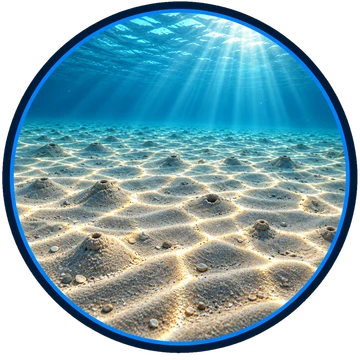
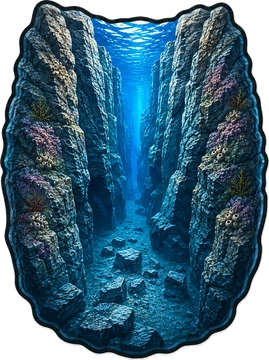
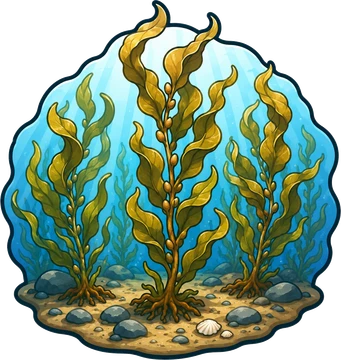
Pacific angel sharks live in the eastern Pacific from Canada, where they are rare, south to the Gulf of California and on to northern Peru. They hold on sand and mud bottom across the continental shelf, from about 10 feet down to roughly 670 feet, and they show up near rock canyons and along the sand edges of kelp forest as well as on open flats. Off California, adults are typically deep, around 330 feet, which is well past a breath-hold diver and past most recreational scuba. The shallow end of the range is where a diver has any chance at all.
Behavior is built entirely around the ambush. By day the shark lies buried in sediment and barely moves. At night it becomes active and hunts. Adults show high site fidelity, often resting in the same spot day after day, which means a shark found once may be findable again. The hunt itself has been measured. Angel sharks are visual predators and they are choosy about geometry: they are far more likely to strike prey approaching from the front than from the side or behind, and they usually wait until the prey is within 6 inches, because accuracy falls off sharply past that distance. When the strike comes, the head lifts and the jaws engulf the prey in under a tenth of a second. The diet reflects a predator that does not chase: croakers, halibut, small sharks, crustaceans, molluscs, squid and octopus.
Deep Dive
Angel sharks look like rays and are not. They sit in their own order, containing nothing but angel sharks, and the flattening happened independently from the flattening in rays. The giveaway is the gills. A ray's gill slits are on the underside of the body; an angel shark's are on the sides, tucked between the head and the pectoral fins, which is where a shark's gills belong. The pectoral fins are the other tell: in rays they are fused to the head, and in angel sharks they are separate from it, which is what lets the animal lift its head and strike upward without moving the rest of its body.
The life history is slow in every dimension that matters to a fishery. The species reaches about 5 feet in females and just under 4 in males, and it lives up to 35 years. Maturity comes between 30 and 44 inches and takes 8 to 13 years to reach, so a female angel shark spends a decade growing before she reproduces once. Reproduction is aplacental viviparity, which means the eggs hatch inside the mother and the pups are nourished by yolk rather than by a placental connection. Gestation runs about 10 months and produces 1 to 13 pups, born March through June at around 10 inches. A species that takes 10 years to mature and produces a handful of pups at a time cannot absorb a fishery that removes a million pounds a year, and it did not.
The rise and fall of that fishery is one of the cleanest examples on the California coast of what happens when a market is invented for an animal nobody had studied. In 1977 the Pacific angel shark was bycatch, hauled up in halibut nets and discarded. A processor in Santa Barbara found a way to fillet it, promoted it, and within 7 years the landings had increased by a factor of nearly 2,000. Nothing about the shark had changed. What changed was demand, and there was no stock assessment, no size limit and no quota standing between the demand and the population. The gillnet ban that ended it in 1994 was not passed to save angel sharks; it was a voter initiative aimed at nearshore gillnetting broadly, and the angel shark fishery happened to depend on exactly the gear and exactly the water it closed. The protection was accidental, and 30 years later the species is still rated Vulnerable.
Finding one is the whole problem, and it is the same slow sand hunt that turns up a halibut. A buried angel shark is a shape under the sediment rather than an animal on top of it, and the search works from 8 to 15 feet off the bottom, along the edges of reef and the sand channels between rocks, moving slowly enough to actually read what is underneath. The first tell is the eyes, 2 dark points raised slightly above a flat surface. The second is the outline, a faint broad wedge where the sand lies a little too evenly. The third is the small ridge of displaced sediment along the leading edge of the pectoral fins, where the shark shrugged itself down. The difference from a halibut hunt is depth: most of the California population sits far below diveable water, so the shallow ones are genuinely uncommon and a diver can go seasons without seeing one.
Divers who do find one are usually surprised by how little it reacts. An angel shark that has not been touched will sit through a close approach, because sitting still is the entire strategy and abandoning it costs the animal its ambush site. That stillness is not calm, and it is where people get hurt. FishBase states plainly that the species can whip its head up and snap very quickly when touched, provoked, harassed or speared, and that it can inflict painful lacerations. There are no confirmed unprovoked attacks on divers, and the warning is specifically about a shark that has been handled, grabbed or stood on. The teeth are needle-shaped and set in jaws built to engulf a croaker whole, and the mouth is at the front of a body that looks, misleadingly, like a ray. The rule is the obvious one: look, do not touch, and do not put a hand or a fin near the head of something that strikes in under a tenth of a second.
Take is legal. Angel shark has no entry of its own in the California ocean sport fishing regulations, which leaves it under the general limit of 20 finfish in combination with no more than 10 of any one species, with no size limit and no closed season, and it is not on the short list of fish that may not be taken by spear. Whether that is a good idea is a separate question from whether it is allowed, and the 2024 Vulnerable listing is the part of the answer the regulations do not carry.
Where to Find Them
Researched habitat and range candidates
San Diego · 20 beaches
Orange County · 13 beaches
Catalina Island · 10 beaches
Los Angeles · 16 beaches
Channel Islands · 24 beaches
Ventura · 14 beaches
Santa Barbara · 12 beaches
San Luis Obispo · 16 beaches
Monterey · 18 beaches
Oregon South Coast · 4 beaches
Oregon Central Coast · 6 beaches
Oregon North Coast · 2 beaches
South Sound · 2 beaches
Hood Canal · 4 beaches
Central Sound · 6 beaches
North Sound · 7 beaches
San Juan Islands · 3 beaches
Strait of Juan de Fuca · 4 beaches
Cape Flattery · 4 beaches
These locations have suitable habitat within the species range. An assignment is a possible encounter, not a confirmed sighting at every beach. Season, depth, and local conditions still matter. Historical habitat without present-day evidence is excluded.