

Also calledbrown seaperch, brown perch, kelp seaperch
Taxonomy
Rarity
Abundance rates how many are in suitable habitat. Find difficulty rates how hard it is to locate one on a daylight snorkel or freedive through 50 ft. A higher find score means a harder search. The rarity category also reflects the kind of encounter; it is not an average of the 2 scores.
Seasonality
Location
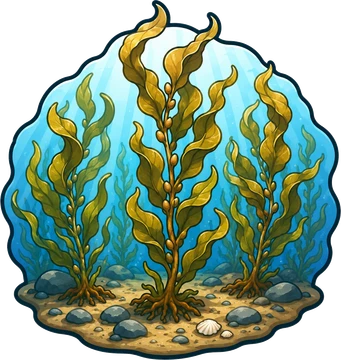
Kelp perch range from southeastern Alaska down to central Baja California, including Guadalupe Island, and the range matters less than the address. This is the most habitat-specific surfperch in California. Where the rest of the family spreads across sand, rock, bays and piers in varying combinations, this species belongs to the kelp forest biome and essentially nowhere else. Every source that describes its habitat names giant kelp and stops.
The vertical position is the part divers get wrong. Kelp perch are canopy fish. They hold high in the fronds near the surface rather than down among the holdfasts where most reef fish sit, which means a diver descending straight to the bottom swims past them on the way down and never registers them. The depth range runs to about 100 feet, with deeper records on file, but the fish that matter are in the top 20 feet of the water column, moving through the blades. They do come inshore around piers when a pier carries a heavy growth of kelp on its pilings, and late summer is when that happens most reliably.
They are not hard to identify once someone knows to look up. Kelp perch have a compressed body, a noticeably long pointed snout for a perch, and long dorsal spines. The color runs olive brown to coppery above the lateral line and brighter below it, with dark pigment sitting under each scale, often a pale stripe along the upper side, and sometimes blue spotting. The fins can be pale or rosy. Against a kelp blade in filtered light the whole animal reads as a piece of the plant, which is the point.
The diet follows the address exactly. Kelp perch eat small crustaceans, and specifically the small crustaceans that live on kelp, picking them off the blades and stipes. A fish built with a long pointed snout, living in the canopy and feeding on what grows there, is a specialist that never needs to leave.
Deep Dive
Kelp perch have a second job, and it is the reason the species deserves more attention than its size suggests. They are cleaners. Kelp perch pick external parasites off the bodies of larger fish, and this is not an anecdote. FishBase carries it in the species account, the California Department of Fish and Wildlife names kelp perch in its list of surfperch that act as cleaners, and California pier-fishing literature reports the same thing independently.
That puts kelp perch in a small and interesting group. Cleaning is common on tropical reefs and much rarer in temperate water, and California has only a handful of fish that do it. The best known is the senorita, a slender wrasse whose cleaning relationship was documented in detail in 1971 and which spends roughly half its feeding effort on parasites picked off other fish. Kelp perch does the same work in a different part of the same forest. The senorita moves through the mid-water and over the reef surface. The kelp perch works the canopy. A fish that wants grooming has options at more than one depth.
What has not been documented for kelp perch is the choreography. In the senorita's case there are records of how a client fish signals its willingness, hanging at an unnatural angle off the reef and holding still while a smaller fish works around its gills. No equivalent study exists for kelp perch, so this entry says the fish cleans and stops there rather than borrowing the details from a different species. The behavior is real and the mechanics are unrecorded.
The other half of the biology is standard for the family and worth restating because it explains why the state is cautious with all of them. Surfperch do not lay eggs. Fertilization is internal, the female carries the developing young, and what emerges is a small but fully formed fish that swims immediately. Kelp perch mate in fall and winter and release their young in spring and summer. How many young is a genuine unknown; California's own summary table records insufficient data for this species, and this entry leaves the blank where the state left it.
That reproductive strategy is a bet on quality over quantity, and it works well until something removes adults faster than they can be replaced. A fish that produces a handful of young a year cannot rebuild a population the way one broadcasting a million eggs can. For most of the family, the pressure comes from a fishery that concentrates on spawning aggregations. Kelp perch is spared that, being too small to interest anyone. Its exposure is to the kelp itself. A fish that lives in the canopy of giant kelp and eats the animals that live on giant kelp has tied its entire existence to a plant that a marine heatwave can strip off a coastline in a season, and that, rather than fishing pressure, is the thing worth watching for this species.
Where to Find Them
Researched habitat and range candidates
San Diego · 7 beaches
Orange County · 5 beaches
Catalina Island · 8 beaches
Los Angeles · 8 beaches
Channel Islands · 24 beaches
Ventura · 3 beaches
Santa Barbara · 7 beaches
San Luis Obispo · 13 beaches
Monterey · 17 beaches
Oregon South Coast · 4 beaches
Oregon Central Coast · 3 beaches
Oregon North Coast · 1 beach
Central Sound · 3 beaches
North Sound · 7 beaches
San Juan Islands · 3 beaches
Strait of Juan de Fuca · 4 beaches
Cape Flattery · 4 beaches
These locations have suitable habitat within the species range. An assignment is a possible encounter, not a confirmed sighting at every beach. Season, depth, and local conditions still matter. Historical habitat without present-day evidence is excluded.