

Also calledsugar bass, dumb bass
 Spearfishing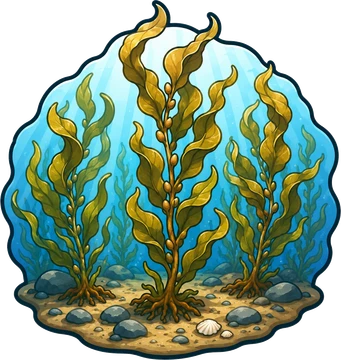
Spearfishing Stats
Central California intact kelp beds
Taxonomy
Rarity
Abundance rates how many are in suitable habitat. Find difficulty rates how hard it is to locate one on a daylight snorkel or freedive through 50 ft. A higher find score means a harder search. The rarity category also reflects the kind of encounter; it is not an average of the 2 scores.
Regulations
CDFW rules verified 2026-08-21
Seasonality
Edibility
Firm, bright white, and clean, with good structure that holds together in the pan.
Location
Kelp rockfish live in the eastern Pacific, from Timber Cove in Sonoma County south to Punta de San Pablo in central Baja California. The northern edge is soft, with records as far north as Albion in Mendocino County. The center of abundance is central and southern California. They hold in rocky reef and kelp forest, from about 7 feet down to 153 feet, most commonly between 23 and 66 feet, in water between 55 and 66 degrees Fahrenheit. The name records what a diver actually sees: kelp rockfish are more closely tied to giant kelp than the other rockfish that share the same reef. Adults spend the day hanging motionless in the blades of giant kelp, sometimes upside down, waiting for small fish to swim within striking range. They are largely nocturnal on the hunt, and they are sedentary through the year. One study on Southern California oil platforms tagged 63 adults, tracked them for as long as 578 days, and found that 63 percent of the tagged fish were still detected at the platform at the end of the study. Individual fish were detected on about 67 percent of their days at liberty. That is a fish that stays home.
Coloration matches the mixed light of a kelp canopy. Kelp rockfish run tan, brown, olive-green, reddish, or gray-brown, mottled with darker marbling, and the fish can shift color and pattern to blend with the surrounding blades. The snout has a slight upturn, and the underside pales to white or pink.
Spearfishing Brief
The kelp rockfish is a beginner-friendly kelp target. Difficulty is 2 to find and 1 to shoot, with the finding driving the overall rating. In a healthy central or Southern California kelp bed the fish are common, but they are up in the canopy rather than on the bottom, they are the color of the kelp itself, and a diver who searches only the reef floor will miss most of them. The way to see them is to hang below the canopy and look up. What gives them away is an outline in the blades and, in good light, the pale underside when a fish shifts.
Once seen, the shot is a gimme. Kelp rockfish rest motionless in the kelp through the day, sometimes upside down, and independent community write-ups converge with the biology: descend quietly, hold still under the canopy, and the fish tolerate a close approach. A slow drift to within a few feet of a hanging fish rarely spooks it. Because kelp rockfish suspend in the canopy rather than tuck under a ledge, a spine or head shot is workable from open water rather than from an awkward angle around structure, and there is no crevice for a wounded fish to rock into. The tagging record of long site fidelity is why: these are resident fish that do not treat their home patch as dangerous.
When choosing a weapon, the first thing to consider is the short working range and the confined space of thick kelp. A short to mid-length speargun in the 75 to 90 centimeter range, single band, with a standard flopper tip, is what most community write-ups recommend for kelp shooting; a longer open-water gun is slow to swing between blades. A 6 to 7 foot polespear is a common alternative for a smaller reef fish like this one. A larger, heavier gun is unnecessary for a fish that tops out at about 16.5 inches and 2 pounds, and it makes moving through the canopy harder.
The species is also a common rod-and-reel and pier target, taken on worms, shrimp, and squid drifted through kelp-adjacent water. Divers are not the only or even the main pressure on the population; the current bag limits are set against the hook-and-line fishery.
Deep Dive
The kelp rockfish belongs to the rockfish family, a Pacific group of live-bearing fish that includes more than 60 species along the west coast of North America. It was formally described in 1880 by David Starr Jordan and Charles Henry Gilbert, and the scientific species name means "black and green," for the olive body with dark marbling. Maximum length is about 16.5 inches, maximum weight around 2 pounds, and maximum age about 20 years, with occasional individuals reported to 25. Females reach sexual maturity around age 5 and about 8.5 inches. Most pier-caught fish measure under 12 inches.
Reproduction follows the rockfish pattern. Fertilization is internal, the female carries the developing embryos inside the body, and she releases live larvae into the water column rather than laying eggs. Females mate with more than one male and can store sperm, so a single brood can carry offspring from several fathers. The female releases the entire brood at once, and only at night. Larvae are 4 to 5 millimeters at release and drift as plankton before settling into kelp beds in summer as juveniles. Documented predators on the larvae include siphonophores (drifting colonial jellies related to the Portuguese man-of-war) and chaetognaths (arrow worms, small transparent predatory zooplankton). Juveniles are eaten by lingcod, cabezon, salmon, seabirds, seals and sea lions, and porpoises. Documented adult predators include sharks, dolphins, and seals.
Diet is what a fish hanging in kelp waiting for prey to swim past would eat: small crabs, shrimps, amphipods and isopods (small shrimp-like crustaceans that live in kelp and on rock), squid, and small fish including juvenile rockfishes. In the water column of the Southern California kelp beds specifically, kelp rockfish eat the kelp isopod, cephalopods (squid and octopus), gastropods (marine snails), juvenile blue rockfish, and the plainfin midshipman, a small nocturnal fish that shelters under rocks in shallow water. The fish does most of its hunting at night.
Kelp rockfish produce a low-frequency pulsing sound, part of a small but growing body of evidence that rockfishes communicate acoustically on the reef. They also take shelter in rock caves during winter storms, one of the few times the sedentary daily habit shifts. Everything else about the fish points the same way: a small, patient predator that lives in a small stretch of kelp, watches from the blades above, and rarely moves far from home.
On the plate the kelp rockfish is a good, mild, white-fleshed fish in the same register as the other small nearshore rockfish. In the 19th century, Italian fishermen in central California considered it one of the best tasting of all the rockfish. Standard preparations are pan-frying, cooking whole for smaller fish, tacos, and fish and chips. Fillets are modest, in keeping with a fish that rarely exceeds 2 pounds. California law requires the skin to be left attached to any rockfish fillet at sea, to allow species identification of the catch.
Where to Find Them
Researched habitat and range candidates
San Diego · 7 beaches
Orange County · 5 beaches
Catalina Island · 8 beaches
Los Angeles · 8 beaches
Channel Islands · 24 beaches
Ventura · 3 beaches
Santa Barbara · 7 beaches
San Luis Obispo · 13 beaches
Monterey · 17 beaches
These locations have suitable habitat within the species range. An assignment is a possible encounter, not a confirmed sighting at every beach. Season, depth, and local conditions still matter. Historical habitat without present-day evidence is excluded.