
 Seagrass
 Seagrass
Seagrass Bed
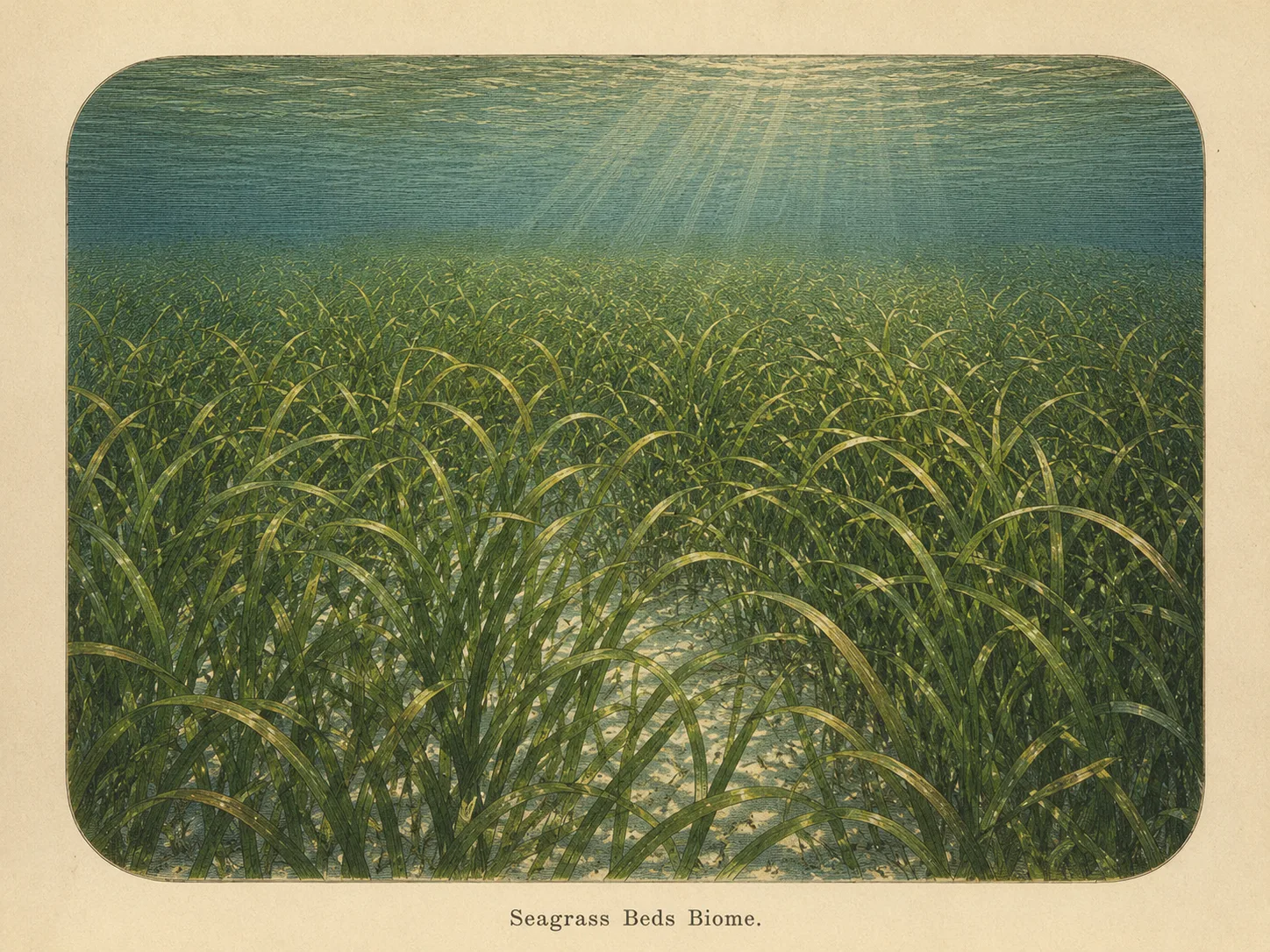
Sandy bottom carpeted with eelgrass or surfgrass.
About
The Seagrass biome is the underwater meadow: broad beds of grass-like plants rooted in the sandy or muddy floor of shallow, sunlit coastal water. Seagrasses are true flowering plants, with roots, stems, leaves, and flowers, which sets them apart from seaweeds, the algae that simply cling to rock. Their meadows grow in sheltered bays and lagoons, and also in open fields on sandy bottoms along the coast. For their small footprint, they are among the most valuable habitats in the sea. Seagrass meadows store an estimated 15 percent of all the carbon buried in the ocean while covering less than 0.2 percent of the seafloor, according to research on blue carbon.
What seagrass is
Seagrasses are flowering plants, or angiosperms, the same broad group as the grasses and wildflowers on land, and they returned to the sea millions of years ago. A seaweed anchors to hard surfaces and takes in nutrients through its whole body. A seagrass is different: it has true roots that draw nutrients from the sediment and hold the plant in place. Those roots and their underground stems, called rhizomes, knit the loose sand and mud into a stable bed. Florida alone has 7 seagrass species. The most common is turtle grass (Thalassia testudinum), joined by manatee grass (Syringodium filiforme) and shoal grass (Halodule wrightii). On the cooler West Coast, the dominant species is eelgrass (Zostera marina).
How the meadow shapes the water
A seagrass meadow reshapes the water around it. The blades slow the current, which causes suspended sediment to drop out and settle, so the water over a healthy meadow is noticeably clearer. The roots lock that sediment in place and reduce erosion. Meanwhile the plants photosynthesize in the sunlit shallows, driving heavy primary production, the building of plant tissue from sunlight. Some of that growth is eaten directly by grazers such as green sea turtles and manatees. The rest dies back and becomes detritus, the decaying plant material that feeds crabs, worms, and other bottom life, which in turn feed fish.
What lives there
The dense blades turn a bare sand flat into a sheltering thicket, and that cover makes seagrass one of the ocean's great nurseries. Young snapper, grouper, seatrout, and many other fish grow up hidden among the grass before moving to reefs or open water. Bay scallops, shrimp, crabs, and seahorses live in the meadow, and larger fish move in to hunt them. Seagrass is also one of the few marine plants eaten directly by large animals. Green sea turtles graze it, and in Florida the manatee relies on it heavily, eating many pounds of seagrass a day.
Why the biome matters
Seagrass earns its reputation as a workhorse habitat. It is a nursery for a large share of coastal fisheries, giving young fish and shellfish a place to grow. It cleans and clears the water by trapping sediment and taking up nutrients. It protects the shore by damping waves and holding the bottom together. And it is a powerful carbon sink. Despite covering less than 0.2 percent of the seafloor, seagrass meadows account for roughly 15 percent of the carbon buried in the ocean, storing it in the sediment for centuries, according to research on blue carbon. This stored carbon is often called blue carbon.
Where the biome occurs
Seagrass grows in shallow, sheltered, sunlit water on almost every coast except the poles, both inside bays and in open meadows on sandy coastal bottoms. Florida holds some of the most extensive seagrass in the country. About 2.2 million acres have been mapped in the state's estuarine and nearshore waters, according to the Florida Fish and Wildlife Conservation Commission, with vast beds in Florida Bay near the Keys and in the Big Bend along the Gulf coast, where a single stretch holds roughly 240,000 acres. These meadows need clear water and sunlight, so they grow only where the water stays shallow and clean enough for light to reach the bottom.
Threats and conservation
Because seagrass needs light, anything that clouds the water threatens it. The main danger is nutrient pollution from farms, lawns, and wastewater. The excess nutrients feed blooms of algae that cloud the water and block the sunlight the grass needs, and that shading has erased meadows across Florida. The Indian River Lagoon on Florida's Atlantic coast shows how fast it can happen. More than 60,000 acres of seagrass there disappeared between 2007 and 2021, roughly three-quarters of the total, according to reporting on the lagoon. The loss was severe enough to starve the manatees that feed there. More than 1,000 Florida manatees died in 2021, mostly of starvation, in what officials declared an unusual mortality event. Boat propellers add another kind of damage, cutting bare trenches called prop scars through shallow meadows, and dredging and warming water take a further toll.
How boaters and divers can help
Much of the harm to seagrass is avoidable. Boaters can protect the meadows by staying in marked channels, trimming the motor up in the shallows, and poling or drifting over grass rather than running the propeller through it, all of which prevent prop scarring. Keeping fertilizer and pollution out of the water protects the light the grass depends on. On the water, respecting limits on bay scallops and on the fish that nursery in the grass keeps the meadow's community intact. Because seagrass recovers slowly, avoiding damage matters far more than repairing it later.
Marine Life
Listed here are many of the aquatic species that you can find in this biome.
 Spearfishing
Locations with seagrass bed habitat
Every tracked location whose detail page carries the seagrass bed tag.