
 Pelagic
 Pelagic
Pelagic
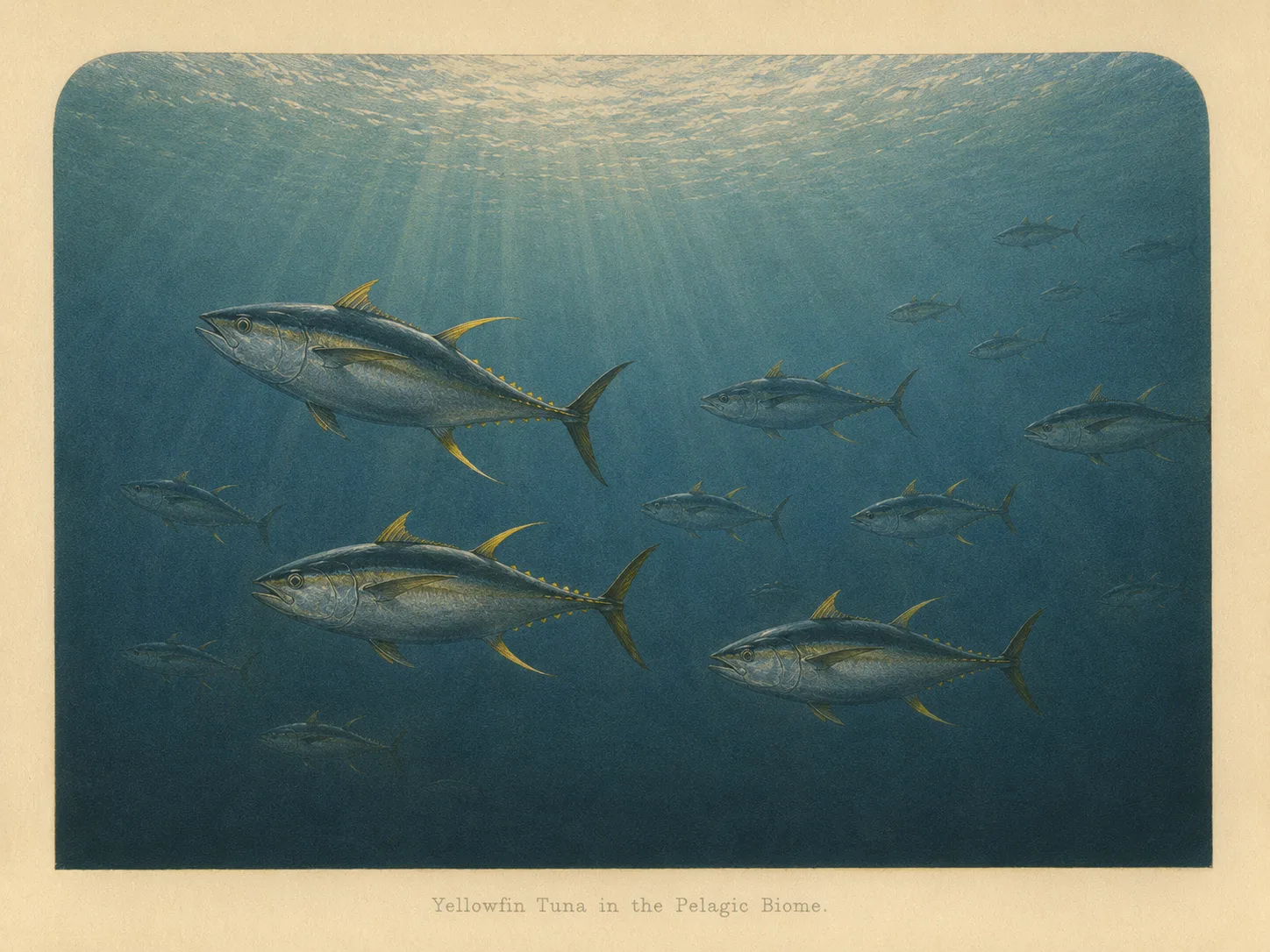
Open water away from structure. Tuna, yellowtail, and dorado country.
About
The Pelagic biome is the open ocean itself: the vast body of water between the surface and the deep, away from any shore or seafloor. It is the water column, the three-dimensional space where animals live suspended with no bottom to rest on and no structure to hide in. This is the largest living space on Earth. The pelagic realm makes up about 99 percent of the habitable volume of the planet, according to published figures on ocean habitats, and open water covers roughly 70 percent of the Earth's surface.
The largest biome, and a desert
For all its size, the open ocean holds surprisingly little life in any given patch. Most of it is what scientists call oligotrophic, meaning extremely low in the nutrients that life needs. This is especially true of the great subtropical gyres, the slow, rotating current systems that fill the centers of the ocean basins. These waters are so nutrient-poor that researchers routinely call them ocean deserts. They cover roughly a quarter to a third of the world's ocean surface (about 26 to 29 percent), and they stay stripped of nutrients such as nitrogen and phosphorus all year, so very little grows in them. The result is a biome that is enormous in total but thin on life per square mile. The tuna, the marlin, and the sharks a diver dreams of are spread across huge distances of nearly empty blue water.
How life finds a living
With little structure and few nutrients, life in the open ocean depends on 2 things: microscopic food and constant movement. The base of the food web is phytoplankton, the drifting single-celled plants that turn sunlight into food in the sunlit surface layer. Tiny animals called zooplankton graze on the phytoplankton. Small schooling fish such as sardines and anchovies eat the zooplankton, and the big predators eat the schooling fish. Because food is patchy, it tends to pile up in specific places: where currents meet, where cold water rises, or near islands and seamounts. Pelagic animals spend much of their lives searching for these patches, which is why so many of them are fast, far-ranging travelers rather than homebodies.
Life in the open water
The open ocean is famous for its fish. Tuna, including the powerful bluefin, cruise it in fast-moving schools, and billfish such as marlin, sailfish, and swordfish are among the quickest animals in the sea. Mahi-mahi and wahoo range the warmer blue water. None of these fish have anywhere to hide, so they rely on speed, sharp eyesight, and countershading, a dark back and pale belly that makes a fish hard to see from above or below.
The biome belongs to far more than fish. Sharks patrol it, from the blue shark and the shortfin mako to the great white (Carcharodon carcharias), which spends much of the year far offshore. Northeastern Pacific great whites migrate more than 2,500 miles a year, according to the California Academy of Sciences, between the California coast and a remote patch of mid-ocean between Baja California and Hawaii that researchers named the White Shark Café. Devil rays, also called mobulas, gather in schools that can number in the hundreds and leap clear of the water in a behavior called breaching. Common dolphins (Delphinus delphis) travel in superpods that can run into the thousands. The greatest whales cross entire ocean basins on their yearly migrations. The blue and humpback whales feed on the same plankton and small fish that anchor the whole food web, while the gray whale makes its living on the bottom, rolling on its side to suck up sediment and strain out the small crustaceans buried there.
All of this life comes together at a bait ball. When a school of sardines or anchovies is attacked in open water, it packs into a tight, spinning sphere for defense, and that sphere becomes a feeding frenzy. Dolphins, sharks, tuna, sea lions, diving seabirds, and even whales converge on it at once. Off southern Africa, the sardine run drives these events on a massive scale. It is the largest animal migration by sheer mass on the planet, rivaling the great herds of the Serengeti. Common dolphins often act as the herders that drive the feast, according to PBS Nature.
Why the biome matters
The open ocean runs much of the planet, not just its fisheries. Its phytoplankton carry out roughly half of all the photosynthesis on Earth, producing a large share of the oxygen people breathe and pulling carbon dioxide out of the air, according to published figures on pelagic ecosystems. The biome also feeds people directly, though less than its size suggests: catch from the high seas, the waters beyond any nation's jurisdiction, accounts for roughly 4 percent of the world's marine catch, with most wild seafood taken from coastal and shelf waters closer to land. And it works as a giant migratory highway. Tuna, sharks, rays, turtles, and whales use it to move between feeding and breeding grounds spread across whole oceans, which ties distant coastlines together into one system.
Where the biome occurs
The pelagic biome begins wherever the seafloor drops away from the coast, and it continues across every ocean on Earth. Off the West Coast, it lies just beyond the kelp beds and canyons, where bluewater hunters run offshore for tuna and yellowtail. Its character changes with the water. Cool, nutrient-rich zones near coasts and areas of upwelling boil with life, while the warm, clear, deep-blue water of the open gyres is the true ocean desert. The animals move constantly between these zones, following the food.
Threats and conservation
The open ocean is hard to protect because it belongs to no single country and is nearly impossible to patrol. Its biggest threat is overfishing. Many tuna, billfish, and shark populations have been heavily depleted, and the sharks are especially slow to recover because they grow and breed slowly. Fishing gear meant for one species also kills many others as bycatch, the unintended catch of nets and longlines, including sharks, turtles, and seabirds. Plastic pollution collects in the calm centers of the gyres. Warming water and the loss of oxygen are shifting where the productive patches form, which forces animals to travel farther to find food.
How divers and anglers can help
Because pelagic animals are shared across the whole ocean, the way each person fishes adds up. Following catch limits on tuna and billfish, and releasing sharks and other slow-growing species rather than killing them, helps stocks that are already stretched thin. Choosing gear and methods with less bycatch keeps the incidental killing down. Supporting the marine protected areas and international agreements that reach into open water gives migratory animals safe passage along the routes they have followed for millions of years.
Marine Life
Listed here are many of the aquatic species that you can find in this biome.
 Spearfishing
Locations with pelagic habitat
Every tracked location whose detail page carries the pelagic tag.